Edward VI
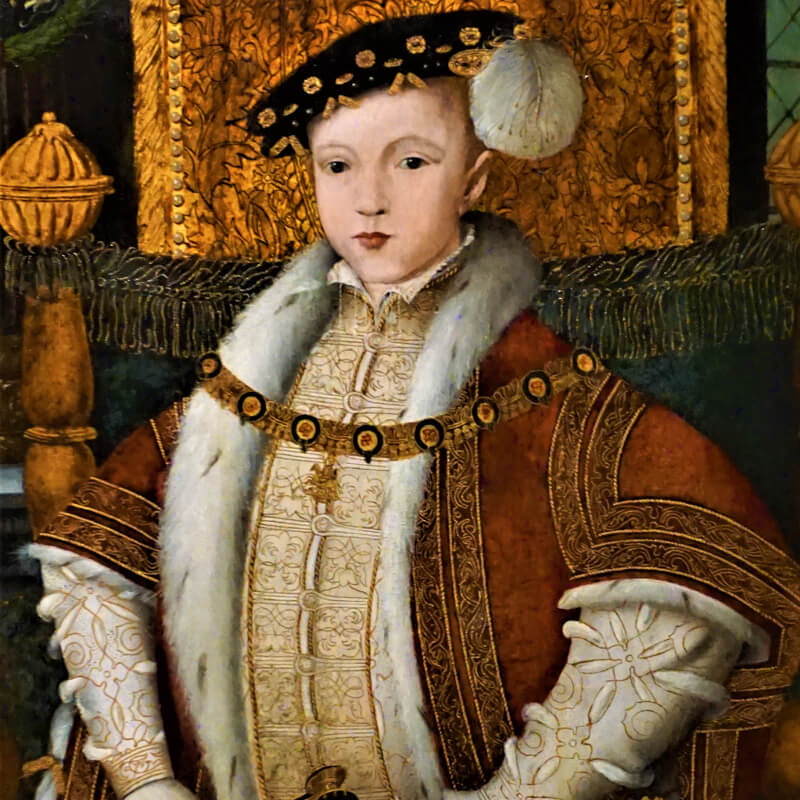
Edward VI became King of England and Ireland at the age of nine upon the death of his father, Henry VIII, from 1547 until his death in 1553. He was the only surviving legitimate son of Henry VIII, and was the first English monarch to be raised as a Protestant. He was a well-educated but sickly and frail child, and died aged just 15 years old.
Quick
Facts.
- Born: 1537
- Died: 1553
- Reign: 1547 - 1553
- House: House of Tudor
- Predecessor: Henry VIII
- Successor: Lady Jane Grey
Edward VI was born on 12th October 1537 at Hampton Court Palace in London. He was the only legitimate son of Henry VIII, by his third wife, Jane Seymour.
Before the birth of Edward, Henry VIII only had two daughters and one illegitimate son, he was therefore desperate for a legitimate son to ensure the Tudor line continued to hold power in England after he died. Consequently, there was much celebrating in the country when Edward was born. However, his mother, Jane Seymour, died 12 days after his birth, which devastated Henry VIII.
Although Edward had two older half-sisters, he was the next in line for the throne because he was male. His sisters were Mary (the future Mary I), who was born to Henry’s first wife Catherine of Aragon, and Elizabeth (the future Elizabeth I), who was born to Henry’s second wife Anne Boleyn.
As a child, Edward enjoyed all the attention that went with being heir to the throne. He was intellectually gifted and very well-educated. He devoted himself to his studies, particularly languages and theology, learning Greek, French and Latin. Edward had a great interest in religion and he was the first English monarch to be raised as a Protestant.
When Henry VIII died on 28th January 1547 aged 55, Edward became king at the age of nine and he was crowned in the following month. Because he was so young, his father had arranged that a council of regency should rule on his behalf, where the country was governed by a group of powerful nobles.
However, his short reign was dominated by the nobles using the Regency to strengthen their own positions. The King’s Council, previously dominated by his father, succumbed to existing factionalism. Edward’s eldest uncle, Edward Seymour, Duke of Somerset, took power and established himself as Lord Protector, and he advised and guided the young king for the first couple of years until he was overthrown by a rival.
Although Edward’s father, Henry VIII, had broken the Church of England away from the Roman Catholic Church, not much had changed, many old Catholic practices were kept. Most of the major changes to the Church of England actually happened during Edward’s reign. Edward was fiercely Protestant, and together, the young king, Lord Somerset and the Archbishop of Canterbury, Thomas Cranmer, were intent on making England a truly Protestant state.
Aspects of Roman Catholic practices including statues and stained-glass windows in churches were eradicated. It was also ruled that clergymen would be allowed to marry. The first English Prayer Book, also known as the Book of Common Prayer, was issued in 1549 with an Act of Uniformity to enforce it, which replaced Latin church services with English ones.
During Edward’s reign, England tried to take over Scotland, but after a good start it ended in defeat. His reign also saw economic problems and unrest. The Protestant changes, especially the imposition of the Prayer Book, led to rebellions in Devon and Cornwall in the summer of 1549. Kett’s Rebellion in Norfolk also happend around the same time, but this was focused on economic and social injustices against land enclosures in Norfolk.
Despite his military ability, Edward’s uncle and protector, Edward Seymour, was too liberal to deal effectively with Kett’s Rebellion, and it was instead suppressed by John Dudley, Earl of Warwick, one of the king’s close advisers. Seymour was left isolated in the Council and factions soon developed around the king. Dudley exploited his success by bringing about the downfall of Seymour. Convinced of the Protector’s incompetence, Dudley and other privy councillors forced Seymour out of office in October 1549 and Dudley emerged as de facto regent for the 12-year-old Edward VI.
Edward Seymour was later arrested on largely fabricated charges, and John Dudley was raised to the Dukedom of Northumberland in October 1551. Three months later, in January 1552, Edward Seymour was executed, an event which was briefly mentioned by Edward VI in his diary: “Today, the Duke of Somerset had his head cut off on Tower Hill”. Although John Dudley never took the title of Protector, this is nevertheless the role he assumed, taking over control of the government and the young king.
Protestant reform was stepped up – the new Prayer Book of 1552 was avowedly Protestant. Altars were turned into tables, religious imagery was destroyed and religious orthodoxy was enforced by a new and more stringent Act of Uniformity.
John Dudley took greater trouble to charm and influence Edward; his powerful position as Lord President of the Council was based on his personal ascendancy over the King. However, in January 1553 Edward showed the first signs of tuberculosis, and by May it was evident that the disease would be fatal. Dudley hurriedly married his son, Lord Guilford Dudley to Lady Jane Grey, one of Henry VIII’s great-nieces, Edward VI’s cousin and a claimant to the throne.
Because Edward had no children there were questions about who would succeed him. Henry VIII had said that if Edward died without having children, the throne should go to Edward’s eldest sister, Mary, and then to Elizabeth. However, Mary was a devout Catholic.
To prevent the country from returning to Catholicism and to ensure that their religious reforms couldn’t be undone, the king and Dudley excluded Edward’s half-sisters, Mary and Elizabeth, from the succession and instead decided to name Lady Jane Grey as his heir. Jane was a Protestant of Tudor blood, and she was also Dudley’s daughter-in-law.
When Edward died in July 1553, Lady Jane Grey was proclaimed queen. However, a power struggle erupted after Edward’s death and she ruled for just nine days before she was overthrown by Edward’s elder sister Mary. With overwhelming popular support, Mary took the throne and convicted John Dudley of high treason and had him beheaded in August 1553. She later had Lady Jane Grey and her husband executed several months later. Mary also undid the Protestant reforms of Edward’s reign, but Elizabeth restored them in 1559.
Did you enjoy this post?
I hope you found this post useful. I put a great deal of time and effort in to building, maintaining and populating the website. If you like, you could say a small thank you by buying me a coffee. You don't have to, but it would be nice :)
Buy me a coffee
Stay up to Date
Follow me on my journey and get notified whenever a new post is published by following Kings & Castles on Facebook.
Follow MeExplore The Map
Discover the hundreds of castles, churches, monasteries, cathedrals and other historic locations that I've personally visited across England and Wales. Search by location, explore nearby sites and plan your next historical adventure.
Share: