Lady Jane Grey
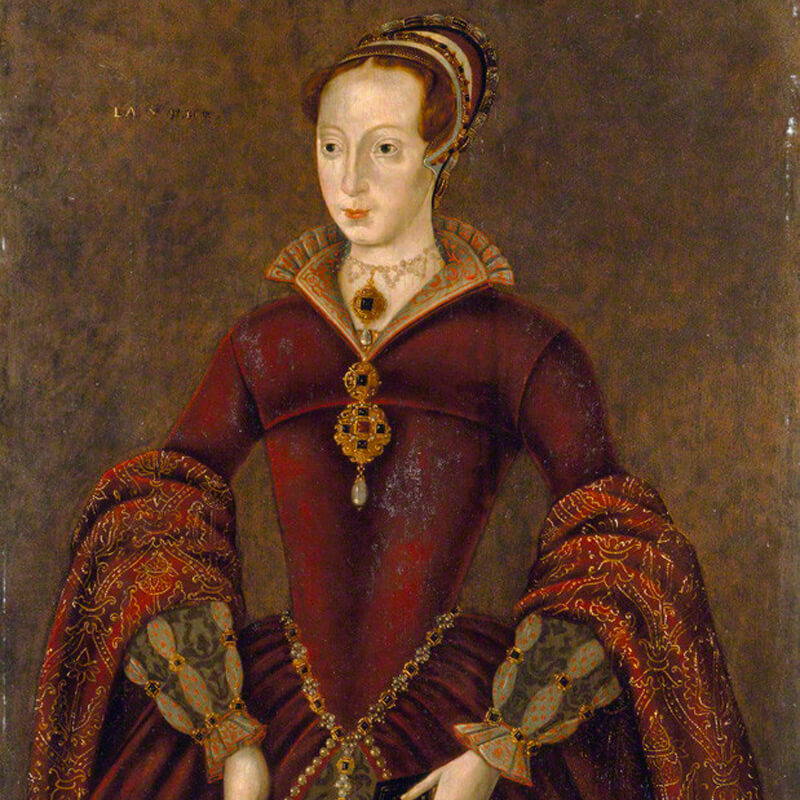
Lady Jane Grey, also known as the ‘Nine Days Queen’, had the shortest reign of any monarch in British history. She was an English noblewoman from the Tudor period who claimed the throne of England and Ireland at age 15. She reigned for just nine days in July 1553 until she was executed by Mary Tudor for treason.
Quick
Facts.
- Born: c. 1536 - 1537
- Died: 1554
- Reign: 1553
- House: House Grey
- Predecessor: Edward VI
- Successor: Mary I
Lady Jane Grey remains one of the most compelling and tragic figures in Tudor history. She possessed royal blood through her grandmother, Princess Mary Tudor (Henry VIII‘s sister), and it would be this heritage that brought her to the scaffold in 1554.
Lady Jane Grey was born in 1537 and was the eldest child of Lord Henry and Lady Frances Grey, the duke and duchess of Suffolk. She was raised as a devout Protestant with her two sisters in a beautiful and luxurious estate, suited to the Grey’s semi-regal status.
Jane’s life began with promise and high expectations. She was beautiful and intelligent. She received an excellent level of education, studying Latin, Greek, Hebrew, and was fluent in French and Italian.
Jane was destined to marry into a well-positioned family, and in 1553 she married Lord Guildford Dudley, the son of the Duke of Northumberland.
When Henry VIII died in 1547, his only Son, Edward became King Edward VI. Edward was a sickly 10 year old boy at the time of his coronation and was easily manipulated by Jane’s Father-in-Law, the fiercely Protestant John Dudley, Duke of Northumberland, who acted as regent to the young king. In January 1553, it was clear Edward was dying, and Dudley was desperate to prevent the throne from passing to Edward’s half-sister, Mary Tudor, who was a devout Catholic. John Dudley successfully convinced Edward to continue to support Henry VIII’s Protestant Reformation by declaring Lady Jane Grey as his successor.
Edward VI died on 6th July 1553, and on 10th July, the 15-year-old Lady Jane Grey became Queen of England and Ireland. Jane didn’t actually want to be queen, and her reluctance to accept the Crown over Mary Tudor fell on deaf ears.
It soon became evident that Jane’s hold on England was flimsy, and her rule very quickly evaporated when it became obvious that the unpopular Dudley was behind the scheme. Facing strong opposition from Mary Tudor and Parliament, citing the 1544 Law of Succession, Jane quickly found herself losing her supporters, even her father abandoned her. Her father tried to save himself by supporting Mary as the rightful Queen of England, but the council didn’t fall for it and declared him a traitor.
On 19th July 1553 Jane’s nine-day reign came to an end. She was never physically crowned and has become known to history as the ‘Nine Days Queen’. She was imprisoned in the Tower of London and Mary Tudor became Queen Mary I. John Dudley was condemned for high treason and executed on 22nd August. On 13th November, Jane and her husband, Guildford Dudley, were both found guilty of treason and sentenced to death. But, because of their youth and relative innocence, Queen Mary was reluctant to carry out the sentences. She believed her cousin was innocent of any intrigue and Jane had never intended to be queen, but had actually been the unwilling dupe of her Father-in-Law. However, this all changed when Jane’s father sealed her fate, and that of her husband, by joining Wyatt’s rebellion against Mary, after she announced that she intended to marry Philip II of Spain.
Queen Mary offered to spare the lives of the young couple if they converted to the Catholic faith. But Jane was pious and a passionately devout Protestant, so they both refused. With reluctance, Queen Mary accepted the Privy Council’s advice and ordered Jane and her husband’s execution.
On the morning of 12th February 1554, Jane watched as her husband was sent to the executioner’s block. When it was her turn, she uttered her last words… “Lord, into thy hands I commend my spirit”, and the axe fell. Jane was just 17 years old.
Did you enjoy this post?
I hope you found this post useful. I put a great deal of time and effort in to building, maintaining and populating the website. If you like, you could say a small thank you by buying me a coffee. You don't have to, but it would be nice :)
Buy me a coffee
Stay up to Date
Follow me on my journey and get notified whenever a new post is published by following Kings & Castles on Facebook.
Follow MeExplore The Map
Discover the hundreds of castles, churches, monasteries, cathedrals and other historic locations that I've personally visited across England and Wales. Search by location, explore nearby sites and plan your next historical adventure.
Share: