Mary I
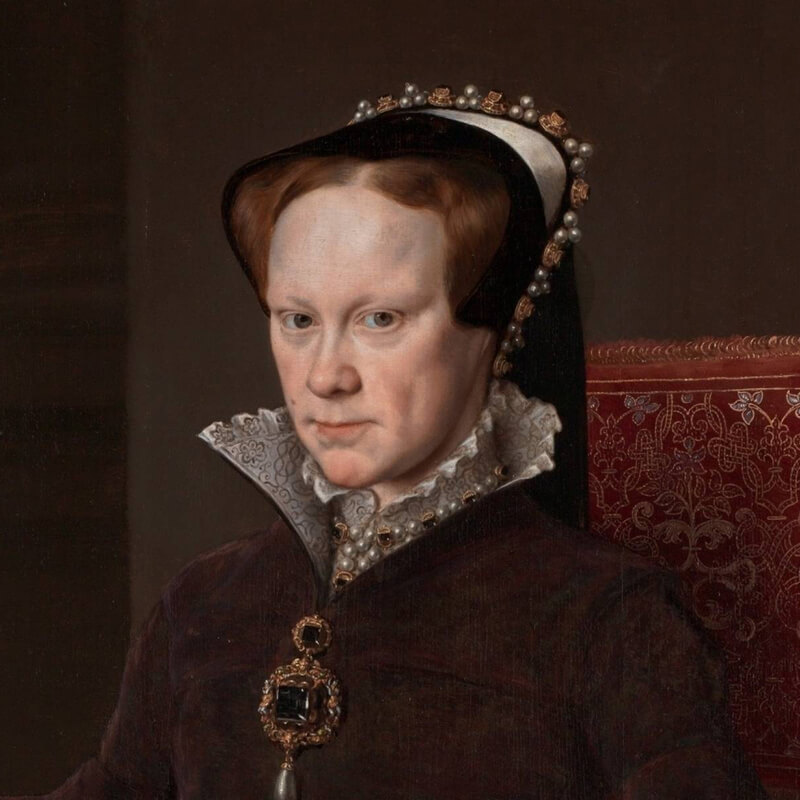
Known as a Catholic tyrant and branded a religious bigot for her ferocious persecution of Protestants, Mary I is a monarch who continues to divide opinions 500 years after her death. She has become known to history as Bloody Mary.
Quick
Facts.
- Born: 1516
- Died: 1558
- Reign: 1553 - 1558
- House: House of Tudor
- Predecessor: Lady Jane Grey
- Successor: Elizabeth I
Mary Tudor was born in 1516 and was the daughter and eldest child of King Henry VIII and the Spanish princess Catherine of Aragon. Mary is famous for being a fierce Catholic, which was a result of her mother being a devout Catholic.
When Mary’s father died, her younger brother Edward VI became King. Before he died in July 1553, he wanted to keep his father’s work of the Protestant Reformation alive be naming a Protestant successor, which Mary most certainly was not. So Mary’s ascension to the throne was excluded and Edward’s cousin, Lady Jane Grey, was recognised as the next monarch of England. However, Lady Jane Grey would never be physically crowned as Queen. Following Edward’s death, the decision to allow Jane to sit on the throne of England was heavily disputed, especially by Mary. Support for Mary grew quickly and most of Jane’s supporters abandoned her. Jane was deposed by Mary just nine days after becoming queen, and she has become known to history as the “Nine Days’ Queen”. Jane was imprisoned by Mary in the Tower of London and executed for treason in the following year in 1554 aged around 16 or 17.
Mary became the first ruling queen of England in July 1553 and immediately attempted to restore the Catholic faith. In what was to be an ineffective attempt to restore Catholicism in England, she is notorious for brutally burning over 280 Protestants at the stake. She even had her half-sister Elizabeth (the future Elizabeth I) imprisoned for nearly a year on suspicion of supporting Protestant rebels.
In a world dominated by men, Queen Mary had to establish herself as a strong female monarch who was able to rule a country. She redefined royal ritual and law with her 1554 Act of Parliament, which declared that a female ruler could have the same power and authority as a male monarch.
Mary would only reign for five years, but in this time she would only be remembered for her ineffective attempts to restore Catholicism in England, for being a brutal murderer, and as a military failure after England’s loss of Calais in 1558.
With an equally tragic personal life, thrust around by the whims of her father, a tempestuous relationship with her half-brother and outshone by her half-sister, there were significant periods where Mary was ostracised, bastardised and vilified. She was actually quite a sad and lonely figure.
Her marriage to Philip II of Spain was loveless and extremely unpopular with the public. Philip sought the union only for its political and strategic gains, whereas Mary viewed her marriage as a union of love and hopes of a family. However, to Mary’s distress the marriage never produced the heir that she so desperately desired and needed. Plagued by illnesses and phantom pregnancies, she was eventually abandoned by Philip and subjected to national ridicule.
Mary died not long after the loss of Calais in 1558, with a reputation as a disgraced, stubborn, and vengeful queen. However, often overlooked are the great advances Mary made during her relatively short reign. She restored the navy, introduced policies of fiscal reform, established new hospitals, and improved the education of the clergy.
Her turbulent life was one of tragedy and triumph, insecurity and stubbornness. Although her rule was ultimately ineffectual and unpopular, there were occasions where she proved herself to be a courageous leader.
Did you enjoy this post?
I hope you found this post useful. I put a great deal of time and effort in to building, maintaining and populating the website. If you like, you could say a small thank you by buying me a coffee. You don't have to, but it would be nice :)
Buy me a coffee
Stay up to Date
Follow me on my journey and get notified whenever a new post is published by following Kings & Castles on Facebook.
Follow MeExplore The Map
Discover the hundreds of castles, churches, monasteries, cathedrals and other historic locations that I've personally visited across England and Wales. Search by location, explore nearby sites and plan your next historical adventure.
Share: