Æthelstan
Æthelstan was the son of Edward the Elder and grandson of Alfred the Great. He is regarded by many historians as the first King of England and one of the greatest Anglo-Saxon kings. He was King of the Anglo-Saxons from 924 to 927 and King of the English from 927 to his death in 939. A distinguished and courageous soldier, he pushed the boundaries of the kingdom to the furthest extent they had yet reached.
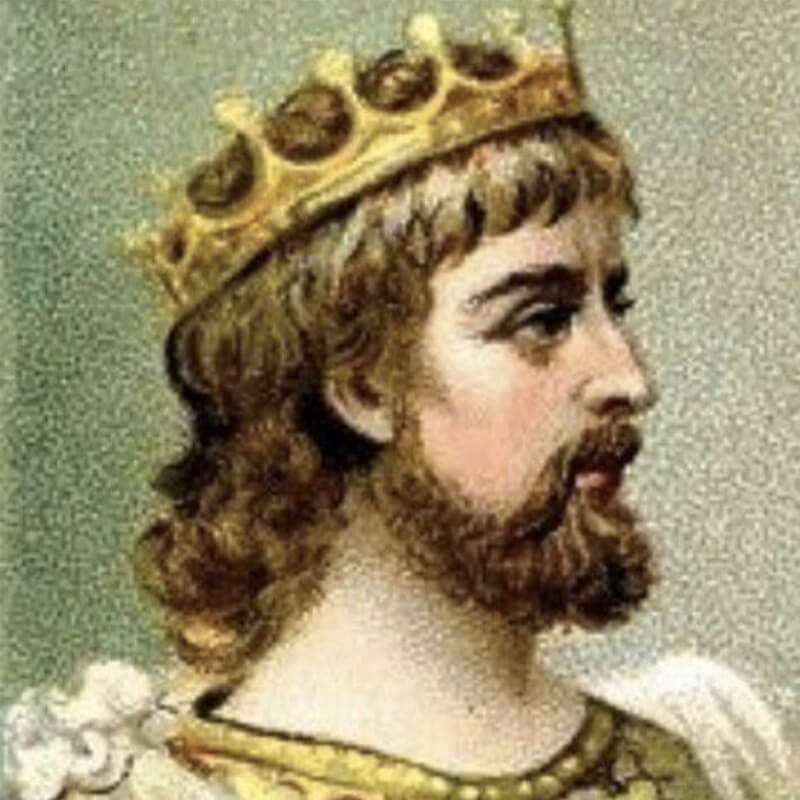
Quick
Facts.
- Born: c. 894
- Died: 939
- Reign: 924 - 939
- House: House of Wessex
- Predecessor: Edward the Elder
- Successor: Edmund I
When Æthelstan’s father, King Edward the Elder died in 924, Æthelstan’s half-brother Ælfweard immediately claimed the throne. Ælfweard’s claim was supported by Wessex, while Mercia supported Æthelstan’s claim. Ælfweard conveniently died just three weeks after Edward’s death and Æthelstan was able to claim both Wessex and Mercia.
Whilst his path to kingship was now unrivalled due to the passing of his half-brother, not all were happy with his ascendancy to the throne. Æthelstan encountered resistance in Wessex for several months but was eventually crowned king of the whole country in September 925.
Now with the title of King, Æthelstan’s task was extensive as he had inherited a great responsibility from his father, who had managed to gain control of all of England south of the River Humber. When Æthelstan did become king, his dedication to the role was obvious, and during his reign he would choose not to marry or have children.
He proceeded to establish boundaries and rule firmly. In 927 he took the Viking kingdom of York from the Danes and forced the submission of the northern kings, including King Constantine of Scotland, King Hywel Dda of Deheubarth, and King Owain of Strathclyde, who all agreed to acknowledge Æthelstan as their overlord. Still keen to build on his successes, he next chose to concentrate his efforts on Wales, and as a result the kings of Wales were forced to reluctantly accept to Æthelstan’s demands and recognise him as “mechteyrn” (greater king). He then went on to define the border between England and Wales on the River Wye.
Æthelstan’s dominion was significantly challenged in 937 when Constantine, King of the Scots, in alliance with the Welsh and Danes of Strathclyde and Dublin joined forces and invaded England. They were defeated by Æthelstan and his forces at the Battle of Brunanburh, thus, he retained control over most of what is now England, except for the Celtic kingdom of Cornwall. The Battle of Brunanburh has been called one of the most important battles in British history.
With little now standing in his way, Æthelstan then continued his efforts on what he called the “West Welsh”, in reference to the people of Cornwall. He asserted his authority in Cornwall and established a new see and appointed a bishop.
Æthelstan became the first king to rule all the Anglo-Saxon people. Referred to as king of all the other kings of Britain, he established himself as overlord of Britain, with very few areas untouched by his power.
Æthelstan died in 939 at the height of his powers and was buried in Malmesbury Abbey, leaving in his wake a significantly larger kingdom than the one he had inherited.
Whilst Æthelstan extended his military and political influence, achieving his personal accomplishment of becoming the first overall ruler of the Anglo-Saxons, he also built on the legal reforms instigated by his grandfather, Alfred the Great. Moreover, during his reign he did much to exemplify his pious nature by establishing churches and focusing on creating social order through the law and spread of religion. He consolidated areas of settlement and Danish towns into shires. Overseas, he built alliances by marrying off four of his half-sisters to various rulers in western Europe.
Æthelstan remains a founding father of medieval England and the kingdoms he surveyed, and only time would tell whether his descendants could hold onto such power. He was succeeded by his half-brother Edmund, who would become King Edmund I, also known as Edmund the Magnificent.
Did you enjoy this post?
I hope you found this post useful. I put a great deal of time and effort in to building, maintaining and populating the website. If you like, you could say a small thank you by buying me a coffee. You don't have to, but it would be nice :)
Buy me a coffee
Stay up to Date
Follow me on my journey and get notified whenever a new post is published by following Kings & Castles on Facebook.
Follow MeExplore The Map
Discover the hundreds of castles, churches, monasteries, cathedrals and other historic locations that I've personally visited across England and Wales. Search by location, explore nearby sites and plan your next historical adventure.
Share: