William II
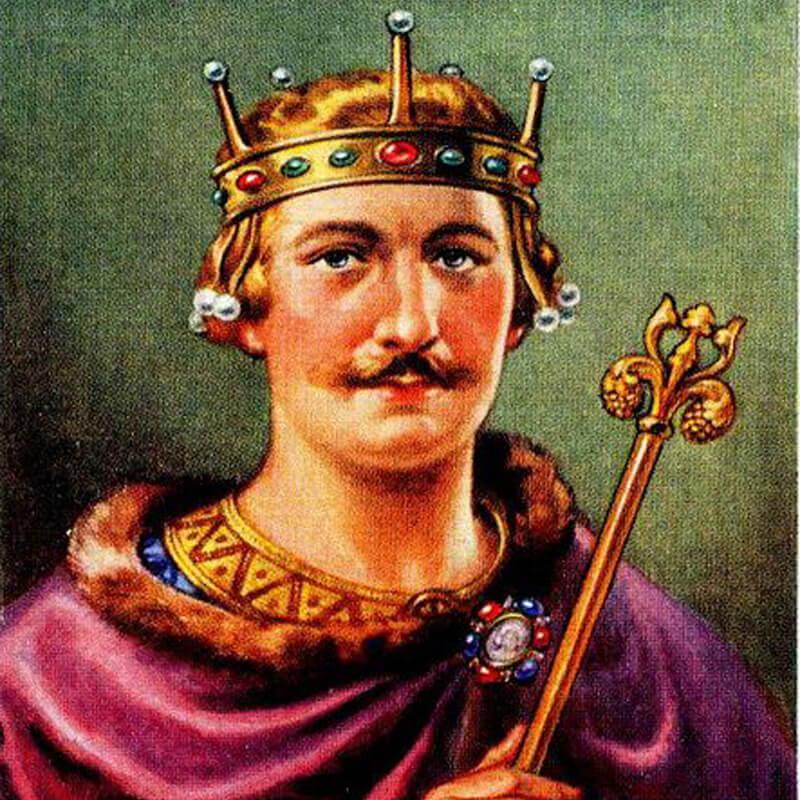
William II, more commonly referred to as William Rufus (Rufus being Latin for “the Red”), perhaps because of his ruddy complexion or, more likely, due to having red hair, was King of England from 1087 until his death in 1100. He was the third son (second surviving) of William the Conqueror, and his successor to the throne of England. He spent a large part of his reign attempting to capture Normandy from his brother Robert Curthose, Duke of Normandy.
Quick
Facts.
- Born: c. 1057
- Died: 1100
- Reign: 1087 - 1100
- House: House of Normandy
- Predecessor: William I
- Successor: Henry I
William Rufus was born in Normandy, France around the year 1057. He was the third and favourite of four sons of William the Conqueror and Matilda of Flanders, he also had six sisters. Almost nothing is known about his childhood.
When William the Conqueror died, he divided his Anglo-Norman kingdom between two of his three remaining living sons. In accordance with feudal custom, he bequeathed his inheritance, the Duchy of Normandy, to his eldest son Robert Curthose; England, William’s kingdom by conquest, was given to William Rufus. His fourth and youngest son, Henry (the future Henry I), was left with wealth but no lands.
William Rufus ascended the throne of England and became King William II of England upon his fathers death in September 1087. William was an able diplomat and a great soldier. He was strong and outspoken, but his strong-armed rule earned him a reputation as a brutal and corrupt tyrant; according to the Anglo-Saxon Chronicle he was hated by almost all his people.
In the following year, in 1088, William crushed a baronial rebellion in Normandy led by his uncle, Odo of Bayeux, in favour of William’s older brother, Robert. Then in 1089 William laid claim to Normandy and waged war against Robert for several years. He defeated his brother and reduced him to the role of a subordinate ally with Robert supporting the claims of Normandy to the English throne.
In 1095 the First Crusade began following a call by Pope Urban II to help free the Holy Land which had been captured by Muslims. William’s brother Robert wanted to join the crusade but he needed money to fund his venture, so he pledged his Duchy of Normandy to William in return for a payment of 10,000 marks, and Robert left to join the crusade in 1096. Once Robert left, William began to consolidate his position in Normandy, also adding Maine to his continental possessions, and England and Normandy were once again united under one leader.
In 1091 and 1093, the Scots, led by Malcolm III of Scotland, invaded England, but they were defeated and Malcolm was killed at the Battle of Alnwick. Thereafter, William maintained the Scottish kings as vassals. In 1095 William suppressed revolts in Northumbria and along the Welsh border.
In the year 1100 William was killed by an arrow while hunting in the New Forest in Hampshire with his younger brother Henry and numerous others. The incident could have possibly been an accident but it was more likely an assassination. It has been suggested that he was shot deliberately; an assassination plot by his younger brother Henry. William died not long after being struck by the arrow, and upon his older brother’s death, Henry raced to be crowned king before anyone could contest him. William never married and never produced any heirs, legitimate or illegitimate, so Henry promptly seized the English throne as King Henry I.
William Rufus reigned for 12 years and 10 months and was buried at Winchester.
Did you enjoy this post?
I hope you found this post useful. I put a great deal of time and effort in to building, maintaining and populating the website. If you like, you could say a small thank you by buying me a coffee. You don't have to, but it would be nice :)
Buy me a coffee
Stay up to Date
Follow me on my journey and get notified whenever a new post is published by following Kings & Castles on Facebook.
Follow MeExplore The Map
Discover the hundreds of castles, churches, monasteries, cathedrals and other historic locations that I've personally visited across England and Wales. Search by location, explore nearby sites and plan your next historical adventure.
Share: