Edward II
Edward II was King of England from 1307 until he was deposed and murdered in 1327. He succeeded his father Edward I after becoming the heir to the throne following the death of his three older brothers. Edward II had very limited capability and possessed very few of the qualities that made a successful medieval king. His reign was marked by conflict with his nobles until he was eventually overthrown by his wife in favour of his son, Edward III.
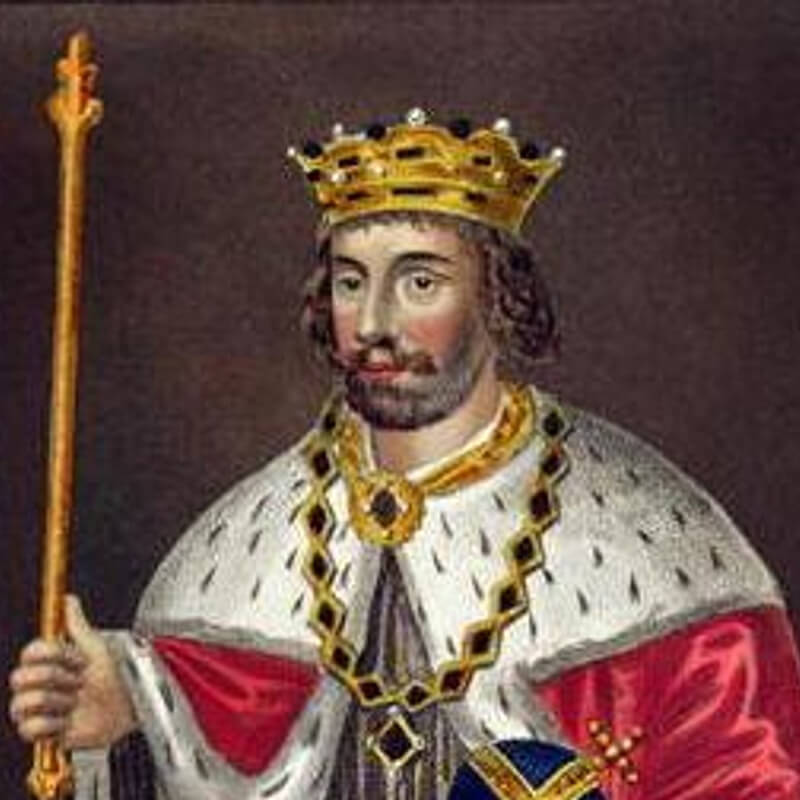
Quick
Facts.
- Born: 1284
- Died: 1327
- Reign: 1307 - 1327
- House: House of Plantagenet
- Predecessor: Edward I
- Successor: Edward III
Edward II, also known as Edward of Caernarfon or Caernarvon, was born in 1284 at Caernarfon Castle in Wales. He was the fourth son of King Edward I and his wife Eleanor of Castile. Edward II was the first English prince to hold the title Prince of Wales, which was bestowed on him by his father in 1301.
Edward’s father, Edward I took great pains to train him in warfare and statecraft. Beginning in around 1300, Edward accompanied his father on campaigns in Scotland, and in 1306 he was knighted at Westminster Abbey. But all his father’s efforts could not prevent him acquiring the habits of extravagance and frivolity which he retained all through his life. His father attributed his son’s defects to the bad influence of his friend and favourite (and possible lover), the Gascon knight Piers Gaveston, and drove him into exile.
Edward’s father died in 1307, and his three elder brothers having pre-deceased him, Edward became king as Edward II. Edward, now as king, immediately recalled his favourite, Piers Gaveston from exile. In the early years of Edward’s reign, he granted Gaveston the earldom of Cornwall and he acted as regent when Edward went to France, where, in 1308, he married Isabella of France, the daughter of the powerful King Philip IV.
Edward’s favouritism of Piers Gaveston angered the barons, but he really earned their hatred when he granted him the earldom of Cornwall. In addition to Gaveston, Edward surrounded himself with other favourites, and the barons, feeling excluded from power, rebelled.
Throughout Edward’s reign, different baronial groups struggled to gain power and control the King. It was immediately evident that Edward’s reign would be a disaster, and the only quality he seemed to share with his warrior-king father was his unusual height. The young king had no stomach for warfare and largely ignored his father’s wishes to continue the campaigns in Scotland which allowed the Scots king, Robert the Bruce to take back the English-held castles in his kingdom and to make regular raids into northern England.
The barons pressured Edward into agreeing to wide-ranging reforms called the Ordinances of 1311, which attempted to limit royal control of finance and appointments. The newly empowered barons once again banished Piers Gaveston, to which Edward responded by revoking the reforms and recalling him back from exile. Led by Edward’s cousin, the Earl of Lancaster, a group of barons seized and executed Piers Gaveston in 1312, beginning several years of armed confrontation.
In 1314, Edward invaded Scotland, only to be decisively defeated by Robert the Bruce at Bannockburn, making Edward even more unpopular. The king’s lack of political and military talents as well as his excessive patronage of friends resulted in his kingdom descending into anarchy. Widespread famine followed, and criticism of the King’s reign mounted. Scotland had effectively reasserted its independence, and Robert the Bruce continued to raid northern England, almost capturing York in 1319.
Power was now in the hands of the barons headed by Edward’s cousin Thomas of Lancaster, who by 1315 had made himself the real ruler of England. However, Lancaster proved to be incompetent, and by 1318 a group of barons led by Aymer of Valence, Earl of Pembroke had assumed the role of arbitrators between Lancaster and the King. However, the king hated the Earl of Pembroke almost as much as his cousin, Lancaster.
Edward found a competent adviser in Hugh le Despenser, a baron of great experience. But what was more important to him was Despenser’s son, Hugh le Despenser the younger, a personal friend and favourite, who was able in some measure to replace his beloved Piers Gaveston. Now the king had two new favourites.
When Edward supported the Despensers’ territorial ambitions in Wales, Lancaster and a group of barons banished both father and son, prompting Edward to fight back. Edward then took up arms on their behalf, and the division led to all-out warfare where Edward defeated Lancaster at the Battle of Boroughbridge in Yorkshire in 1322, where Lancaster was captured and executed. Edward recalled the Despensers back from exile, with whom he now ruled.
Edward and the Despensers strengthened their grip on power, revoking the 1311 reforms, removing any limits to Edward’s royal power, executing their enemies and confiscating estates. However, another failed attempt to invade Scotland saw Edward defeated, where he had to flee for his life, and finally sign a truce with Robert the Bruce.
Edward’s reliance on the Despensers soon aroused the resentment of his queen, Isabella, and opposition to the regime grew. When Isabella was sent to France to negotiate a peace treaty in 1325, she turned against Edward and refused to return. She became the mistress of Roger Mortimer, an exiled baronial opponent of Edward, and one of the anti-royalist leaders. Roger Mortimer had previously been imprisoned in the Tower of London by the king but he managed to escape in 1324.
In September 1326 the couple invaded England with a small army, executed the Despensers, and deposed Edward in favour of his eldest son and heir, who was crowned Edward III in January 1327. When Edward II was forced to abdicate the throne, he was imprisoned at Berkeley Castle and died soon after in September 1327. According to traditional accounts, he was most likely murdered on the orders of the new regime.
Did you enjoy this post?
I hope you found this post useful. I put a great deal of time and effort in to building, maintaining and populating the website. If you like, you could say a small thank you by buying me a coffee. You don't have to, but it would be nice :)
Buy me a coffee
Stay up to Date
Follow me on my journey and get notified whenever a new post is published by following Kings & Castles on Facebook.
Follow MeExplore The Map
Discover the hundreds of castles, churches, monasteries, cathedrals and other historic locations that I've personally visited across England and Wales. Search by location, explore nearby sites and plan your next historical adventure.
Share: