Eadwig
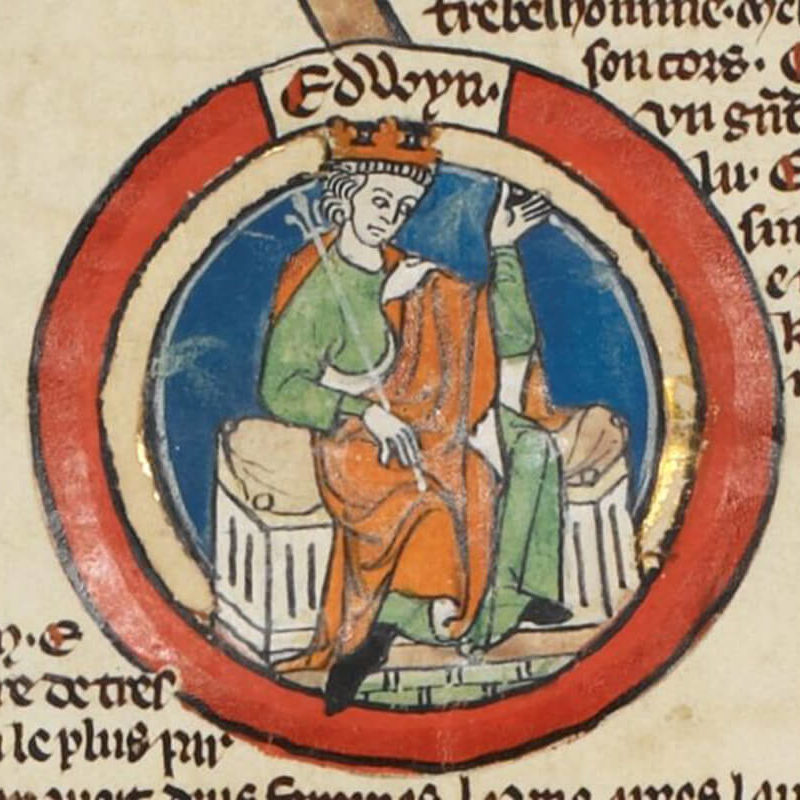
In the year 955 Eadwig (or Edwy) All-Fair (Eadwig “The Fair”) succeeded his uncle King Eadred to the throne aged around 13 to 15, and was King of the English until his death in 959. He was the eldest son of King Edmund I and his first wife Ælfgifu. Whilst Eadwig’s ancestors faced continuous Viking threats, his reign was relatively unchallenged by the heathens, instead, his problems would come from those much closer to him.
Quick
Facts.
- Born: 940/941
- Died: 959
- Reign: 955 - 959
- House: House of Wessex
- Predecessor: Eadred
- Successor: Edgar the Peaceful
Eadwig was born around 940/941 as the eldest son of King Edmund I and his first wife Ælfgifu.
When Eadwig and his siblings were still very young, their father King Edmund I was murdered by an outlaw in 946. As Eadwig and his siblings were all too young to rule, Edmund’s younger brother Eadred succeeded the throne. Eadred suffered from ill-health for most of his life but he managed to rule for about a decade until he died in 955.
Eadwig succeeded the throne in 955, still only a teenager. King Eadwig unlike his younger brother Edgar the Peaceful, did not leave behind such a good record of medieval kingship. After Eadwig’s death and a short four year reign which was interrupted by a division of the kingdom between himself and his brother, Eadwig left behind a legacy of fractious relationships and instability.
Almost immediately, Eadwig gained a rather undesirable reputation, particularly amongst the advisors who were close to the Crown.
In 956, at his coronation ceremony he left his feast and instead chose to entertain the charms of a mother and daughter. He had left to enjoy the company of the ladies Aethelgifu (perhaps his foster mother) and her daughter Aelfgifu, whom the king intended to marry. Such activities were against royal protocol and this contributed to Eadwig’s image as an irresponsible king.
The nobles resented the king’s withdrawal. Dunstan, Abbot of Glastonbury found the king and told him to return to the feast. Eadwig resented this interference and the relationship between Eadwig and Dunstan became irrevocably damaged, and in 957 Dunstan was driven into exile.
In order to proclaim his independence he reduced the power of those around him including his own grandmother, ridding her of her possessions. The same was done to Aethelstan, Ealdorman of East Anglia, who saw his authority dwindle. By making new appointments and reducing the influence of the older order, he hoped to gain more authority and control.
He married the younger female involved in his controversial encounter at his coronation ceremony. This was a choice that had serious consequences, as the church disapproved of the union, citing reasons that the two were in fact related to each other. In 958 Archbishop Odo of Canterbury secured their separation on the grounds of them being cousins.
With further significant members of the church alienated by the king, these fractures in relations ultimately led to Mercia and Northumbria pledging their allegiance to his more popular younger brother, Edgar. At around 14 years of age, Edgar’s reputation was already better than that of his brother and thus the support he garnered led to the splitting up of the kingdom.
In the year 957, the Mercians and Northumbrians revolted, broke away in rebellion and proclaimed Eadwig’s younger brother Edgar as their king. Whilst Eadwig was the rightful king, in order to prevent further contention and chaos during his short reign, Edgar was given control of the north whilst Eadwig retained Wessex and Kent.
It is probable that no actual conflict took place, and whilst the exact origins of the agreement remain unknown, the arrangement continued until Eadwig’s death two years later. King Eadwig died before he was 20.
In 959, on Eadwig’s death, Edgar acceded peacefully to the whole kingdom, and Wessex, Mercia and Northumbria were once again combined.
Did you enjoy this post?
I hope you found this post useful. I put a great deal of time and effort in to building, maintaining and populating the website. If you like, you could say a small thank you by buying me a coffee. You don't have to, but it would be nice :)
Buy me a coffee
Stay up to Date
Follow me on my journey and get notified whenever a new post is published by following Kings & Castles on Facebook.
Follow MeExplore The Map
Discover the hundreds of castles, churches, monasteries, cathedrals and other historic locations that I've personally visited across England and Wales. Search by location, explore nearby sites and plan your next historical adventure.
Share: