Edgar the Peaceful
Edgar I (also known as Edgar the Peaceful, or “the Peaceable”) was King of the English from 959 until his death in 975. Edgar became king of all England aged just 16 years old on the death of his elder brother, King Eadwig All-Fair. The reign of Edgar the Peaceful was a rare period of peace and stability in Anglo-Saxon England.
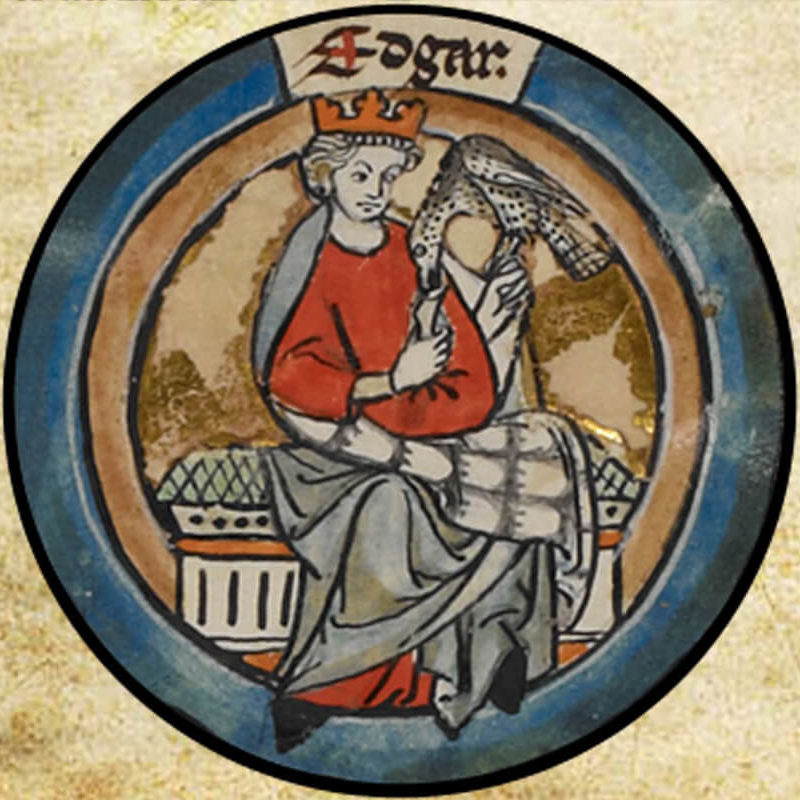
Quick
Facts.
- Born: c. 942 - 944
- Died: 975
- Reign: 959 - 975
- House: House of Wessex
- Predecessor: Eadwig
- Successor: Edward the Martyr
Edgar was born some time around 942 – 944. He was the younger son of King Edmund I and his first wife Ælfgifu, and the brother of his predecessor King Eadwig.
During the short reign of his elder brother, Edgar was preferred by many over his brother, and in the year 957, the Mercians and Northumbrians revolted against the king, broke away in rebellion and proclaimed Edgar as their king instead. At this time Edgar was aged around 14 years old, and his reputation was already better than that of his elder brother and thus the support he garnered led to the splitting up of the kingdom.
Whilst Eadwig was the rightful king, Edgar was given control of the north whilst Eadwig retained Wessex and Kent. Therefore Edgar became the king of the Mercians and Northumbrians from 957, and became king of all England from the year 959 when his elder brother King Eadwig died. Edgar acceded peacefully to the whole kingdom, and as his first act as king, Edgar united the two halves of England which were governed in unity under his sole control. As a result of his lengthy and peaceful rule, he would become known as King Edgar the Peaceful.
He earned the nickname “the Peaceable”, but he was in fact a stronger king than his elder brother Eadwig. He was a firm and capable ruler whose power was acknowledged by other rulers in Britain, as well as by Welsh and Scottish kings. He was efficient and tolerant of local customs and his reign was peaceful. He was most important as a patron of the English monastic revival. From the beginning of his reign, Edgar was keen to reverse his brother’s divisive policies and repair fractious relationships, particularly with the church.
Almost immediately Edgar recalled St. Dunstan from exile (his brother Eadwig had controversially exiled him during his reign) and made him archbishop of Canterbury. Dunstan insisted on strict observance of the Benedictine Rule. King Edgar supported Archbishop Oswald of York and Bishop Aethelwold of Winchester in founding abbeys and reforming the church.
For unexplained reasons, King Edgar’s coronation was delayed for a considerable length of time, and eventually took place in Bath in 973 with much ceremony. Following his coronation, Edgar travelled to Chester and held court in a palace in a place now known as Edgar’s field near the old Dee bridge in Handbridge. There he was met by eight sub-Kings of Britain whom he had summoned. Among them was Kenneth, King of Scots and his son Malcolm, King of the Cumbrians. In a demonstration of the power of Wessex, Edgar was rowed up the River Dee to the Monastery of St. John the Baptist, by all eight sub-Kings, attended by a large group of nobles. The entire occasion represented an assertion of Saxon supremacy over the Celts of England, Scotland and Wales.
Edgar married twice, had several mistresses and had four children. He left two sons, the eldest named Edward (Edward the Martyr), the son of his first wife Æthelflæd, and Æthelred (Æthelred the Unready), the youngest, the child of his second wife Ælfthryth.
King Edgar the Peaceful died at the height of his power at Winchester in July 975 at the age of 33 and was buried at Glastonbury Abbey.
After his death the throne was disputed between the supporters of his two surviving sons. His eldest son, Edward the Martyr was chosen with the support of Dunstan, Archbishop of Canterbury. Three years later Edward was murdered and succeeded by his younger half-brother, Æthelred the Unready.
From Edgar’s death to the Norman Conquest, every single succession to the throne was contended. Furthermore, it seemed to be the beginning of the end for Anglo-Saxon England as it resulted in three 11th-century successful conquests; two Danish and one Norman.
King Edgar, unlike his predecessors, ruled for a considerable time, during which he created stability and continuity unlike anything which had been achieved since the time of Æthelstan.
It is fair to say that Edgar’s reign saw the Anglo-Saxon kingdom of the English at its height. Although other previous kings have been recorded as the founders of England, it was Edgar who consolidated this.
Did you enjoy this post?
I hope you found this post useful. I put a great deal of time and effort in to building, maintaining and populating the website. If you like, you could say a small thank you by buying me a coffee. You don't have to, but it would be nice :)
Buy me a coffee
Stay up to Date
Follow me on my journey and get notified whenever a new post is published by following Kings & Castles on Facebook.
Follow MeExplore The Map
Discover the hundreds of castles, churches, monasteries, cathedrals and other historic locations that I've personally visited across England and Wales. Search by location, explore nearby sites and plan your next historical adventure.
Share: