Richard I
Richard I, more commonly known as Richard the Lionheart because of his reputation as a great military leader and warrior, was King of England from 1189 until his death in 1199. He was the eldest surviving son of King Henry II and the older brother of the infamous King John. Richard fulfilled his main ambition by going on the Third Crusade in 1190, leaving the ruling of England to others. During his 10-year reign he spent only six months in England.
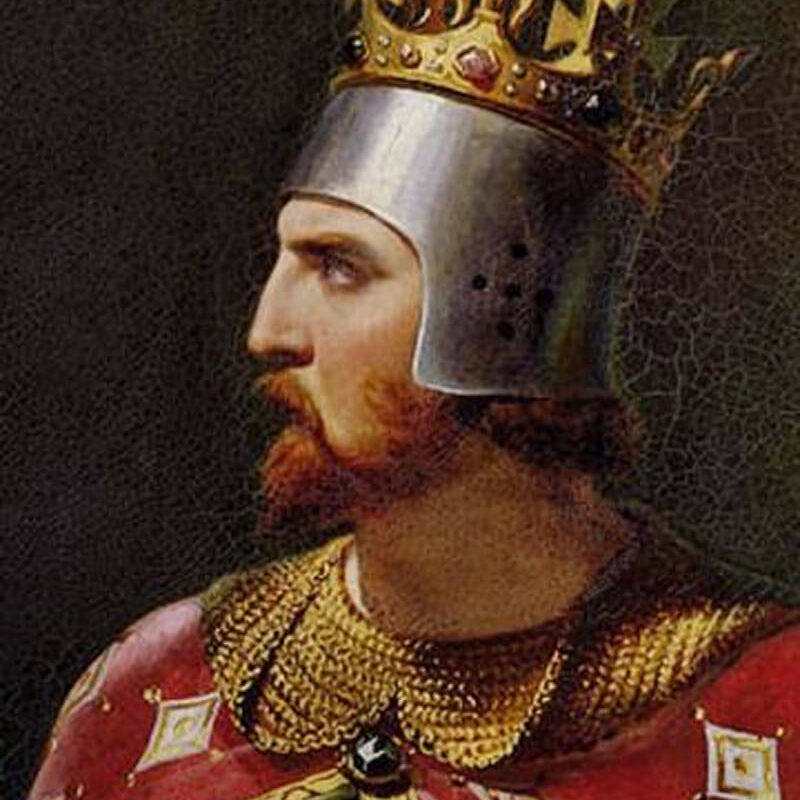
Quick
Facts.
- Born: 1157
- Died: 1199
- Reign: 1189 - 1199
- House: House of Plantagenet
- Predecessor: Henry II
- Successor: John
Born in 1157 in Oxford, England, Richard I was the third son of King Henry II and Eleanor of Aquitaine. He became the Duke of Aquitaine by the time he was 11, and was enthroned as Duke at Poitiers in 1172.
Richard’s father, King Henry II, ruled over a vast empire which stretched from the Scottish border to the Pyrenees, which was known as the Angevin Empire. As Richard and his brothers grew up, their relationship with their father grew more and more fractured as he struggled to find ways to satisfy his sons desires for land and immediate power. Richard and two of his brothers, Henry the Young King (so called because he was his heir and was crowned during his father’s reign as king-in-waiting) and Geoffrey of Brittany became greedy and impatient and tensions rose over the future inheritance of the Angevin empire. Several battles ensued between King Henry and his sons over many years, and his wife Eleanor would always side with their sons. She attempted to overthrow her husband in favour of her sons and for this she was locked up for 16 years. Their younger brother John (the future King John) was more loyal to their father and didn’t participate as much in the rebellions against their father, and for this he was Henry’s favourite son.
Richard and his elder brother, heir to the throne and king-in-waiting, Henry the Young King, turned on each other and a war ensued, however the war was terminated abruptly when Henry the Young King died from dysentery in 1183, leaving Richard heir to England, Normandy and Anjou.
Henry II wanted to give Aquitaine to his youngest son, John. Richard refused as that was his inheritance, and in 1189 Richard joined forces with King Philip II of France against his father, and for obscure reasons, John deserted Henry for Richard. The discovery of John’s treason broke his father’s heart, and together they hounded their ageing father to a premature death in 1189. When Henry II died in 1189, Richard became Richard I, King of England, and also became Duke of Normandy as well as Aquitaine, and Count of Anjou and Maine.
Now king of the Angevin empire, Richard had only one ambition, to lead the Crusade prompted by Saladin’s capture of Jerusalem in 1187. However, his ambitions almost bankrupted England as he practically put England up for sale and dipped deep into his father’s treasure to pay for the Crusade. Richard, with his newly purchased formidable fleet and army, became one of the leaders of the Third Crusade against Saladin, and during his journey on the way to the Holy Land in 1190 he conquered Sicily and Cyprus. Before leaving Cyprus for the Holy Land, Richard married Berengaria, the first-born daughter of King Sancho VI of Navarre.
Richard arrived in the Holy Land in 1191 and won some early battles. However, in the end, the crusade did not succeed. Although he came close, he was never able to win back Jerusalem from the Muslims which was the crusade’s main objective. So after a year’s stalemate, Richard made a truce with Saladin and he decided to return home to England.
On his way back from the crusade, Richard was captured by Duke Leopold of Austria. Later, he was handed over to the German emperor Henry VI, who kept him at various imperial castles and ransomed him for a huge sum of money. Meanwhile, in England, Richard’s younger brother John occupied Windsor Castle and prepared an invasion of England by Flemish mercenaries. Their mother, Queen Eleanor, took firm action against John by strengthening garrisons and exacting oaths of allegiance to Richard. John’s rebellious activities against his brother were ended by the payment of the crushing ransom made to the German emperor for Richard’s release in 1194.
Set free in 1194 and fearing that the independence of his kingship had been compromised, Richard immediately returned to England and was re-crowned at Winchester. Yet a month later he went to Normandy to defend his various territories against King Philip II of France, never to return to England again. His final five years were spent in warfare against Philip II, leaving the controlling of England to others, including Hubert Walter, the Archbishop of Canterbury.
While besieging the castle of Châlus in Limousin, central France, against a rebellious baron, he was fatally wounded and died after being shot with a crossbow in 1199. By the time of his death, Richard had recovered all of his lands. He was buried in the abbey church of Fontevrault, where his father King Henry II, and his mother Queen Eleanor are also buried, and his effigy is still preserved there. Richard I died having no children, so he was succeeded by his younger brother John, who had spent the years of Richard’s absence scheming against him. However, when John became king, Philip II successfully invaded Normandy, and within a few years John had retreated to England and lost the French lands of Normandy and Anjou that his brother Richard fought to keep.
Richard I was irresponsible, hot-tempered and capable of great cruelty. But, he was more accomplished than most of his family. Richard possessed exceptional political and military ability. Winning fame for his knightly prowess made him a popular king in his own time, later being referred to as the ‘Lion Heart’ for his exploits in the Third Crusade.
Did you enjoy this post?
I hope you found this post useful. I put a great deal of time and effort in to building, maintaining and populating the website. If you like, you could say a small thank you by buying me a coffee. You don't have to, but it would be nice :)
Buy me a coffee
Stay up to Date
Follow me on my journey and get notified whenever a new post is published by following Kings & Castles on Facebook.
Follow MeExplore The Map
Discover the hundreds of castles, churches, monasteries, cathedrals and other historic locations that I've personally visited across England and Wales. Search by location, explore nearby sites and plan your next historical adventure.
Share: