Sweyn Forkbeard
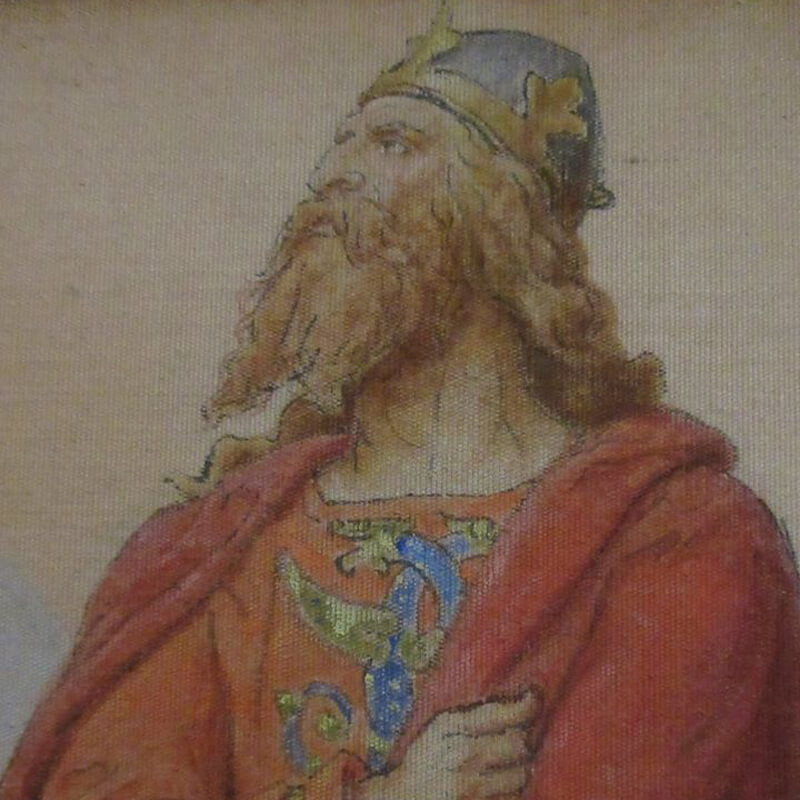
Most people have heard of the Danish king of England Cnut the Great (also spelled Canute) who according to legend, tried to command the waves. However it was his father Sweyn (also spelled Svein) who was the first Viking king of England.
Quick
Facts.
- Born: 963
- Died: 1014
- Reign: 1013 - 1014
- House: House of Denmark
- Predecessor: Æthelred the Unready
- Successor: Æthelred the Unready
Because he ruled for just five weeks, Sweyn Forkbeard has become one of England’s forgotten kings. He was declared King of England on Christmas Day in 1013 and ruled until his death on 3rd February 1014, although he was never crowned.
Sweyn, known as Forkbeard due to his long cleft beard, was born around 960 to 963 and was the son of the king of Denmark, Harald Bluetooth.
Although he was a Viking warrior, Sweyn was baptised a Christian, after his father converted to Christianity and became the first Scandinavian King to accept the faith. Despite this, Sweyn was a brutal man who lived in a brutal time; he was a violent warlord and a belligerent warrior. He started his life of violence with a campaign against his own father; in around the year 986 Sweyn attacked and deposed Harald.
Sweyn then turned his attention to England, and in the early 990s he led a campaign of fear and destruction, laying waste to large areas of the country. Æthelred the Unready was king of England at this time. He decided to pay Sweyn to return to Denmark and leave the country in peace, a tax which became known as Danegeld. However, despite paying the Danegeld, it turned out to be an unsuccessful strategy and the Danes continued raiding in the north of England. Some even began to settle there. Æthelred was persuaded that in order to protect England he would have to rid the land of these Danish settlers entirely.
On St Brice’s Day, 13th November 1002, Æthelred ordered the massacre of all Danes in England, including men, women and children. Amongst those killed was Sweyn’s sister Gunhilde. This would become known to history as the St Brice’s Day Massacre.
Sweyn found out what had happened and swore revenge on Æthelred, and in 1003 he landed in England with an invading force. His attacks were on an unprecedented scale, his forces pillaging and plundering without mercy. The devastation was so severe that King Æthelred yet again paid off the Danes.
The raids continued on and off for many years and King Æthelred proved to his people be a very ineffective king. In the year 1013 Sweyn returned to invade once more, landing this time at Sandwich in modern-day Kent. He rampaged through England and the terrified locals submitted to him and his forces. Finally he turned his attention to London. Disillusioned with their ineffective king, the English earls reluctantly declared Sweyn as King of England and Æthelred fled into exile, first to the Isle of Wight and then to Normandy in France.
Sweyn was proclaimed king on Christmas Day 1013, but his reign lasted for a matter of weeks; he died suddenly at his capital at Gainsborough in Lincolnshire on 3rd February 1014. Sweyn was at first buried in England, but his body was later taken to Denmark.
How Sweyn died is uncertain. There are several theories; one theory is that he fell from his horse, another is that he died of an apoplexy, and a later legend says that he was murdered in his sleep by St Edmund, who himself was martyred by Vikings in the 9th century. It is said that St Edmund returned from the grave in the dead of night and killed him with a spear.
Did you enjoy this post?
I hope you found this post useful. I put a great deal of time and effort in to building, maintaining and populating the website. If you like, you could say a small thank you by buying me a coffee. You don't have to, but it would be nice :)
Buy me a coffee
Stay up to Date
Follow me on my journey and get notified whenever a new post is published by following Kings & Castles on Facebook.
Follow MeExplore The Map
Discover the hundreds of castles, churches, monasteries, cathedrals and other historic locations that I've personally visited across England and Wales. Search by location, explore nearby sites and plan your next historical adventure.
Share: