Æthelred the Unready
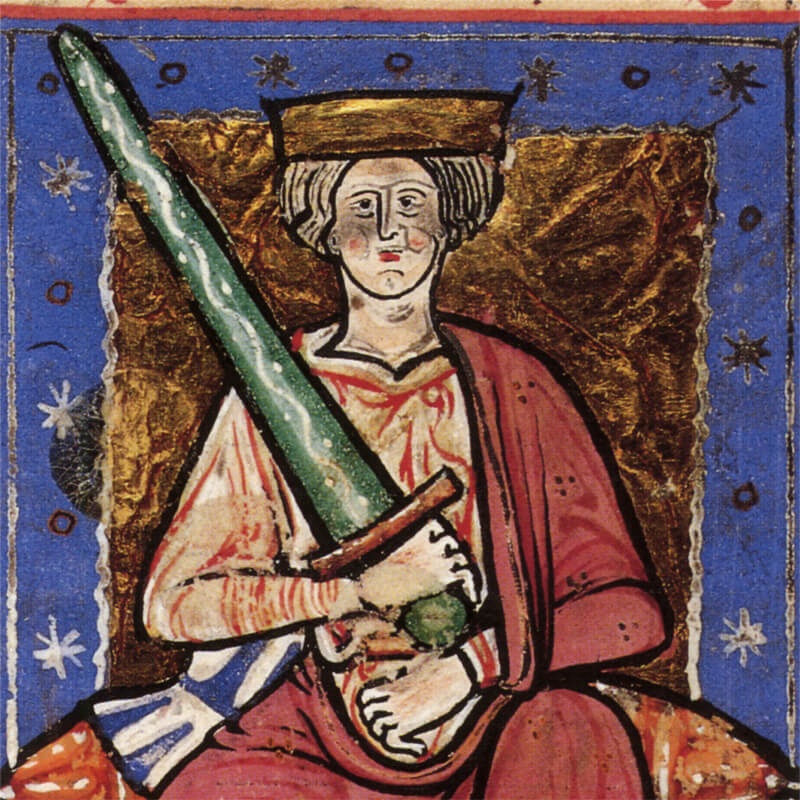
Æthelred II, also known as Æthelred the Unready, was King of the English from 978 to 1013 and again from 1014 until his death in 1016. His epithet comes from the Old English word ‘unræd’, meaning ‘no counsel’, or ‘poorly advised’, or that he was unwise. He was a largely incompetent king whose terrible decision making led to England being ruled by Viking leaders.
Quick
Facts.
- Born: c. 966
- Died: 1016
- Reign: 978 - 1013 & 1014 - 1016
- House: House of Wessex
- Predecessor: Edward the Martyr
- Successor: Sweyn Forkbeard
Æthelred (or Ethelred) II was born around 966 – 968. He was the son of King Edgar the Peaceful and Queen Ælfthryth. He ascended the throne at around the age of 10 – 12 following the assassination of his older half-brother King Edward the Martyr in 978.
The reign of King Æthelred II was one of conflict with repeated Viking raids. Not being an able soldier, Æthelred defended the country against increasingly rapacious Viking raids from the 980s onwards by diplomatic alliance with the duke of Normandy (he later married the duke’s daughter Emma) and by buying off renewed attacks by the Danes with money levied through a tax called the Danegeld.
Æthelred married twice. He had numerous children, including the future king Edmund Ironside, with his first wife Ælfgifu of York, daughter of an Earl of Northumbria, until her death in 1002. In the same year, he married his second wife Emma of Normandy, the daughter of Richard I of Normandy. They went on to have three children, most famously, the future king Edward the Confessor.
Æthelred was an ineffectual ruler and failed to prevent the Danes from overrunning England. Widespread suspicion that Æthelred may have had a part in the murder of his half-brother King Edward the Martyr created much distrust and disloyalty that undermined his authority. Hence, there was no unified defence when the Danish invasions resumed in 980. Nearly all of the country was ravaged, and Æthelred’s efforts to buy peace only made the invaders more rapacious. Many times the king paid them tribute (Danegeld) but they always came back for more. They did eventually begin to settle down in towns, however, Æthelred would later provoke further invasions by launching a mass murder of the Danish settlers.
Æthelred failed to command respect, and to win or retain the allegiance of many of his subjects. He was most known for making many mistakes, and his biggest mistake came in the year 1002 when he ordered the massacre of all Danes in England to eliminate potential treachery. This event is known as the St Brice’s Day Massacre. One of the Danes that was killed was Gunhilde, the sister of the Danish King Sweyn Forkbeard.
This gave the Danes a reason to invade England again, they wanted revenge, but for King Sweyn it was more personal. England had not seen a Danish invasion like it for over a hundred years. After years of conquering and much devastation, in the year 1013 the English nobility became so disillusioned with their existing king, Æthelred the Unready, that they acknowledged Sweyn as their new king, forcing Æthelred into exile in Normandy. Sweyn became the first Viking king of England, however, he ruled for just five weeks until his death in February 1014 and he was never officially crowned.
After the death of Sweyn, Æthelred’s advisers invited him to return to the throne on condition that he agree to satisfy their grievances. He became king again for a short while until his death in April 1016. Æthelred was able to secure the support of the nobility against his new opponent, Sweyn’s son Cnut, who at this time was ravaging England claiming to be the new King of England after his father’s passing.
Cnut temporarily returned to Scandinavia where he used his time to regroup and make a comeback. In the meantime, Æthelred sought his own revenge on those who had either betrayed him, given in to the Vikings or supported Cnut. This included the murder and seizure of lands for anyone believed to be traitors.
Cnut returned to England in 1015 supported by his Viking fleets. At this time Æthelred was suffering from ill health and the responsibility of Anglo-Saxon resistance fell to his son, Edmund Ironside. In April 1016 Æthelred passed away, leaving the fate of his land in the hands of his son. Edmund Ironside died after just a few months of being king (he was most likely murdered) and was replaced by Cnut, who became known as Cnut the Great.
Did you enjoy this post?
I hope you found this post useful. I put a great deal of time and effort in to building, maintaining and populating the website. If you like, you could say a small thank you by buying me a coffee. You don't have to, but it would be nice :)
Buy me a coffee

Stay up to Date
Follow me on my journey and get notified whenever a new post is published by following Kings & Castles on Facebook.
Follow MeExplore The Map
Discover the hundreds of castles, churches, monasteries, cathedrals and other historic locations that I've personally visited across England and Wales. Search by location, explore nearby sites and plan your next historical adventure.
Share: