Saint Bede the Venerable
Bede, also known as Saint Bede, the Venerable Bede, and Bede the Venerable, was an Anglo-Saxon monk, author and scholar. Best known for his writings, he was one of the greatest teachers and writers of the Early Middle Ages, and is widely regarded as one of the most important figures in early English Christianity and the greatest of all the Anglo-Saxon scholars.
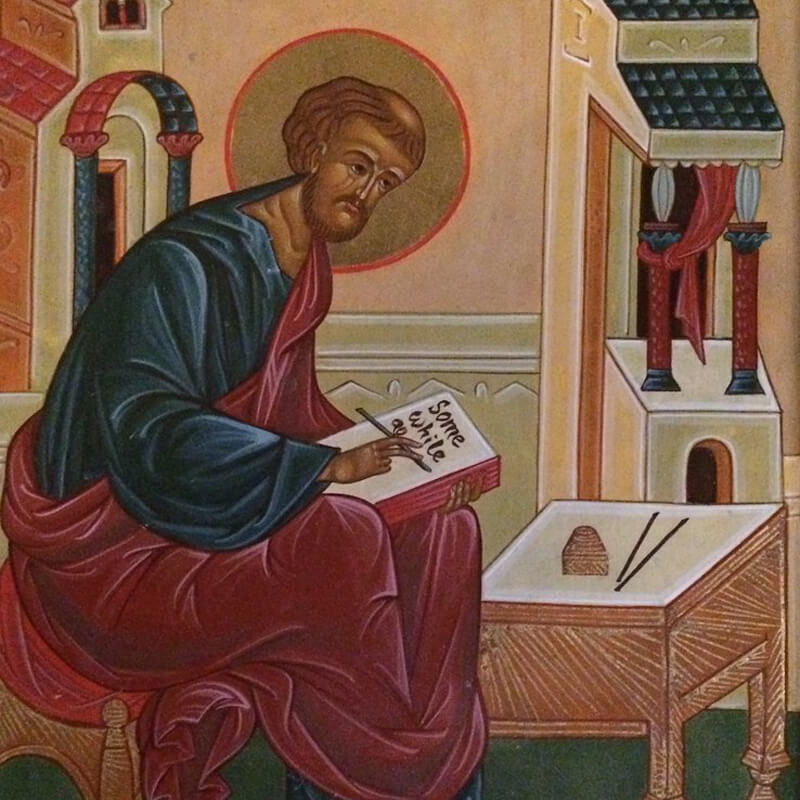
Bede was born in either 672 or 673 in the Kingdom of Northumbria, England. He was born on lands belonging to the twin Benedictine monasteries of Saint Peter and Saint Paul, known simply as Monkwearmouth–Jarrow Abbey in present-day Tyne and Wear in the North East of England.
Bede was raised in the monastery from the age of seven and spent most of his life there and rarely left it. He was ordained a deacon when he was 19 years old and a priest at age 30.
The combination of his genius and the instruction of scholarly, saintly monks, produced a saint and an extraordinary scholar. He was deeply versed in all the sciences of his time: nature, philosophy, astronomy, arithmetic, grammar, poetry, ecclesiastical history, martyrology, and holy scripture.
Bede wrote or translated over 40 books on practically every area of knowledge, with the majority dealing with theology and history. He also wrote the first martyrology (a chronicle about the lives of martyrs and saints), but his most famous work, Historia ecclesiastica gentis Anglorum (Ecclesiastical History of the English People), written in around 731/732, gained him the title “The Father of English History”.
Divided into five books, Historia ecclesiastica records Britain’s history starting with the raids by Julius Caesar in 54 BC to the arrival of St Augustine of Canterbury in Kent in 597 AD. Not only is it a source vital to the history of the conversion to Christianity of the Anglo-Saxon tribes in Britain, it is regarded as of decisive importance in the art and science of writing history.
It is the first work of history in which the AD system of dating is used. His method of dating events from the time of the incarnation, or Christ’s birth – AD (anno Domini, “in the year of our Lord”), came into general use through the popularity of the Historia ecclesiastica and his works on chronology.
Up until the arrival of St Augustine, who was a missionary sent from Rome in 597 to convert the Anglo-Saxons to Christianity, the Anglo-Saxons were either pagans or practised an early form of Celtic Christianity, and were seen as wild barbarians in the eyes of the Church. But by the time of Bede’s death, the Church had already fulfilled its purpose of preparing Western Christianity to assimilate the non-Roman barbarian North with Roman Christianity. It is mostly thanks to Bede’s Ecclesiastical History of the English People that we know this, for it is a key source for the understanding of early British history and the arrival of Christianity.
Bede remained in his monastery until his death, ever occupied with learning, writing, and teaching. Leaving his monastery only once or twice during his lifetime, he died in his cell at the monastery in May 735 aged 61 or 62. Originally buried at his monastery at Jarrow, the Venerable Bede’s bones have been in Durham Cathedral since 1022, now entombed in the Galilee Chapel.
Bede was declared Venerable by the Church in 836 and was canonised in 1899. He was named “Doctor of the Church” by Pope Leo XIII because of his work and piety. He is the Patron Saint of scholars and historians.
Bede can be referred to as many things – a monk, author, scholar, teacher, writer, theologian, historian, chronologist. The influence of this humble early-medieval monk from Northumbria was felt throughout Europe and continues across the world today. He is remembered as the earliest English historian, whose work has shed light on a period of English history that would have otherwise been unknown, remaining as an indispensable source for some of the facts and much of the feel of early Anglo-Saxon history.
Did you enjoy this post?
I hope you found this post useful. I put a great deal of time and effort in to building, maintaining and populating the website. If you like, you could say a small thank you by buying me a coffee. You don't have to, but it would be nice :)
Buy me a coffeeMore People Profiles
View all People Profiles

Stay up to Date
Follow me on my journey and get notified whenever a new post is published by following Kings & Castles on Facebook.
Follow MeExplore The Map
Discover the hundreds of castles, churches, monasteries, cathedrals and other historic locations that I've personally visited across England and Wales. Search by location, explore nearby sites and plan your next historical adventure.
Share: