The Murder of Thomas Becket
Thomas Becket was one of the most famous religious and political figures of medieval England. He rose from a relatively modest background to become Archbishop of Canterbury in 1162. His conflict with King Henry II eventually led to his murder in Canterbury Cathedral, which made him a martyr and transformed him into one of the most important saints of medieval England.
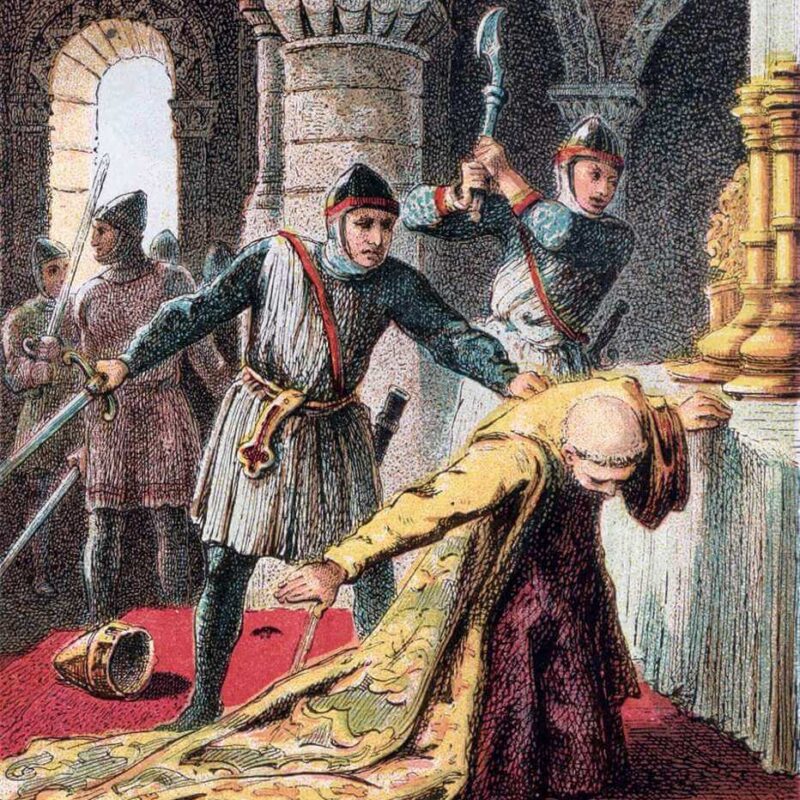
Thomas Becket, also known as Thomas à Becket, was born around 1120 in London. He was educated in London and Paris before beginning a career in the Church. His intelligence and administrative abilities attracted the attention of Theobald, Archbishop of Canterbury, who employed him as a clerk. Becket quickly became an important royal official. In 1155, Henry II appointed him as Chancellor of England, making him one of the king’s most trusted advisers.
Becket and Henry II initially had a close relationship. The king relied on Becket to help strengthen royal authority and improve the administration of England. However, their relationship changed dramatically when Henry appointed Becket as Archbishop of Canterbury in 1162. Henry expected his former friend and adviser to support the Crown, but Becket increasingly saw his new role as a responsibility to defend the independence and privileges of the Church.
The main dispute between the king and the archbishop concerned the relationship between royal and church authority. Henry wanted greater control over clergy who were accused of crimes. He believed that members of the clergy should be subject to royal justice for serious offences. Becket opposed measures that he believed threatened the Church’s traditional rights.
In 1164, Henry introduced the Constitutions of Clarendon, which attempted to define the relationship between the monarchy and the Church. Becket initially accepted some of the proposals but later rejected them. The disagreement became increasingly bitter, and Becket fled to France, where he remained in exile for several years.
Eventually, Becket and Henry reached a fragile reconciliation, allowing Becket to return to England in 1170. However, the conflict was not completely resolved. Becket continued to oppose some of the king’s policies and excommunicated several bishops who had supported Henry.
Henry’s anger towards Becket ultimately contributed to the archbishop’s death. On 29th December 1170, four of the king’s knights arrived at Canterbury Cathedral. They confronted Becket and demanded that he submit to the king. When he refused, they attacked and killed him inside the cathedral.
Becket’s murder caused shock throughout Europe. Although Henry II may not have directly ordered his assassination, his angry words regarding Becket were said to have been misinterpreted by his knights and were widely understood to have contributed to the knights’ actions. The king was forced to make public acts of penance, and Becket was canonised as a saint by Pope Alexander III in 1173.
Becket’s tomb at Canterbury Cathedral quickly became an important pilgrimage site. Thousands of pilgrims travelled to Canterbury to honour the new saint, and his reputation spread across Europe. His story was later immortalised in literature, most famously in Geoffrey Chaucer’s The Canterbury Tales, in which pilgrims travel to Canterbury to visit the shrine of Saint Thomas.
Thomas Becket remains an important figure in English history because his life represents the struggle between religious and political authority in medieval Europe. His transformation from royal servant to defender of the Church, followed by his dramatic martyrdom, made him a symbol of resistance to excessive political power. His death also demonstrated the enormous influence that religious belief and the Church could have on medieval society.
Did you enjoy this post?
I hope you found this post useful. I put a great deal of time and effort in to building, maintaining and populating the website. If you like, you could say a small thank you by buying me a coffee. You don't have to, but it would be nice :)
Buy me a coffee

Stay up to Date
Follow me on my journey and get notified whenever a new post is published by following Kings & Castles on Facebook.
Follow MeExplore The Map
Discover the hundreds of castles, churches, monasteries, cathedrals and other historic locations that I've personally visited across England and Wales. Search by location, explore nearby sites and plan your next historical adventure.
Share: