Edward the Elder
Edward the Elder was King of the Anglo-Saxons from 899 until his death in 924. He was the elder son of Alfred the Great and his wife Ealhswith. Edward’s three sons would rule after him as King of the English, with his eldest son Æthelstan famously uniting the English kingdoms to become the first king of a united English kingdom.
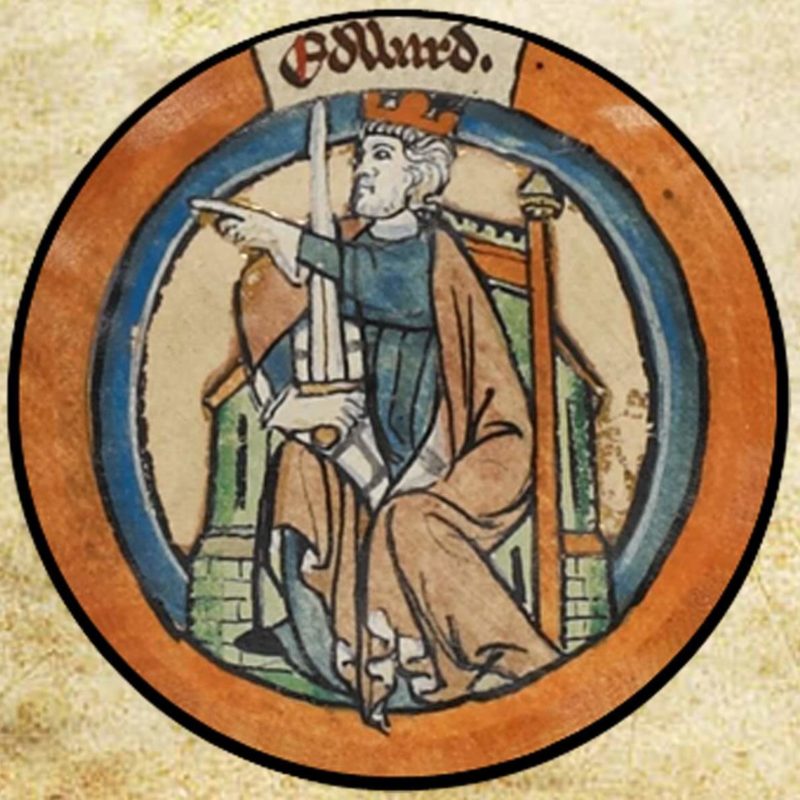
Quick
Facts.
- Born: 874
- Died: 924
- Reign: 899 - 924
- House: House of Wessex
- Predecessor: Alfred the Great
- Successor: Æthelstan
As the son of King Alfred the Great, Edward the Elder had a lot to live up to during his reign but he did not disappoint. Whilst he did not share Alfred’s great scholarly reputation, Edward was able to rule effectively as King of the Anglo-Saxons, extending his authority over almost all of England by conquering areas that previously had been held by Danish invaders. His military record and ability to maintain central authority for 25 years was more than admirable.
Edward was referred to as the “Elder”, not because he was the eldest son, but rather used by historians to differentiate between him and King Edward the Martyr.
Edward had three marriages during his lifetime. In total he had thirteen children, three of whom would inherit the throne after his death.
His father Alfred the Great did his best to ensure that young Edward’s path to kingship was clear, making arrangements long before, in order to bolster Edward’s position as well as give him military instruction. Edward ascended the throne upon his father’s death in the year 899, and in a battle in 902 his forces killed a rival claimant, Æthelwold, who had allied with the Danes. Æthelwold was actually Edward’s cousin and had a legitimate claim to the throne. He was the son of Alfred the Great’s elder brother and predecessor, King Æthelred I, and felt that the throne should have been passed to him.
After defeating the Northumbrian Danes, Edward set out in 912 to subdue the Danes of the eastern Midlands and East Anglia. From 910 to 916 he constructed a series of fortified enclosures around his Kingdom of Wessex. At the same time, his sister, the Mercian ruler Æthelflæd, known as the Lady of the Mercians, constructed a complementary series of fortresses in the north-west Midlands. Together, brother and sister constructed a huge number of fortifications known as burhs in order protect their territory.
In 917 Edward and his sister Æthelflæd launched a massive offensive, quickly overwhelming the entire Danish army of East Anglia. Upon Æthelflæd’s death in 918, Edward assumed control of Mercia, and by the end of the year the last Danish armies in the Midlands had submitted. By that time Edward’s kingdom included all the land south of the Humber estuary, and in 920 he forced the submission of Northumbria.
What Edward lacked in academic aptitude, he made up for in military acumen and political machinations. However, he soon faced a number of revolts against his growing power and involvement in other territories such as in Mercia where a revolt in Chester broke out. A combined Mercian and Welsh effort against King Edward demonstrated how not all of his subjects were happy with his extended domination over their own kingdoms.
In the year 924, whilst facing off attacks from a revolt, he died at Farndon near Chester, from wounds inflicted by the rebel forces. Edward the Elder’s 25 year reign came to an end on the battlefield, leaving his eldest son Æthelstan to inherit the throne, and it is under Æthelstan that the complete political unification of England was finally achieved.
Whilst his father, King Alfred, had a great impact on culture and social infrastructure during his reign, Edward the Elder’s biggest impact was his military prowess in the face of great adversity from overseas Danish threats.
Did you enjoy this post?
I hope you found this post useful. I put a great deal of time and effort in to building, maintaining and populating the website. If you like, you could say a small thank you by buying me a coffee. You don't have to, but it would be nice :)
Buy me a coffee
Stay up to Date
Follow me on my journey and get notified whenever a new post is published by following Kings & Castles on Facebook.
Follow MeExplore The Map
Discover the hundreds of castles, churches, monasteries, cathedrals and other historic locations that I've personally visited across England and Wales. Search by location, explore nearby sites and plan your next historical adventure.
Share: