Æthelflæd, Lady of the Mercians
Warrior queen, defender, strong and independent, daughter of King Alfred the Great, and one of the most powerful women to have lived during Anglo-Saxon England – Æthelflæd, who battled Vikings, built forts and founded towns, ruled as Lady of the Mercians in the early 10th century until her death in 918.
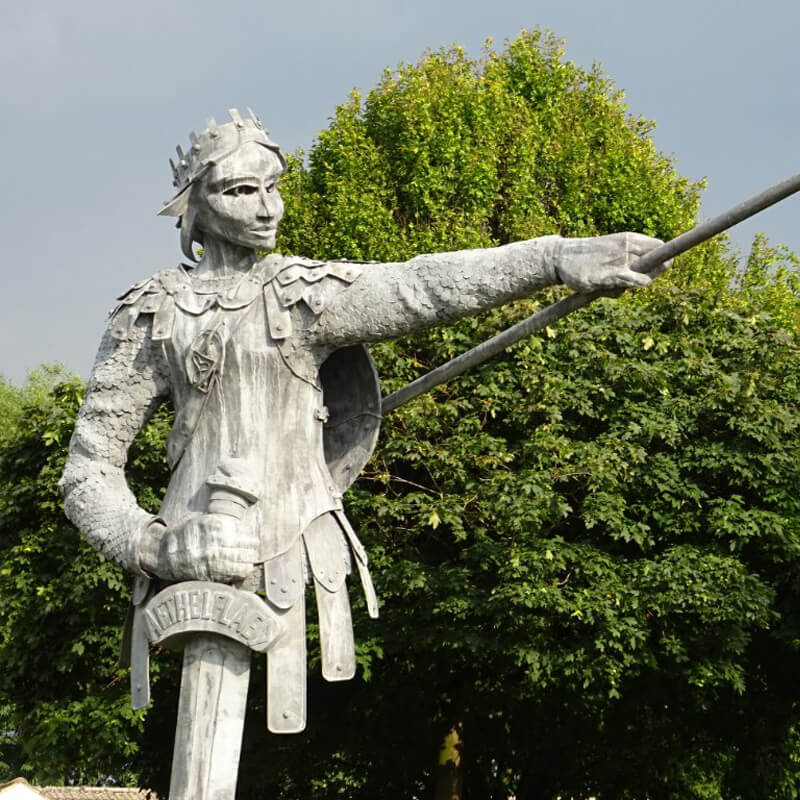
Æthelflæd was born around 868 at the height of the Viking invasions of England. She was the eldest child of Alfred the Great, king of the Anglo-Saxon kingdom of Wessex, and his wife Ealhswith.
During Æthelflæd’s youth, most of England was under Danish Viking rule. East Anglia and Northumbria had been conquered, and Mercia was spilt between the English and the Vikings. But from 878, Æthelflæd witnessed her father take back large parts of England from the Vikings, starting with the famous battle of Edington in Wiltshire, a key turning point in the Anglo-Saxon campaign against the Vikings.
After the victories of King Alfred against the Danes, the English-controlled western half of Mercia came under the rule of Æthelred, Lord of the Mercians, also known as the Ealdorman of Mercia, who accepted Alfred’s overlordship after he assisted him in regaining some of his Mercian lands from the Danes. It was at this time that Alfred, King of the West Saxons, declared himself King of the Anglo-Saxons.
The Danish threat remained, so King Alfred began a large-scale building programme of well-defended fortified settlements across southern England known as burhs. These burhs were fortified towns, and this is where we get the word ‘borough’ from today. Æthelflæd and her brother Edward the Elder also helped with the building of this network of Anglo-Saxon burhs, which they continued after their father’s death.
In the mid-880s, Alfred sealed a strategic alliance between the surviving English kingdoms of Wessex and Mercia by marrying his daughter Æthelflæd to Æthelred, Lord of the Mercians, and within a few years they had their first and only child whom they called Ælfwynn. When Alfred the Great died in 899, Æthelflæd’s brother Edward the Elder succeeded as King of the Anglo-Saxons.
Æthelflæd, alongside her husband and brother, launched a series of military campaigns against the Danes, which brought large parts of England back under Anglo-Saxon control, both in the Midlands and to the north, whilst at the same time, fortifying the Mercian borders and building new burhs. Some of the towns that Æthelflæd fortified included Worcester, Chester, Stafford, Bridgnorth, Warwick, and Derby. She also fortified the town of Gloucester, where she built a new minster, and Tamworth, a centre of royal power, where she made it her capital and spent much of her time in later life. She also gave generous donations to Mercian churches.
Æthelred’s health started to deteriorate and he died in 911, at which time Æthelflæd became the sole ruler of Mercia, earning her the title ‘Lady of Mercia’, and she continued her campaign to further defend and expand her kingdom. The accession of a female ruler in Mercia has been described as “one of the most unique events in early medieval history”.
Æthelflæd and her brother shared their father’s vision of a ‘united England’, with an understanding that the fragmented Anglo-Saxon kingdoms could not drive back the Vikings unless unified as one. One of Æthelflæd’s first acts as the Lady of Mercia was handing both Oxford and London (originally Mercian lands) over to Wessex for their own protection.
The brother and sister alliance of Æthelflæd and Edward continued to drive the Danes out of central and southern England. In 916 Æthelflæd had great military successes in Wales. She then captured Derby in 917, the first of the Five Boroughs of the Danelaw to fall to the English, a victory described as “her greatest triumph”. And finally, in 918 Leicester surrendered without a fight.
Their campaign was almost complete, they just needed to take back York. The Viking leaders of York offered Æthelflæd their loyalty, however, she died at Tamworth in June 918, just weeks before her planned visit to take advantage of the offer and see its citizens pay homage. Æthelflæd was buried in St Oswalds Priory in Gloucester.
Æthelflæd was succeeded by her daughter Ælfwynn, but this was short lived. Just a few months later, her brother Edward claimed his sister’s kingdom without opposition and sent Ælfwynn to Wessex. Edward then completed the subjugation of the Danes and the conquest of Mercia. Additionally, because Æthelflæd had extended her influence into Wales and Northumbria, Edward was able to assert his authority over these regions as well, and almost all of England came under his control.
Æthelflæd, Lady of the Mercians was one of the most powerful and influential women in Anglo-Saxon England. Unfortunately, few are aware of her legacy and the significant role she played in the history and making of a united England. She was a formidable warrior and a brilliant diplomat. She lead her armies, built many fortresses, led many successful military campaigns against the Vikings and won back a lot of English lands. Linked to many places throughout the country, she was thought of as ‘queen’ by many of her subjects, and leaves a legacy as one of the most powerful female rulers of the time.
Did you enjoy this post?
I hope you found this post useful. I put a great deal of time and effort in to building, maintaining and populating the website. If you like, you could say a small thank you by buying me a coffee. You don't have to, but it would be nice :)
Buy me a coffee
Stay up to Date
Follow me on my journey and get notified whenever a new post is published by following Kings & Castles on Facebook.
Follow MeExplore The Map
Discover the hundreds of castles, churches, monasteries, cathedrals and other historic locations that I've personally visited across England and Wales. Search by location, explore nearby sites and plan your next historical adventure.
Share: