Saint George
Who Was Saint George, Really?
Ahh good ol’ Saint George. The patron saint of England, hailed as a national hero. England’s pride and joy and shining beacon of hope and glory. A heroic knight who slayed a ferocious fire-breathing dragon. But who was he really?
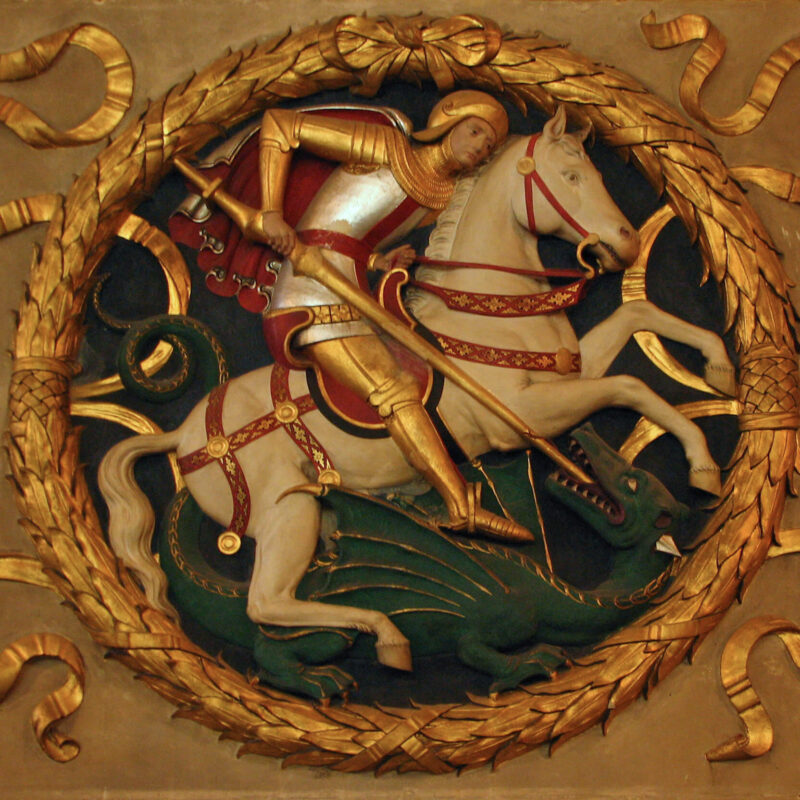
Saint George wasn’t actually England’s first patron saint. That accolade goes to Edmund the Martyr, the 9th-century king of East Anglia who was killed by the Vikings and became one of England’s earliest national saints. George wasn’t English either. He was associated with Cappadocia, in modern-day Turkey, and is believed to have lived during the late 3rd and early 4th centuries.
So how did a soldier from the eastern Roman Empire become England’s patron saint?
The Real Saint George
Very little about the historical George can be established with certainty. According to the traditional account, he was a Christian who served as a soldier in the Roman army during the reign of the Emperor Diocletian.
This was a dangerous time to be a Christian. Diocletian launched one of the Roman Empire’s most severe persecutions of Christians in the early 4th century. George supposedly refused to renounce his faith and was executed at Nicomedia, probably around AD 303.
His story quickly became that of a Christian martyr. Churches were dedicated to him, and his cult spread throughout the Christian world. George became particularly popular among soldiers, who came to regard him as a protector and an example of courage.
But there is a rather important problem with this story: we don’t actually know how much of it is true.
The earliest surviving accounts of George were written long after his supposed death and contain legendary elements. Even his career as a Roman soldier is difficult to establish with certainty. What seems most likely is that a Christian martyr named George really did exist, but the spectacular story surrounding him grew considerably over the centuries.
And Then Came the Dragon
The famous dragon didn’t originally feature in George’s story.
The legend developed centuries later and was eventually incorporated into medieval versions of his life. In the most famous version, a terrifying dragon terrorised a city, and the inhabitants were forced to provide it with sheep and eventually human sacrifices.
When the king’s daughter was chosen as the next victim, George arrived on horseback. He confronted the beast, wounded it with his lance and rescued the princess. The dragon was then killed after the townspeople agreed to convert to Christianity.
It’s a brilliant story — but it was never intended as a historical account.
The dragon became a powerful symbol of good overcoming evil, with George representing the Christian hero defeating the forces of darkness.
How Did he Become England’s Patron Saint?
George’s connection with England developed during the Middle Ages. English soldiers were using his battle cry by the time of the Crusades, and his popularity grew enormously during the 13th and 14th centuries.
Edward III established the Order of the Garter in the 14th century, placing Saint George at the heart of England’s royal and military identity. Under Edward III, the red cross associated with George became increasingly prominent, eventually becoming the famous flag of England.
George was officially adopted as England’s patron saint during the medieval period, gradually replacing earlier favourites such as Edmund the Martyr and Edward the Confessor.
By the late Middle Ages, Saint George had transformed from a relatively obscure Christian martyr from the eastern Roman Empire into one of England’s most recognisable national symbols.
So, Who Was Saint George Really?
The honest answer is that we don’t really know.
He probably wasn’t an Englishman, he almost certainly never fought a fire-breathing dragon, and he wasn’t the first saint England chose as its patron.
But somewhere behind the medieval legends was probably a real man: a Christian who lived in the Roman Empire, served as a soldier and died for his faith.
Over a thousand years of storytelling transformed that obscure martyr into the armoured knight we know today — charging into battle beneath a red cross, lance in hand, with a dragon beneath his feet.
Not a bad legacy for a man whose real life has almost disappeared into history.
Did you enjoy this post?
I hope you found this post useful. I put a great deal of time and effort in to building, maintaining and populating the website. If you like, you could say a small thank you by buying me a coffee. You don't have to, but it would be nice :)
Buy me a coffeeMore People Profiles
View all People Profiles

Stay up to Date
Follow me on my journey and get notified whenever a new post is published by following Kings & Castles on Facebook.
Follow MeExplore The Map
Discover the hundreds of castles, churches, monasteries, cathedrals and other historic locations that I've personally visited across England and Wales. Search by location, explore nearby sites and plan your next historical adventure.
Share: