Harold Godwinson
Harold Godwinson, also referred to as Harold II, was the last crowned Anglo-Saxon English king. Harold reigned for just nine months, from 6th January 1066 until his death at the Battle of Hastings, fighting the Norman invaders led by William the Conqueror during the Norman Conquest of England. The Bayeux tapestry documents the heroic battle and death of King Harold, showing him being shot in the eye by an arrow (even though he probably wasn’t).
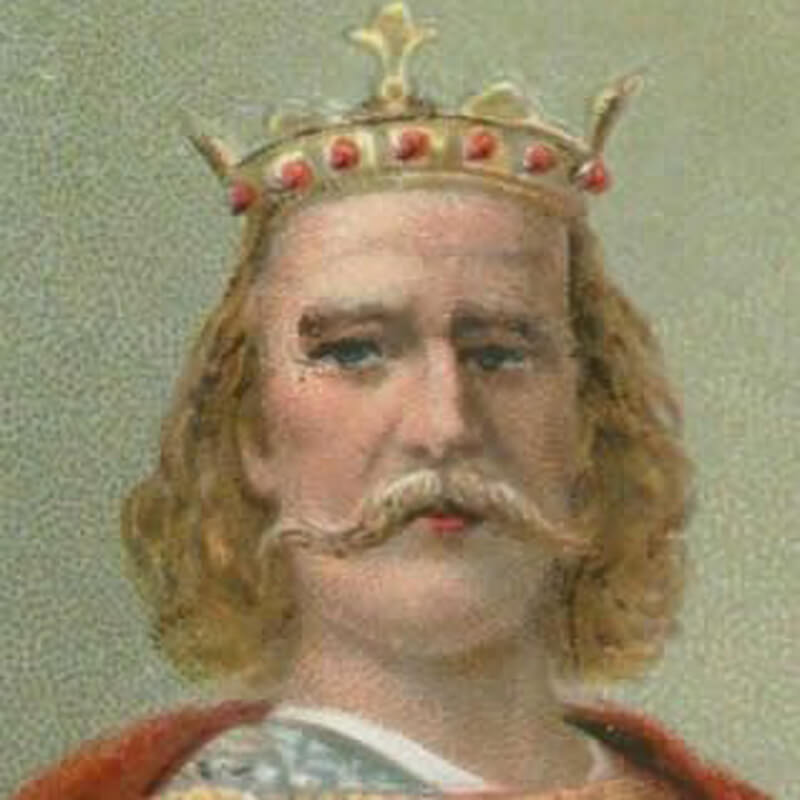
Quick
Facts.
- Born: c. 1020 - 1022
- Died: 1066
- Reign: 1066
- House: House of Godwin
- Predecessor: Edward the Confessor
- Successor: William I
Harold Godwinson was born in the early 1020s and was a member of a prominent Anglo-Saxon family (House of Godwin) with ties to Cnut the Great. His mother, Gytha, belonged to a powerful Danish noble family with close connections to Cnut. His father was the powerful earl Godwin of Wessex, who served under King Cnut when he was king of England, and later played an important role in securing the throne for Edward the Confessor. Edward the Confessor later married Harold Godwinson’s sister, Edith, in 1045 making him brother-in-law to the King.
Harold became a powerful earl himself in the 1040s when his father obtained for him the earldom of East Anglia. However, in 1051 tensions rose between King Edward and Earl Godwin. Both sides rallied their troops but Godwin’s rebellion collapsed and Godwin and his sons were banished. Godwin and his sons returned with an army in 1052, and to avoid a civil war, the king was forced to make terms and restored Godwin and his family to their previous positions and returned their lands.
Harold’s father, Earl Godwin died the following year in 1053, and Harold succeeded to his father’s earldoms. He became the Earl of Wessex, making him one of the most powerful men in England, second only to the king, just as his father had been. His hand was further strengthened in the 1050s by the deaths of the earl of Mercia and other rivals, and by 1057 Harold had obtained earldoms for his three brothers, Tostig, Gyrth and Leofwine.
In the latter half of King Edward’s reign he distanced himself from political duties, and Harold would subsequently control much of England whilst Edward withdrew. During the 1050s and 1060s, Harold showed his military and political skills in fighting against the Welsh and protecting the Marches with the help of his brother Tostig. Harold had proved himself to be a strong leader with great military and diplomatic ability having spent many years ruling England on Edward’s behalf. Harold was therefore most likely expected to ascend the throne after the passing of the childless King Edward.
Shortly before Edward’s death, Edward named Harold Godwinson as his successor even though he may already have promised the crown to a distant cousin in Normandy; William, Duke of Normandy (William the Conqueror). According to Norman sources, Edward sent Harold to Normandy in 1064 to confirm his promise to Duke William and nominate him as the king’s heir. It is said that while on his way to visit William, Harold was shipwrecked and captured by one of William’s vassals. Duke William demanded Harold’s release, welcomed him and joined him on a military campaign in Brittany. According to the Bayeux Tapestry and other Norman accounts, Harold also swore an oath of fealty to William and promised to protect his claim to the English throne.
When Edward the Confessor died without an heir on 5th January 1066, the king’s council (the Witan) convened and chose Harold to succeed him. With this decision and with Edward’s succession promise made to him by Edward on his deathbed, Harold became King of the English on 6th January 1066. This inevitably led to conflict and chaos when William, Duke of Normandy found out that the promise made to him was broken.
Harold’s reign, however, was destined to be short and troubled. From almost the beginning of his reign, Harold Godwinson faced challenges from rival claimants to the throne. In May 1066, Harold mobilised his forces to guard the south coast against an expected invasion by William. But by early September, Harold was forced to disband his southern army because they had run out of supplies. This left the coast unguarded and William free to cross the English Channel unopposed. However, more problems arose for Harold in the form of his brother Tostig, Earl of Northumbria, and Harald Hardrada, King of Norway.
Harold’s brother Tostig governed Northumbria with some difficulty. He was very unpopular with the Northumbrian ruling class, which was a mix of Danish invaders and Anglo-Saxon survivors of the last Norse invasion. Tostig was said to have repressed the Northumbrians, murdered several members of leading Northumbrian families, was frequently absent from the court of King Edward the Confessor, and showed a lack of leadership against the raiding Scots.
In 1065 the Northumbrians rebelled against Tostig and declared him outlawed for his unlawful actions. The rebels offered the Northumbrian earldom to Morcar of Mercia, and forced Harold to accept him. Harold Godwinson and King Edward the Confessor agreed to the demands of the rebels and Tostig was outlawed and fled to Flanders. Harold however, gained some advantage from this situation. Although he had lost the support of his brother, he strengthened his position with the Mercians and the Welsh by marrying Morcar’s sister, who had previously been married to a Welsh prince. This led to intense hostility between the two Godwinson brothers, and later, the fateful confrontation at the Battle of Stamford Bridge, at which point Harold was king.
In September 1066 Tostig plotted his vengeance and made contact with the King of Norway, Harald Hardrada. He pledged his allegiance to Hardrada and persuaded him to invade England to claim the English throne. Harald Hardrada, which translates to “hard ruler” claimed that his right to the English throne originated from an agreement made by the previous King of Norway, Magnus I and a previous King of the English, Harthacnut. The terms of the agreement were that if either should have died without an heir, the surviving king would become the ruler of both kingdoms.
Tostig and the Norweigan King amassed a large army and sailed up the Humber, raided the coast and defeated Morcar, the new earl of Northumbria, and Edwin, Earl of Mercia at the Battle of Fulford near York. Tostig and Hardrada’s army then invaded York. King Harold Godwinson received news of his brother’s invasion and raced north with an English army from London, and on 25th September 1066, surprised his brother at Stamford Bridge and defeated them. Hardrada and Tostig were killed, and the majority of their army was wiped out.
Meanwhile, William, Duke of Normandy had gathered forces along the coast of Normandy in preparation for his own invasion of England. On 27th September, while Harold was occupied with his brother in the north, William crossed the English Channel and landed the following day at Pevensey on the coast of East Sussex. Having just defeated Harald and Tostig, Harold hastened southward, marching his army 240 miles south where he met William near Hastings.
The two armies clashed at the Battle of Hastings, at Senlac Hill (near the present town of Battle) close to Hastings on 14th October 1066, where after nine hours of fighting, Harold was killed and his forces defeated. William then took the throne as King William I, ending the Anglo-Saxon phase of English history.
Did you enjoy this post?
I hope you found this post useful. I put a great deal of time and effort in to building, maintaining and populating the website. If you like, you could say a small thank you by buying me a coffee. You don't have to, but it would be nice :)
Buy me a coffee
Stay up to Date
Follow me on my journey and get notified whenever a new post is published by following Kings & Castles on Facebook.
Follow MeExplore The Map
Discover the hundreds of castles, churches, monasteries, cathedrals and other historic locations that I've personally visited across England and Wales. Search by location, explore nearby sites and plan your next historical adventure.
Share: