1066: The Norman Conquest of England
In the year 1066, Duke William of Normandy invaded England, took the throne, installed a new dynasty, and changed the face of England forever.
Overview
In 1066, England saw three monarchs sit on the throne in quick succession. First, Edward the Confessor was King of the English from 1042 until his death on 5th January 1066. Edward died without an heir, causing a succession crisis. The powerful earl of Wessex, Harold Godwinson, was chosen as his successor and he became the new King of the English the following day.
However, Edward had already promised the crown to a distant cousin in Normandy; William, Duke of Normandy. As a result, William invaded England to take the crown from the usurper, and on 14th October 1066 William defeated Harold at the Battle of Hastings, ending Harold’s reign after just nine months. William had himself crowned King William I at Westminster Abbey on Christmas Day in 1066, but we now know him better as William the Conqueror.
Before we get into the Norman Conquest in more detail, we first need to travel back in time a little bit to fully understand why the Normans invaded and the events leading up to it…
Edward the Confessor
Edward the Confessor was the son of Æthelred the Unready, King of the English, and his queen Emma of Normandy, the great-aunt of William the Conqueror. Edward spent much of his early life living in exile in Normandy whilst England was being invaded and ruled by Danish Vikings, which is where he would have met his distant cousin, William, who was the Duke of Normandy at the time. Spending such a significant amount of time in Normandy meant that Edward developed close ties with the Norman court, which later led to William claiming that Edward promised him the English throne upon his death.
Edward finally returned from exile for good in 1041 when he was invited by his Danish half-brother, King Harthacnut, to be prepared for his succession to the English throne. Harthacnut died suddenly in 1042 and Edward ascended the throne, restoring the native royal house of Wessex, a branch now intertwined with the Danish-Norman dynasty of Emma of Normandy. Edward’s time in Normandy significantly influenced his rule in England, leading him to surround himself with Norman advisors and adopt Norman customs. This initially caused problems with his nobles, but England endured relative peace throughout the majority of Edward’s reign. However, this would change drastically when he died in January 1066.
Harold Godwinson
Harold Godwinson was a member of a prominent Anglo-Saxon family, the house of Godwin, with ties to Cnut the Great. His father was the powerful earl Godwin of Wessex, who played an important role in securing the throne for Edward the Confessor. Edward the Confessor later married Harold Godwinson’s sister in 1045, making him brother-in-law to the King. When Godwin died in 1053, Harold succeeded to his father’s earldoms and became the most powerful figure in the kingdom, second only to the king, just as his father had been.
Edward the Confessor distanced himself from political duties in the latter half of his reign, and Harold subsequently took control of much of England whilst Edward withdrew. Harold proved himself to be a strong leader with great military and diplomatic ability having spent many years ruling England on Edward’s behalf, and Harold was therefore most likely expected to ascend the throne after the passing of the childless King Edward.
Shortly before Edward’s death, he named Harold Godwinson as his successor, even though he may have already promised the crown to his distant cousin in Normandy, William (soon to be William the Conqueror). According to Norman sources, Edward promised the throne to William in 1051 after inviting William to his court, though historians debate how serious this promise was. Edward then sent Harold to Normandy in 1064 to confirm his promise to William and nominate him as the king’s heir. Harold apparently also swore an oath of fealty to William and promised to protect his claim to the English throne.
When Edward the Confessor died without an heir on 5th January 1066, the king’s council (the Witan) chose Harold Godwinson to succeed him. With this decision and Edward’s succession promise made to him on his deathbed, Harold became King of the English on 6th January 1066. This inevitably led to conflict and chaos when William, Duke of Normandy, found out that the promise made to him was broken. However, Harold Godwinson had more urgent threats to deal with in the form of his exiled brother, Tostig, who had allied himself with the King of Norway, Harald Hardrada, another claimant to the English throne. From almost the beginning of his reign, Harold Godwinson faced challenges from rival claimants to his throne.
Tostig and Harald Hardrada
Before the death of Edward the Confessor, Harold’s brother Tostig was the earl of Northumbria, but he was very unpopular with the Northumbrian ruling class. Tostig was said to have repressed the Northumbrians, murdered several members of leading Northumbrian families, and showed a lack of leadership. In 1065 the Northumbrians rebelled against Tostig, declared him outlawed for his unlawful actions and offered the Northumbrian earldom to Morcar of Mercia. Harold Godwinson and King Edward the Confessor agreed to the demands of the rebels and Tostig was outlawed and fled to Flanders. As a result, Harold lost the support of his brother, leading to intense hostility between them, and later, the fateful confrontation at the Battle of Stamford Bridge, at which point Harold was king.
In May 1066, Harold Godwinson mobilised his forces to guard the south coast against an expected invasion by William of Normandy. With the support of Emperor Henry IV and papal approval, William began making his preparations to invade England and take what had been promised to him, from, in William’s eyes, a usurper. But by early September, William was still in Normandy with his forces and Harold was forced to disband his southern army because they had run out of supplies. This left the coast unguarded and William free to eventually cross the English Channel unopposed.
In September 1066, Tostig plotted his vengeance against his brother and made contact with the king of Norway, Harald Hardrada. He pledged his allegiance to Hardrada and persuaded him to invade England to claim the English throne. Harald Hardrada, which translates to “hard ruler” claimed that his right to the English throne originated from an agreement made by the previous king of Norway, Magnus I, and a previous king of the English, Harthacnut. The terms of the agreement were that if either should have died without an heir, the surviving king would become the ruler of both kingdoms.
Using his connection to the earlier Viking reign in England to justify his claim, Harald Hardrada, along with Tostig, amassed a large army and sailed up the Humber, raided the north coast and defeated Morcar, the new earl of Northumbria, and Edwin, Earl of Mercia, at the Battle of Fulford near York. Tostig and Hardrada’s army then invaded York. Harold Godwinson received news of his brother’s invasion and raced north with an English army from London, and on 25th September 1066, surprised his brother and the king of Norway at Stamford Bridge and defeated them. Hardrada and Tostig were killed, and the majority of their army was wiped out.
The Norman Invasion
Meanwhile, after taking several months to prepare his invasion force, William crossed the English Channel and landed unopposed at Pevensey on the coast of East Sussex. On 27th September, while Harold was occupied in the north, having just defeated his brother and the king of Norway, Harold hastened southward, marching his army 240 miles south where he met William near Hastings.
Harold’s long and exhausting march south gave William and his forces time to rest and raise fortifications in preparation for battle. King Harold gathered inexperienced reinforcements to replenish his exhausted veterans as he marched his army to meet William and his Norman forces.
The Battle of Hastings
The two armies clashed at the Battle of Hastings, at Senlac Hill near the present town of Battle close to Hastings on 14th October 1066. William’s army was positioned across a valley from Harold’s army on Senlac Hill. The Anglo-Saxons were outnumbered and created a shield wall for defence. Norman archers fired arrows at Harold’s army, but were unable to break through the shield wall. William’s cavalry then charged up the hill but were still unable to break through as Harold’s army held firm.
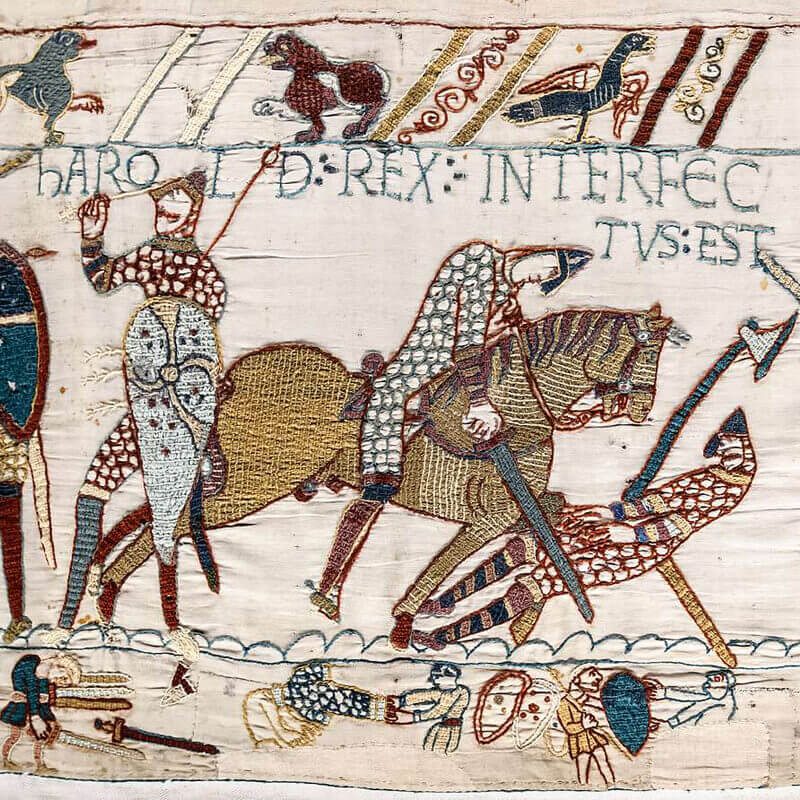
Using a false retreat tactic, the Normans pretended to retreat to break the shield wall and lure English troops off the hill. The tactic worked, as many Anglo-Saxon soldiers chased after the Normans, breaking the shield wall and opening up Harold’s forces making them vulnerable to attack. William rallied his troops and many English soldiers were slaughtered. According to Norman sources such as the Bayeux Tapestry, Harold was killed by Norman swords and an arrow to the eye. After nine hours of fighting, which was unusually long and bloody by medieval standards, King Harold Godwinson was killed and his forces defeated.
The battle changed the course of English and European history. It led to the establishment of a foreign aristocracy in England and influenced the political and ecclesiastical institutions of Christendom. William built Battle Abbey in 1070 to fulfil a vow he made after the battle. The high altar of the abbey’s church was placed on the spot where Harold Godwinson was slain, but the location of Harold’s body is unknown.
William the Conqueror
After his victory at the Battle of Hastings, William moved quickly and marched to London, overcoming local resistance, and was crowned at Westminster Abbey on Christmas Day in 1066. William took the throne as King William I, ushering in a new era of Norman domination and ending the Anglo-Saxon phase of English history.
Now with a vast empire at his disposal, William made arrangements for England and its governance before returning back to Normandy. He immediately introduced the Norman practice of building castles to protect his news lands and to confirm to the Anglo-Saxons that they were a defeated people. He replaced the English aristocracy, upper clergy, and administrative officers with Normans. The Norman church flourished under his reign as he promoted monastic reform by importing Norman monks and abbots.
By early 1067, William was confident enough to return to Normandy leaving two joint regents (including his half-brother Odo, Bishop of Bayeux, who later commissioned the Bayeux Tapestry) behind to administer the kingdom.
The Harrying of the North
However, William’s position was challenged as a number of rebellions were launched against his kingship, forcing him to return in December 1067 to deal with unrest. Those who opposed William and Norman rule, particularly in the north, were slaughtered. The rebellions reached their peak in the winter of 1069–1070 when William resorted to extreme violent measures, and would carry out what would become known as ‘The Harrying of the North’.
The Harrying of the North was a series of military campaigns waged by William to subjugate Northern England, where the presence of the last Wessex claimant, Edgar Ætheling, had encouraged Anglo-Saxon Northumbrian, Anglo-Scandinavian and Danish rebellions. Edgar Ætheling was probably born in Hungary, where his father Edward the Exile, son of King Edmund Ironside, had spent most of his life in exile in the Kingdom of Hungary following the death of his father and the conquest of England by the Danish king Cnut 1016. Edgar was the last male member of the royal house of Cerdic of Wessex, and was elected King of England by the Witan in 1066 but was never crowned.
William and his army’s brutal slaughter and pillaging of Northumbria was so severe, it is thought to have been devastating to the extent that 100,000 people starved to death. William used scorched earth tactics to starve out the rebels, including burning crops, herds and food, which led to a famine. People ate animals, including dogs, cats and horses, and some even ate other people. Many Anglo-Saxons became refugees and fled and settled in other parts of the country, including southern Scotland. The campaign left large areas of Yorkshire and northern England in ruins, with many manors losing more than half of their wealth and population.
Conquest
To secure England’s frontiers, William invaded Scotland in 1072 and Wales in 1081, creating defensive ‘marcher’ counties along the Scottish and Welsh borders, guarded by castles and marcher lords, who were nobles appointed by the king of England to guard the marcher borders.
Sometime in the 1070s, William ordered his half-brother, Bishop Odo, to commission the creation of The Bayeux Tapestry. This masterpiece of 11th-century Romanesque art tells the story of the events surrounding the conquest of England by William. The original tapestry still survives and is on display at the Bayeux Museum in France, and a Victorian replica is on display at Reading Museum in England.
Domesday Book
In the latter years of his reign, William ordered a survey to be made of all land holdings in England, and commissioned the Domesday survey in 1085, which was completed the following year. After the conquest huge amounts of land in England changed hands, and the Domesday survey was designed to record and keep track of these changes, such as:
- Land ownership: Who owned the land, how much they owned, and the value of the land
- Land use: How the land was used, including the number of peasants and plough teams working the land
- Resources: The value of livestock, churches, mills, and other economic resources
- Taxation: The value of each estate and the new system of taxation on each estate
- Rights and dues: What rights and dues were owed to the King
- Military resources: The liability of barons to provide military resources to the King
The scope, speed and efficiency of the survey was remarkable for its time and resulted in the two-volume Domesday Book of 1086, one of the greatest administrative accomplishments of the Middle Ages, which still exists today. Along with the Magna Carta, it is one of England’s most iconic documents.
The Domesday Book also revealed that bout 10 per cent of the people were enslaved, and by the middle of the 12th century, the institution of slavery as it had existed prior to the Norman conquest had fully disappeared.
The greatest change introduced after the Norman conquest was the introduction of the feudal system and new tax system. Norman feudalism was different from the Anglo-Saxon system in one important way; the King owned all of the land. The creation of the Domesday Book allowed William to decide who to lease the land to. He rewarded his closest supporters with large areas of land to manage on his behalf, and his new system of taxation allowed him to raise more money from all landholders quickly.
Legacy
William left England towards the end of 1086 and spent the remainder of his life in Normandy. Before his death, he divided his Anglo-Norman kingdom between his sons. Normandy went to his eldest son Robert Curthose, William Rufus was to succeed him as King of England, and his third remaining son, Henry (the future Henry I), was left with wealth but no lands.
William the Conqueror’s Norman conquest of England was unlike anything else in our country’s history, leaving a lasting legacy that transformed the country forever. This included the establishment of the Anglo-Norman kingdom, Norman architecture, castles, the Domesday Book, and introduced the system of surnames. The way we name ourselves comes from the Normans because they introduced the system of surnames to show people’s occupations or where they had migrated from. The conquest also abolished slavery over several generations, had a huge impact on our laws, land ownership and system of government which is still felt today.
The Normans also introduced a new language, a dialect of Old French, although for some time only the ruling class spoke and understood it, whereas lower classes continued to speak Old English. Over time Old English and Old French came together to form a single language, giving us the language we speak today, and the separation between ‘higher’ words of French origin (e.g. commence) and ‘common’ words of English origin (e.g. begin) still remain. The Saxon/Norman divide can still be seen today. Despite everyone’s good intentions, we remain a nation of two halves, split by class and hardening North-South attitudes, from the newspapers we read and the vocabulary we use, to the difference in education institutions, the availability of work, and government funding for economic infrastructure.
Did you enjoy this post?
I hope you found this post useful. I put a great deal of time and effort in to building, maintaining and populating the website. If you like, you could say a small thank you by buying me a coffee. You don't have to, but it would be nice :)
Buy me a coffee
Stay up to Date
Follow me on my journey and get notified whenever a new post is published by following Kings & Castles on Facebook.
Follow MeExplore The Map
Discover the hundreds of castles, churches, monasteries, cathedrals and other historic locations that I've personally visited across England and Wales. Search by location, explore nearby sites and plan your next historical adventure.
Share: