The Legend of King Arthur
The Legend of King Arthur is one of the most famous stories in British history and literature. It tells of a heroic king who united Britain, defended his kingdom against its enemies and gathered a remarkable group of knights. His story has developed over many centuries, blending possible historical events with mythology, folklore and medieval romance.
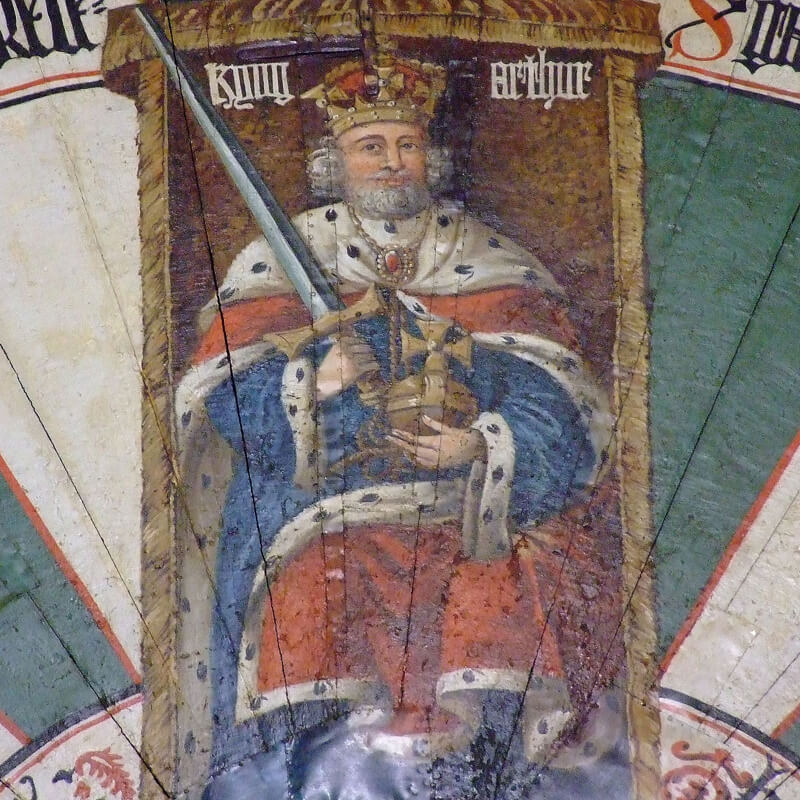
The Origins of Arthur
The earliest references to Arthur appear in medieval Welsh and British traditions. One important early source is the Historia Brittonum, traditionally associated with the 9th-century writer Nennius. It describes Arthur as a military leader who fought against invading Anglo-Saxons rather than as a crowned king.
Another important source is the Welsh Annales Cambriae, which records a battle at Badon associated with Arthur and a later battle at Camlann, where Arthur supposedly died. However, these records were written centuries after the period in which Arthur is believed to have lived, making it difficult to separate historical fact from legend.
Some historians have suggested that Arthur may have been based on a 5th- or 6th-century British warrior or military leader who fought against the Anglo-Saxons. Others believe that he may be entirely legendary. There is currently no reliable archaeological evidence proving that a historical King Arthur existed.
Geoffrey of Monmouth
Arthur’s legend became much more influential in the 12th century through the work of Geoffrey of Monmouth. His Historia Regum Britanniae (History of the Kings of Britain), written around 1136, presented Arthur as a powerful king of Britain.
Geoffrey introduced or developed many elements that became central to the Arthurian tradition. Arthur was portrayed as the son of Uther Pendragon and the husband of Guinevere. He became king after successfully drawing a magical sword from a stone and went on to conquer large parts of Europe.
Geoffrey also introduced Merlin, a wise magician and adviser who helped guide Arthur’s destiny. Although Geoffrey’s work contains many legendary elements, it had an enormous influence on later writers.
Camelot and the Knights of the Round Table
Later medieval writers expanded Arthur’s story further. Arthur became associated with Camelot, his magnificent royal court, although the exact location of Camelot has never been established.
The Knights of the Round Table became another central feature of the legend. The Round Table symbolised equality among Arthur’s greatest knights because no knight had a position of superiority over the others.
Famous knights included Sir Lancelot, Sir Gawain, Sir Galahad, Sir Percival and Sir Tristan. Their adventures involved battles, quests and tests of courage and honour.
One of the most important stories was the Quest for the Holy Grail, the sacred object believed to have been used by Jesus at the Last Supper. The quest represented the knights’ search for spiritual perfection. Sir Galahad, regarded as the purest of Arthur’s knights, was ultimately considered worthy of finding the Grail.
Merlin, Guinevere and Lancelot
Arthurian legend also contains powerful stories of love and betrayal. Queen Guinevere, Arthur’s wife, falls in love with Sir Lancelot in many versions of the story. Their relationship threatens the unity of the Round Table.
The legend often presents Lancelot as Arthur’s greatest knight but also as a tragic figure whose love for Guinevere contributes to the destruction of Arthur’s kingdom. The conflict demonstrates one of the central themes of Arthurian literature: the tension between personal desire and duty.
The Fall of Arthur
Arthur’s kingdom eventually collapses because of betrayal and internal conflict. In many versions, Arthur’s nephew or illegitimate son, Mordred, rebels against him.
Arthur and Mordred meet at the Battle of Camlann, where both are fatally wounded. Arthur is carried away to the mysterious island of Avalon, where he is expected either to die or to remain until Britain needs him again.
This gave rise to the famous idea that Arthur is “the Once and Future King.” According to the legend, he may return to Britain in its hour of greatest need.
Arthur’s Legacy
The legend of King Arthur has survived because it combines adventure with universal themes such as loyalty, courage, leadership, love, betrayal and the struggle between good and evil. Writers and artists have repeatedly adapted the story for new generations.
From medieval romances to modern novels, films and television programmes, Arthur remains one of the most recognisable figures of British legend. Whether he was based on a real warrior or created entirely through folklore, his story has become an important part of Britain’s cultural heritage.
The enduring appeal of King Arthur lies not simply in the sword, the magic or the knights, but in the ideal of a just and heroic ruler whose kingdom represents a golden age of courage, honour and unity.
Did you enjoy this post?
I hope you found this post useful. I put a great deal of time and effort in to building, maintaining and populating the website. If you like, you could say a small thank you by buying me a coffee. You don't have to, but it would be nice :)
Buy me a coffee
Stay up to Date
Follow me on my journey and get notified whenever a new post is published by following Kings & Castles on Facebook.
Follow MeExplore The Map
Discover the hundreds of castles, churches, monasteries, cathedrals and other historic locations that I've personally visited across England and Wales. Search by location, explore nearby sites and plan your next historical adventure.
Share: