What Was The Danelaw?
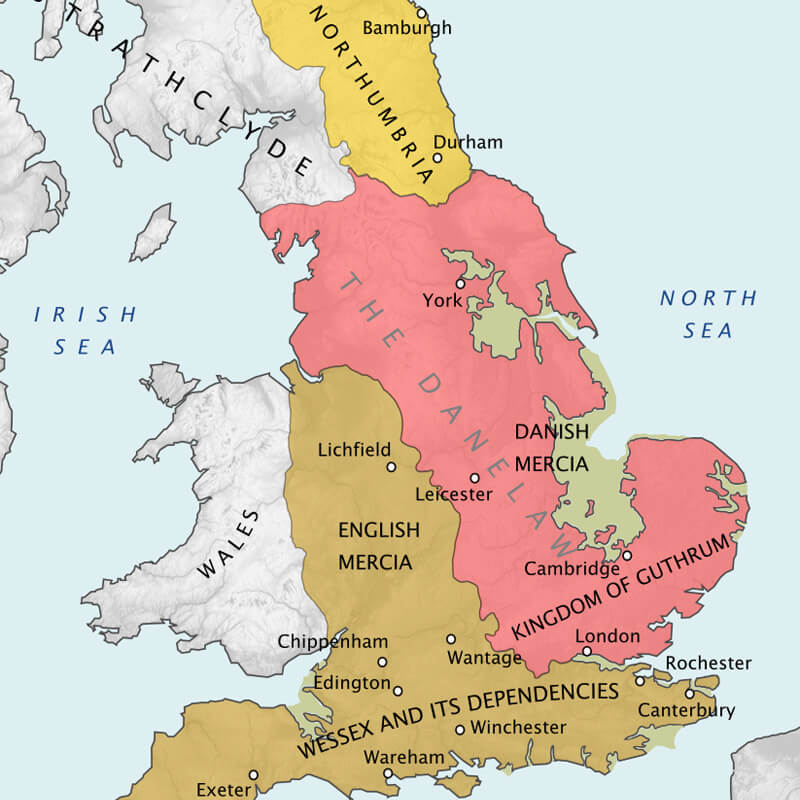
The Danelaw was the area of England where Danish laws were in effect from the late 9th century until the Norse king Eric Bloodaxe, King of Northumbria, was deposed in 954. This huge Viking controlled area of England consisted of 15 shires, with its capital at Jorvik, modern-day York.
Before the Danelaw
The late 8th century and early 9th century was a time of land-grabs, conquest and raiding parties. In Northern Europe, the Vikings had set their sights on the British Isles, keen to embark on successful naval expeditions in search of territory and wealth. They had been raiding the British Isles ever since a group of Norwegian Vikings attacked the famous abbey at Lindisfarne in 793.
The attack on Lindisfarne was the first of many raids which were launched against Britain in the following centuries, with Norse Vikings attacking areas in Scotland, the Shetlands, Orkneys, Hebrides, Isle of Man and Ireland. The Danes however, focused their attention on the Anglo-Saxon kingdoms in England, although it wasn’t actually England just yet.
The Great Heathen Army
In 865, a sizeable combined force of Danish Viking invaders called the Great Heathen Army, landed in East Anglia with the ambition of conquering the Anglo-Saxon kingdoms of Wessex, East Anglia, Northumbria, and Mercia. Up until this point Britain had only seen waves of Viking assaults on the coastlines of the British Isles, but this was something different, and on a much larger scale. Previous invasions were for looting, but this one led to semi-permanent settlement and the creation of a Viking kingdom in Anglo-Saxon England.
This invasion was in response to the death of legendary Viking warrior Ragnar Lothbrok at the hands of King Ælla of Northumbria (he threw him in a pit of poisonous snakes). The army was a coalition of Danish Viking warriors led by the sons of Ragnar, including brothers Halfdan and Ivar the Boneless, and its sole purpose was revenge and complete domination of England. They took over Northumbria, East Anglia, parts of Mercia, and made York their capital, which they called Jorvik. They continued to press southwards and to the west and gained more territory in parts of Mercia. Finally, in 870 the Danes attacked the only remaining independent Anglo-Saxon kingdom, Wessex, whose forces were commanded by King Æthelred and his younger brother Alfred, who would later become known as Alfred the Great.
The Great Summer Army
In 871, the Viking warlord Guthrum came to England as leader of the Great Summer Army, which joined forces with part of the Great Heathen Army. Guthrum had his sights set on the territory belonging to King Alfred the Great, focusing his attention on acquiring Wessex for himself.
Alfred and his West Saxon army were the only remaining resistance to the Vikings in southern England, but they gained an early victory at the battle of Ashdown in 871. However, only defeats and some minor victories would follow. With his army on the verge of collapse, Alfred responded to many attacks by paying off the Danes for a promise of peace.
In early 878, Guthrum and his Danish army seized Chippenham in Wiltshire, devastated Wessex, put the people to flight, and the West Saxons were reduced to hit and run attacks seizing provisions when they could. With only a small army of followers, King Alfred withdrew to the Somerset marshes and was forced into hiding.
The Danes now controlled East Anglia, Northumbria and Mercia, with only Wessex continuing to resist. A resourceful fighter, Alfred reassessed his strategy and adopted the Danes’ tactics by building a fortified base in the Somerset marshes and summoning an army of men from Wiltshire, Somerset and part of Hampshire to pursue guerrilla warfare against the Danes. In May 878, Alfred’s army defeated the Danes at the battle of Edington, and Wessex emerged as the dominant kingdom in England.
The Establishment of Danelaw
Alfred demanded, as a term of the surrender, that Guthrum become baptised as a Christian, which Guthrum agreed to do, with Alfred acting as his godfather. It was around this time that agreements between Alfred and Guthrum formed the basis for what would become the Danelaw. Almost a decade after the Battle of Edington, the Treaty of Alfred and Guthrum was formalised, which established the boundaries of the Danelaw and allowed for Danish self-rule in the region. This treaty cemented kingdom boundaries and set in place regulations to promote peaceful interactions and trade agreements between the Vikings and the Anglo-Saxon kingdoms.
Guthrum left the boundaries uncontested and turned his attention to East Anglia, where he settled and created the Kingdom of Guthrum, making himself King, where he remained until his death.
The term ‘Danelaw’ comes from the Old English words Dena lagu, meaning ‘areas under Danish law’. The English kings allowed the Danes to keep their own laws in exchange for their loyalty, meaning that the Danes ruled their own large territory according to their own laws, where they could exercise their rights according to their own legal frameworks, unlike those living under English law.
How Big Was the Danelaw?
Danelaw gave the Vikings control of all the land in England north and east of an imaginary line running from east London to Chester. The south and west of England was all under King Alfred’s control. The Danelaw was at its pinnacle an all-encompassing territory which spread from London to East Anglia, through the Midlands and up to the north of England.
The Danelaw was vast, and consisted of 15 shires, including Leicester, Nottingham, Derby, Lincoln, York, Essex, Cambridge, Suffolk, Northampton, Norfolk, Huntingdon, Bedford, Middlesex, Hertford and Buckinghamshire. Within this area was something known as ‘the Five Boroughs’. The five boroughs of the Danelaw were the five most important fortified towns, or burhs, existing under Danish law and customs located in the territory of Danish Mercia. They served as important territory and bases for political Danish power. These five boroughs were Leicester, Nottingham, Derby, Stamford and Lincoln, each independently ruled with leaders that had the power to govern as they saw fit. Jorvik (York) remained the capital of the Danelaw, and the leader of each borough still had to report to and obey the commands of the Viking rulers in Jorvik.
The Effects of Danelaw
The treaty for the Danelaw also outlined terms to try and limit discrimination and violence towards both Viking or Anglo-Saxon inhabitants, regardless of which kingdom they resided in. Of course this didn’t stop the violence completely, but the division of land allowed for a time of relative peace, with Saxons and Danes mixing together and often trading peacefully. Nearly half of the population of the Danelaw were ‘sokemen’, which were a class of peasants between free peasants and serfs. Like serfs, sokemen lived on their lord’s land and owed them service. Unlike serfs, sokemen were free and owned and paid taxes on their land and could buy and sell their land.
For many ordinary people living in the Danelaw, life didn’t really change. Like those who lived in the rest of Anglo-Saxon England, they lived with their families in villages, built farms, grew crops, raised livestock and made goods to trade with others. They became part of English life, but with Danish laws.
The Vikings and Anglo-Saxons were able to communicate with each other surprising well, as both the Old Norse and Old English languages were closely related Germanic languages. This is because the Anglo-Saxons originally came from Germany and Denmark, and those who remained on the continent during their invasion of England in the 5th century eventually evolved into the Danish Vikings some 400 years later. Vikings and Anglo-Saxons within the Danelaw even intermarried and had Anglo-Scandinavian children. One example of a mixed Anglo-Scandinavian union was the English king Harold Godwinson, who’s mother was Danish.
The Downfall of Danelaw
Alfred the Great died in 899 and his son Edward the Elder took the throne. Together, Edward and his sister Æthelflæd, Lady of the Mercians, and her husband Æthelred, Lord of the Mercians, attempted to reconquere the Danish territories. They launched a series of military campaigns against the Danes, which brought large parts of England back under Anglo-Saxon control, both in the Midlands and to the north. The brother and sister alliance of Æthelflæd and Edward continued to drive the Danes out of central and southern England. Derby was captured in 917, and Leicester surrendered peacefully in 918. Some jarls (Danish lords) who swore allegiance to them were allowed to keep their lands. The Danelaw slowly became smaller over time, and by 918 the southern Danelaw was back under Anglo-Saxon control.
The Vikings at Jorvik (York) gave their loyalty to Æthelflæd in 918, however, she died in June of the same year and Edward took control of Mercia. Edward died in 924 and his son Æthelstan took the throne. In 927 Æthelstan took the Viking kingdom of Jorvik from the Danes and forced the submission of the northern kings, who all agreed to acknowledge Æthelstan as their overlord.
Æthelstan’s dominion was significantly challenged in 937 when Constantine, King of the Scots, in alliance with the Welsh and Danes of Strathclyde and Dublin joined forces and invaded England. They were defeated by Æthelstan and his forces at the Battle of Brunanburh, thus, he retained control over most of what is now England, except for the Celtic kingdom of Cornwall. Viking power collapsed in the northern Danelaw after the Battle of Brunanburh and Æthelstan became the first king to rule all the Anglo-Saxon people. Referred to as king of all the other kings of Britain, he established himself as overlord of Britain, King of the English, with very few areas untouched by his power.
Æthelstan died in 939 at the height of his powers and was succeeded by his half-brother Edmund the Magnificent. Edmund did his best to maintain the territorial, diplomatic and administrative legacy left behind by Æthelstan. On Æthelstan’s death, Olaf Guthfrithson, the Norse king of Dublin, and other Norwegian kings occupied Northumbria and raided the Midlands. Despite attempts to restore Danish control within the Danelaw, by 942 King Edmund had recovered the five boroughs, recaptured areas of northern England, regained control of Mercia and extended his rule as far as southern Scotland.
The End of Danelaw
Edmund died in 946 and was succeeded by his younger brother Eadred, who continued defending the country against Viking attack. In 947 King Eadred reinforced his control of Northumbria, and the Northumbrians acknowledged his overlordship, but it soon fell back into the hands of the Viking ruler and former King of Norway, Eric Bloodaxe, son of Norwegian king Harald Fairhair. Eric Bloodaxe was a tyrannical ruler who oppressed his subjects which made him very unpopular. Eventually, the people of the Danelaw and other Viking leaders came together to force him out of Northumbria. Eric Bloodaxe was driven out of the Danelaw and killed in 954, making him the last of the Viking kings of York. The Northumbrians then resumed their allegiance to Eadred, who gained control and ruled Northumbria for the remainder of his reign.
The death of Eric Bloodaxe in 954 is generally considered to be the end of the Danelaw as the country entered a period of relative peace with the Vikings until the reign of Æthelred the Unready. The death of Eric Bloodaxe marked the end of the prospect of a northern Viking kingdom stretching from York to Dublin and the Isles. The Danelaw had become small and insignificant, and had lost all of its power and influence.
After the Danelaw
While the Danelaw may have come to an end nearly a century after it first was established, it wasn’t the end of Vikings in England, with other major invasions and conflicts occurring throughout the 11th century. Æthelred the Unready reigned twice, but he was an incompetent king whose terrible decision making led to England being ruled by Viking leaders for several decades. His first reign was from 978 until he lost the English throne to Viking leader Sweyn Forkbeard in 1013. However, Sweyn died shortly after, ruling England for just five weeks until 3rd February 1014. Æthelred then ruled for a second time until his death in 1016. Vikings then ruled England from 1016, starting with Cnut the Great, until the death of Harthacnut in 1042.
Edward the Confessor, the son of Æthelred the Unready, then became the new ruler of England until 1066. After Edward’s death there was a succession crisis between Harold Godwinson, a powerful Anglo-Saxon noble, Harald Hardrada of Norway and William of Normandy. Harold Godwinson had himself crowned, and as a result Harald Hardrada and William of Normandy both invaded England in 1066. Harald Hardrada invaded first, landing in the north of England, where he was defeated by Harold Godwinson at the Battle of Stamford Bridge. This was the last Viking invasion of England and was seen as the end of the Viking Age. William of Normandy then landed on the south coast of England, where he defeated Harold Godwinson at the Battle of Hastings and became the first Norman king of England, now more commonly known as William the Conqueror.
The Legacy of Danelaw
Although small, insignificant and powerless, the Danelaw remained part of England as a geographical area until the 12th century. The Danelaw may not have lasted forever, but the establishment of Danelaw and Viking rule in the north and east of England left a lasting legacy which can still be seen today. It had an impact on everything from language and place names to traditions and cultural customs.
Place names ending with -thwaite (meaning woodland clearing) such as Slaithwaite, or -howe or -by (meaning farmstead or village) such as Grimsby or Whitby, or -thorp (meaning hamlet) such as Scunthorpe, all have Old Norse origins. There are also many places with the name ‘kirk’ in the north of England, which is also derived from Old Norse and means ‘church settlement’.
Four of the five boroughs which were part of the Danelaw became county towns. Leicestershire, Lincolnshire, Nottinghamshire and Derbyshire all became English counties named after the Danelaw boroughs. Stamford was the only borough that failed to gain such status, perhaps because it failed to reach the same level of prominence as the others.
Vikings, who spoke Old Norse, and Anglo-Saxons, who spoke Old English, could understand each other to a significant degree because both languages were closely related Germanic languages, meaning they shared many vocabulary similarities and grammatical structures, allowing for basic communication. This meant that Old Norse words began to integrate into Old English, and many still survive today. For example; give, take, get, husband, sister, odd, hale, ugly, law, and sky are all English words with Old Norse origins. Our third-person plural pronouns, ‘they’, ‘them’ and ‘their’, were also imported into the English language from Scandinavia.
While the Danelaw and the overall Viking Age of Britain did eventually come to an end, there is no doubt that the arrival of these Scandinavian warriors changed the course of British history.
Did you enjoy this post?
I hope you found this post useful. I put a great deal of time and effort in to building, maintaining and populating the website. If you like, you could say a small thank you by buying me a coffee. You don't have to, but it would be nice :)
Buy me a coffee
Stay up to Date
Follow me on my journey and get notified whenever a new post is published by following Kings & Castles on Facebook.
Follow MeExplore The Map
Discover the hundreds of castles, churches, monasteries, cathedrals and other historic locations that I've personally visited across England and Wales. Search by location, explore nearby sites and plan your next historical adventure.
Share: