The Stuarts
The Stuarts had a bloody and disastrous reign which lasted for over 100 years in England. The House of Stuart brought about the union of the Scottish and English crowns when James I, the son of Mary, Queen of Scots ascended to the throne after the death of his cousin, Elizabeth I. The reign of the Stuarts also saw the only English monarch in history to be executed, and the only time in history for England to become a republic due to having no monarch.
Origins
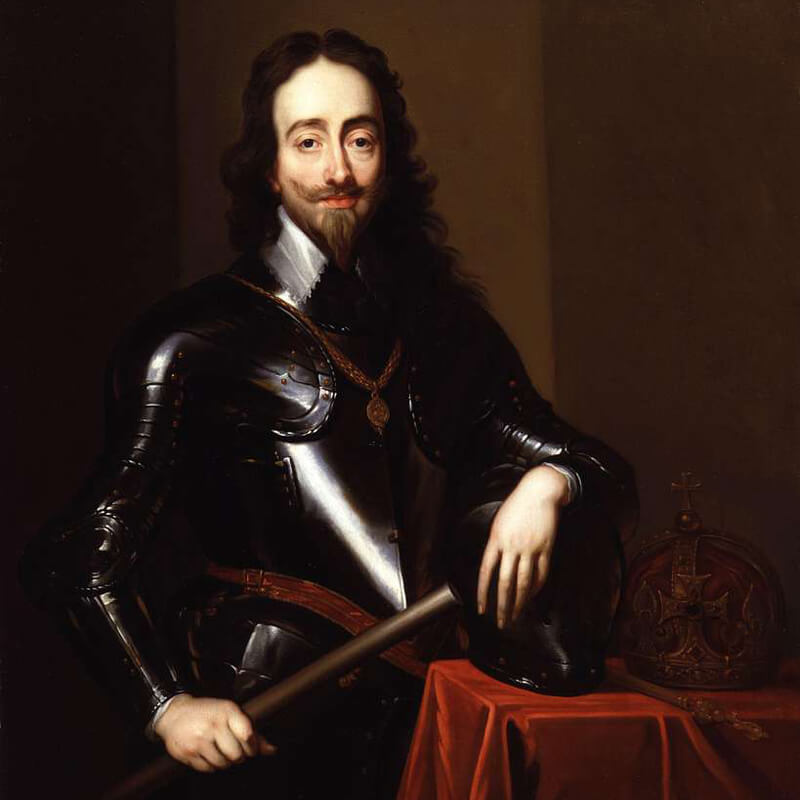
The House of Stuart, originally spelled Stewart, was a royal house of Scotland, England, Ireland and later Great Britain. The house was founded in the 14th century, and the family name comes from the office of High Steward of Scotland, which was a title held by the family from the 12th century. The name Stewart would become established as a family name a couple of generations later, and Mary, Queen of Scots would later adopted the French spelling of the name Stuart. The first monarch of the Stewart line was Robert II, King of Scots, whose descendants were kings and queens in Scotland from 1371, and of England, Ireland and Great Britain from 1603 until 1714. The House of Stuart gave us seven monarchs.
- James I (1603-1625)
- Charles I (1625-1649)
- Charles II (1660-1685)
- James II (1685-1688)
- Mary II (1689-1694)
- William III (1689-1702)
- Anne (1702-1714)
During the Stuart’s reign of both England and Scotland as a union, the Stuart period saw a flourishing Court culture but also much upheaval, instability and intense religious and political conflicts, which shifted power from the monarchy to Parliament.
James I
When Elizabeth I, the last Tudor monarch died in 1603 without an heir, the throne was passed on to the next nearest Protestant relation, which was her cousin, James VI of Scotland. When the crown passed to him he then became James VI of Scotland and James I of England and Ireland. Being a Protestant helped back up James’ ascension to the English throne as Catholics were mostly despised at this point and England didn’t want another Catholic monarch. James was the son of Mary, Queen of Scots, who was the next in line to the throne after Elizabeth. However, Elizabeth had Mary executed for a number of reasons, including being a devout Catholic and a threat to her reign, and for being involved in several plots to overthrow her. It was during the reign of James I that the Mayflower set sail, carrying the Pilgrims from England to the New World in 1620.
Charles I
When James I died in 1625, his son Charles I became King and his reign was a disaster. He had Catholic religious views, believed in the divine right of kings, ignored his parliament and their advice and policies, levied heavy taxes without parliamentary consent and was viewed as a tyrannical absolute monarch. Eventually, parliament had had enough and turned on him, forcing him to flee into hiding. This was the start of the English Civil War between the Parliamentarian forces (Roundheads) led by Oliver Cromwell and the Royalist forces (Cavaliers) led by the King. From 1642, Charles I and his Royalist forces fought against the Parliamentarians for many years until he was finally defeated in 1645, captured, jailed and tried for treason, he was then executed in 1649.
Oliver Cromwell and the Commonwealth
At the time of Charles I’s execution, to avoid the automatic succession of his son, Charles II, who went into exile, an Act was passed forbidding the proclaiming of another monarch, and the office of King was formally abolished. The country now entered a period of 11 years without a monarch, this was called the Interregnum and the establishment of the Commonwealth of England which lasted from 1649 until 1660. Oliver Cromwell, the leader of the Parliamentarians who defeated Charles I, was given the title Lord Protector of the Commonwealth of England, Scotland and Ireland. He governed the country until his death in 1658, after which his son, Richard Cromwell took over to become Lord Protector. This didn’t last long however, as he lacked authority and basically made a huge mess of things, and he formally renounced power just nine months after succeeding.
Charles II
Shortly after, in 1660, it was decided that the monarchy should be restored. This brought about The Restoration of the Stuart monarchy when Charles II returned from exile in continental Europe. The Great Plague of London came just five years into his rule followed by the Great Fire of London in the following year. He ruled for 25 years but spent most of his reign handling religious unrest until he died in 1685.
James II
When Charles II died in 1685, his elder brother James became the next Stuart king. He became James VII of Scotland and James II of England and Ireland. However, he was a very unpopular king because of his support of the Catholic religion and reigned for just under four years until he was deposed in the Glorious Revolution of 1688 in favour of his daughter, Mary. Mary and her husband, William of Orange, were invited to invade England and overthrow James. William’s reputation as a staunch Protestant enabled him and his wife to take power. The invasion/revolution was successful and relatively bloodless. James II was the last Catholic monarch of England, Scotland and Ireland.
Mary II and William III
Mary was the eldest daughter of James II and the niece of Charles II. When her father was deposed in December 1688, she succeeded to the throne shortly after in 1689 as Mary II, Queen of England, Scotland, and Ireland. She co-reigned with her Dutch husband, William of Orange, who became William III, King of England, Scotland, and Ireland. Mary mostly deferred to her husband who was a renowned military leader, however, whenever William was engaged in military campaigns abroad she did act alone and proved herself to be a powerful, firm, and effective ruler. Their joint reign ended when Mary died in 1694, however, William would continue to rule the country as its sole ruler and monarch until his death. In 1696 the Jacobites, a faction loyal to the deposed James II, plotted unsuccessfully to assassinate William and restore the deposed James II to the throne. William and Mary had no children, so when he died in 1702 the crown went to Mary’s sister, his sister-in-law, Anne.
Just before William died in 1702, the Act of Settlement was passed in 1701, reinforcing the Bill of Rights agreed by William and Mary in 1689. The main aim of this legislation was to ensure a Protestant succession to the English throne. In 1707, as a result of the Act of Union, this Act was extended to Scotland.
Queen Anne
Anne succeeded to the throne in 1702 and reigned for 12 years. She became the first monarch of the Kingdom of Great Britain and Ireland after the Acts of Union which led to the creation of the united kingdoms of England, Scotland and Wales to be called “Great Britain”. Although she achieved the union of England and Scotland in 1707 and brought the War of the Spanish Succession to a conclusion, unfortunately, Queen Anne is often forgotten about. She was shy, conscientious, stout, and short-sighted. She lacked glamour and charisma, presided over a dreary court and was by far the least colourful of the Stuart dynasty.
Anne was plagued by poor health throughout her life, and from her thirties she grew increasingly ill and obese. Despite around 17 or 18 pregnancies, she died in 1714 aged 49 without any surviving children and was the last monarch of the House of Stuart. Under the Act of Settlement 1701, which excluded all Catholics from succeeding the throne, William and Mary’s cousins, the Protestant Hanoverians, were placed next in line to the throne after Anne, and she was succeeded by her second cousin George I of the House of Hanover.
Did you enjoy this post?
I hope you found this post useful. I put a great deal of time and effort in to building, maintaining and populating the website. If you like, you could say a small thank you by buying me a coffee. You don't have to, but it would be nice :)
Buy me a coffee
Stay up to Date
Follow me on my journey and get notified whenever a new post is published by following Kings & Castles on Facebook.
Follow MeExplore The Map
Discover the hundreds of castles, churches, monasteries, cathedrals and other historic locations that I've personally visited across England and Wales. Search by location, explore nearby sites and plan your next historical adventure.
Share: