The Tudors
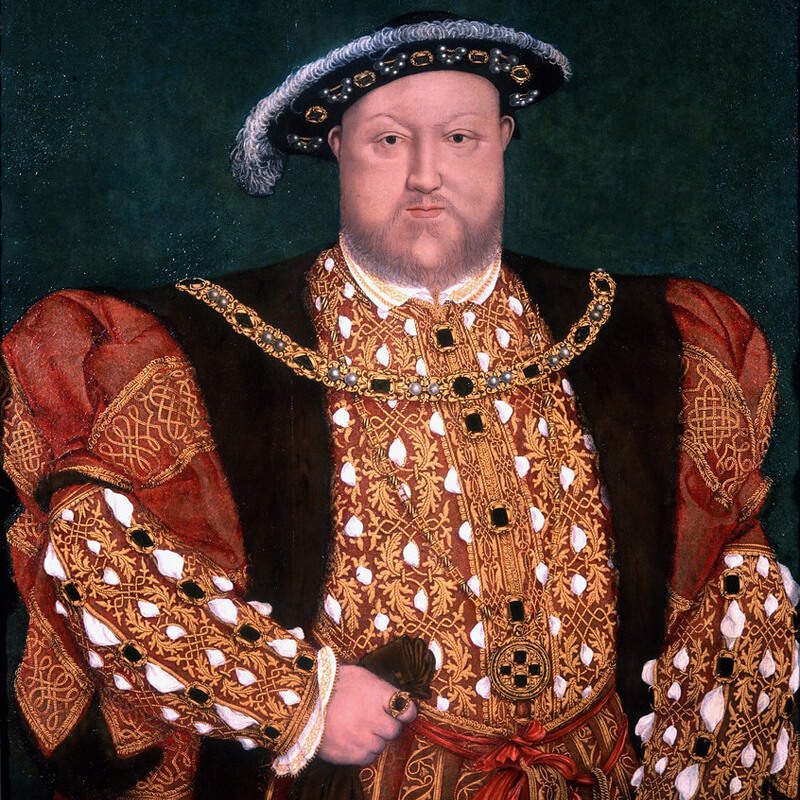
Henry Tudor, who became Henry VII, brought an end to the Wars of the Roses in 1485 and introduced us to a name that would never be forgotten. The House of Tudor is probably the most well-known royal dynasty in British history, and from this house came arguably our most famous and most talked about king, Henry VIII.
Origins
The Tudors descended from King Edward III on Henry VII‘s mother’s side, from one of the illegitimate children of John of Gaunt, the third surviving son of Edward III. The Tudors ruled for 118 eventful years from 1485 until 1603. They gave us five monarchs, from Henry VII until the death of his childless granddaughter, Queen Elizabeth I.
- Henry VII (1485-1509)
- Henry VIII (1509-1547)
- Edward VI (1547-1553)
- Mary I (1553-1558)
- Elizabeth I (1558-1603)
Henry VII
Henry VII was of Welsh and English origin and a nephew of the last Lancastrian king, Henry VI, but only by marriage and not through Henry V‘s bloodline. Edward III was the most recent king that he could lay claim of descent from, therefore his claim to the throne was rather weak. His father was Edmund Tudor, 1st Earl of Richmond, a half-brother of Henry VI and a member of the noble Welsh Tudors of Penmynydd family. After defeating Richard III in battle in 1485 he succeeded in ending the Wars of the Roses between the houses of Lancaster and York and took the throne. He was the last king of England to win his throne on the field of battle. He then married Elizabeth of York, daughter of Edward IV, bringing the two houses together to found the highly successful House of Tudor and became the first Tudor king. Henry was a successful king, restoring power and stability to the English monarchy following the civil war. He reigned for 24 years and upon his death the crown passed to his son, Henry VIII.
Henry VIII
Henry VIII became the second Tudor king in 1509. He did start out as a good monarch, sensible, reasonable and fairly pleasant, but as we all know, eventually his behaviour changed drastically. He became irritable, difficult, intolerant, violent and tyrannical. Henry married six times, he divorced two of his wives and had another two beheaded. His divorce from his first wife, Catherine of Aragon, resulted in the separation of the Church of England from the Catholic Church and the pope, which would become known as the English Reformation and the begin of the conversion from Catholicism to Protestantism in England. The English Reformation also resulted in the dissolution of the monasteries in England, Wales, and Ireland. Henry’s health deteriorated over many years and he died in 1547 aged 55 and was survived by three legitimate children; Edward, Mary and Elizabeth, all of all of whom would become monarchs of England themselves.
Edward VI
Henry VIII died in 1547 and was succeeded by his 9 years old son Edward, who became Edward VI. He was the only surviving son of Henry VIII by his third wife, Jane Seymour, and was the first English monarch to be raised as a Protestant. He took great interest in religious matters and continued his father’s work of the English Reformation and the transformation of the Church of England. During his reign the realm was governed by a regency council because he never reached maturity. Six years after his ascension to the throne, in 1553 aged just 15, he fell terminally ill. Edward and his council drew up a “Devise for the Succession” to prevent the country’s return to Catholicism. Edward named his Protestant first cousin once removed, Lady Jane Grey, as his heir, excluding his half-sisters, Mary and Elizabeth.
Lady Jane Grey
Edward VI died on 6th July 1553, and Lady Jane Grey was recognised as the next monarch of England a few days later, however, she would never be physically crowned as Queen. Following Edward’s death, the decision to allow Jane to sit on the throne of England was heavily disputed, especially by Mary. Support for Mary grew quickly and most of Jane’s supporters abandoned her. Jane was deposed by Mary just nine days after becoming queen, and she has become known to history as the “Nine Days’ Queen”. Jane was imprisoned in the Tower of London and executed for treason in the following year in 1554 aged around 16 or 17.
Mary I
Mary became Queen of England in July 1553. She was a fierce Catholic and reversed Edward’s Protestant reforms during her reign, which is what he correctly guessed she would do and the reason why he excluded her ascension to the throne. Mary’s strong Catholic beliefs came from her mother and first wife of Henry VIII, Catherine of Aragon. She even had her half-sister Elizabeth imprisoned for nearly a year on suspicion of supporting Protestant rebels. Mary would only reign for 5 years, but during her short reign she had over 280 protestants burned at the stake, giving her the name “Bloody Mary”. Mary died childless in 1558 and her half-sister Elizabeth would be her lawful successor.
Elizabeth I
Elizabeth reigned as Elizabeth I, Queen of England for 45 years until her death in 1603. Elizabeth was the only surviving child of Henry VIII and his second wife Anne Boleyn, who was executed when Elizabeth was two years old. She is arguably one of the most glorious and greatest ruling queens in English history. During her lengthy reign she presided over a period of exploration and great invention, the defeat of the Spanish Armada in 1588, and a secure Church of England was established as well as a compromise between Roman Catholicism and Protestantism. Elizabeth was expected to marry and produce an heir, however, despite numerous courtships, she never did, and because of this she was referred to as the “Virgin Queen”. The American state of Virginia was named in honor of the “Virgin Queen” by Sir Walter Raleigh, a favourite of hers and one of the most famous explorers of the Elizabethan era. It’s impossible to talk about Elizabeth I without talking about Mary, Queen of Scots. Though Elizabeth and Mary were cousins, they never actually met. Elizabeth saw Mary as a threat to her throne. Mary was the great-granddaughter of Henry VII, granddaughter of Henry VIII’s older sister, and next in line to the throne after Henry VIII’s children. Elizabeth also saw her presence as a threat because Mary could become a figure to her Catholic opponents. Elizabeth imprisoned her cousin Mary in England for 19 years. She was involved in several plots to kill and overthrow Elizabeth and start a Catholic uprising, which became Mary’s ultimate undoing. Mary, Queen of Scots, was eventually executed in 1587 after being found guilty of plotting Elizabeth’s assassination. Elizabeth I died without an heir in 1603 and was the last monarch of the House of Tudor. Her lack of an heir would bring about the next dynasty to rule over England; the Stuarts, and rather poetically, the first Stuart monarch would be the son of Mary, Queen of Scots.
Did you enjoy this post?
I hope you found this post useful. I put a great deal of time and effort in to building, maintaining and populating the website. If you like, you could say a small thank you by buying me a coffee. You don't have to, but it would be nice :)
Buy me a coffee
Stay up to Date
Follow me on my journey and get notified whenever a new post is published by following Kings & Castles on Facebook.
Follow MeExplore The Map
Discover the hundreds of castles, churches, monasteries, cathedrals and other historic locations that I've personally visited across England and Wales. Search by location, explore nearby sites and plan your next historical adventure.
Share: