Alfred the Great
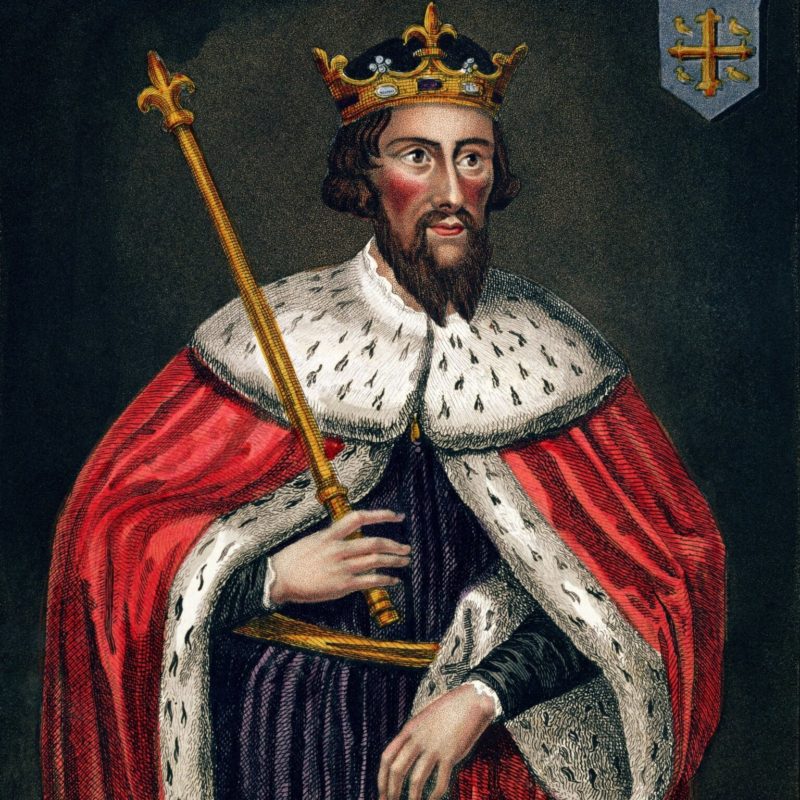
Alfred the Great was King of the West Saxons from 871 to 886, and King of the Anglo-Saxons from 886 until his death in 899. Known as ‘the Great’ for his outstanding accomplishments; he was the first king from the British Isles to call himself the ‘King of the Anglo-Saxons’ and so he is sometimes said to be the first English king. He is also credited with the founding of the very first English navy.
Quick
Facts.
- Born: 849
- Died: 899
- Reign: 871 - 899
- House: House of Wessex
- Predecessor: Æthelred I
- Successor: Edward the Elder
Early Life
Born in 849, Alfred was the youngest son of Æthelwulf, King of Wessex, and his first wife Osburh, who both died when Alfred was young. Alfred had three older brothers; Æthelbald, Æthelberht, and Æthelred, so his succession to the throne did not seem likely. However, all three of his brothers would reign as kings and Alfred would eventually ascend to the throne.
From an early age he discovered a love for books. His mother gave him a book of poetry as a prize for being able to memorise it. Alfred’s dedication to literature would later make him passionate about spreading books throughout the kingdom.
However, the reality during his childhood was not as peaceful as paging through illuminated manuscripts. The British Isles were a fractured place. To the west and north were Celtic, the kingdoms of the Britons who had no love for the Anglo-Saxons, while the seven Anglo-Saxon kingdoms had been the subject of great rivalries, especially between the kingdom of Mercia and Alfred’s own kingdom of Wessex.
To add to the constant rivalries were the increasingly bold Viking raids, which would evolve into a full invasion. In the 840s, these raids became bigger and more frequent, and major battles were fought with significant loss of life. King Æthelwulf and his sons Æthelstan and Æthalbald suffered losses as well as great victories.
The Great Heathen Army
After the short reigns of his three older brothers, Æthelbald, Æthelberht and Æthelred, Alfred was crowned king in 871, but before this could pass, England was invaded by a huge Viking force called The Great Heathen Army.
In 870 the Danes attacked the only remaining independent Anglo-Saxon kingdom, Wessex, whose forces were commanded by Alfred and his older brother, King Æthelred. At the battle of Ashdown in 871, it was a victory for Alfred and his West Saxon army. However, defeats would follow the victory and Alfred’s brother, King Æthelred died shortly afterwards, most likely from battle wounds.
King Alfred
After the death of his brother, Alfred became King of Wessex at the age of 21. By this point he was a strong-minded but highly strung battle veteran at the head of remaining resistance to the Vikings in southern England.
In early 878, the Danes led by King Guthrum, King of East Anglia, seized Chippenham in Wiltshire. They devastated Wessex, put the people to flight, and the West Saxons were reduced to hit and run attacks seizing provisions when they could. With only a small army of followers, King Alfred withdrew to the Somerset marshes and was forced into hiding. The legend of him burning cakes probably comes from this period.
A resourceful fighter, Alfred reassessed his strategy and adopted the Danes’ tactics by building a fortified base in the Somerset marshes and summoning an army of men from Wiltshire, Somerset and part of Hampshire to pursue guerrilla warfare against the Danes. In May 878, Alfred’s army defeated the Danes at the battle of Edington and Wessex emerged as the dominant kingdom in England.
Alfred realised that he could not drive the Danes out of the rest of England, so he made peace with them in the treaty of Wedmore. As part of the peace deal, King Guthrum was converted to Christianity with Alfred as his godfather and many of the Danes returned to East Anglia. In 886, Alfred negotiated a partition treaty with the Danes, in which a border was created along the Roman Watling Street, and northern and eastern England came under the jurisdiction of the Danes, which became an area known as the Danelaw. Alfred therefore gained control of the areas of West Mercia and Kent which had previously been beyond the boundaries of his kingdom of Wessex.
To consolidate alliances with the Mercians against the Danes, Alfred married his daughter, Æthelflæd, to the ealdorman of Mercia and she became Lady of the Mercians. Alfred himself married a Mercian noblewoman called Eahlswith.
The Danish threat remained, so Alfred reorganised the Wessex defences, staring with the organisation his army known as “the fyrd”. Then he started a building programme of well-defended settlements across southern England known as burhs. These burhs were fortified towns, boroughs, or market places, and this is where we get the word ‘borough’ from today; borough comes from the Old English burh, meaning fortress.
Centred round Alfred’s royal palace in Winchester, this network of burhs with extra defences on the main river routes meant that no part of Wessex was more than 20 miles from the refuge of one of these settlements. Together with a new fleet of fast ships built on Alfred’s orders, southern England now had a strong defence against the Danes. It is this fleet of ships that would be the start of what would become the British Royal Navy many centuries later.
Alfred’s concept of kingship extended far beyond the administration of his kingdom. He was a very religious and pragmatic man, devoted to learning, and recognised that the deterioration in learning and religion caused by the Vikings’ destruction of monasteries had serious implications. To improve literacy he learnt Latin in his late thirties, and arranged and took part in the translation from Latin into Anglo-Saxon of many books he thought it “most needful for men to know”.
Alfred was patron of the Anglo-Saxon Chronicle; a collection of annals in Old English, chronicling the history of the Anglo-Saxons and designed to inspire its readers and celebrate Alfred and his monarchy.
Alfred’s Death and Legacy
By the 890s Alfred’s charters and coinage referred to him as ‘king of the English’. Alfred died in 899 aged 50 and was buried in Winchester, the burial place of the West Saxon royal family. He was succeeded by his son Edward the Elder.
By stopping the Viking advance and consolidating his territorial gains, Alfred started the process by which his successors eventually extended their power over the other Anglo-Saxon kings and their kingdoms, and would ultimately result in the complete unification of Anglo-Saxon England.
At a time filled with great challenges, Alfred shone as a beacon of hope, guiding the disparate kingdoms of England into a united force in the face of great peril that, without him, would have surely succeeded in bringing an end to Anglo-Saxon England. He was a visionary, a warrior, a reformer, and an educator, taking great steps to improve the literacy of his realm. He was also one of the greatest kings to have ever ruled in England.
It is for his valiant defence of his kingdom against a stronger enemy, for securing peace with the Vikings and for his far-sighted reforms in the reconstruction of Wessex and beyond, that Alfred is known as ‘the Great’.
Did you enjoy this post?
I hope you found this post useful. I put a great deal of time and effort in to building, maintaining and populating the website. If you like, you could say a small thank you by buying me a coffee. You don't have to, but it would be nice :)
Buy me a coffee
Stay up to Date
Follow me on my journey and get notified whenever a new post is published by following Kings & Castles on Facebook.
Follow MeExplore The Map
Discover the hundreds of castles, churches, monasteries, cathedrals and other historic locations that I've personally visited across England and Wales. Search by location, explore nearby sites and plan your next historical adventure.
Share: