The 7 Anglo-Saxon Kingdoms
In early medieval England after the Romans left our shores in the early 5th century, there was a migration of West Germanic tribes that came to replace them. They settled here, divided the country into seven kingdoms known as The Heptarchy, and stayed and dominated England for 600 years until the Norman Conquest.
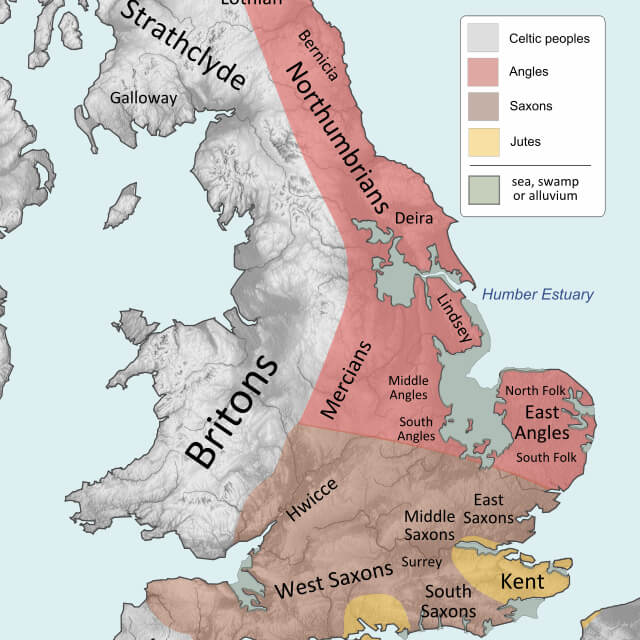
The Anglo-Saxon Migration
When Rome was being attacked by Germanic barbarian tribes in the early 400s, the majority of Romans that occupied the British Isles had to leave and return to Rome to help save their empire. When the Romans left they created a power vacuum, and a struggle between the native Britons ensued. They turned against each other, plundering to avoid starvation, and those who could, fled overseas.
The native Britons didn’t know how to support themselves, and trade and the economy deteriorated. Another blow came from invading Picts and Scots from across the northern border. Vulnerable and alone, they asked Rome for help but no help came and they were left to defend and support themselves. The Britons then instead turned to groups of West Germanic tribes from across the English Channel for help, which they did.
Three groups of West Germanic tribes; the Angles, Saxons and Jutes, travelled across the English Channel to help the Britons, offering them protection in exchange for wealth and land. They were successful in defeating the enemies of the Britons, but they liked the land in Britain so much that they decided to stay. And when the Britons could no longer afford to pay them, the arrangement broke down and backfired. They plundered the country and there was nothing the Britons could do to stop them. They sent word back to their tribes on the Continent about this new fertile and prosperous land, and more and more of them travelled over to settle.
Over several years hoards of Angles, Saxons and Jutes travelled across the English Channel in longboats and first arrived in east and southeast England. The Jutes came from the Jutland peninsula (modern Denmark), Angles from Angeln in southwest Jutland and the Saxons from northwest Germany.
They turned on the native people that invited them and began to raid their villages, killing their people and leaders. The Angles, Saxons and Jutes divided the lands between them and settled there for good. Many Britons left the country to escape from the invaders, to the Armorican peninsula (Brittany and Normandy in modern-day France) and to Britonia (modern-day Galicia, in northwest Spain), but the native Britons that remained either became slaves or were driven north and west into lands we now refer to as Scotland, Ireland, Wales and Cornwall. This left the large majority of the land to be settled by their new overlords, which would eventually become the Heptarchy.
The First Anglo-Saxon kingdoms
The story goes…
In around the middle of the 5th century, Vortigern, a British warlord, and possibly the King of the Britons (the most powerful ruler among the Celtic Britons) invited Hengist and Horsa to come to Britain to help them defeat the Picts and Scots that were causing them much trouble. Hengist and Horsa were Germanic brothers said to have led the Angles, Saxons and Jutes in their invasion of Britain. The brothers at first helped the Britons but eventually turned against them and established the Jutish kingdom of Kent, with Hengist becoming the first Jutish king of Kent.
Next was the arrival of the Anglo-Saxons a few decades later. The Angles settled in the east, while the Saxons settled in the south. It is during this period that the legendary figure of King Arthur first emerges.
Between the late-5th and mid-6th centuries, England was first divided into many small kingdoms, from which the main kingdoms would eventually emerge. These smaller kingdoms were Bernicia, Deira, East Anglia (East Angles), Mercia (Middle Angles and South Angles), Essex (East Saxons), Sussex (South Saxons), Wessex (West Saxons), Kent, Hwicce and Lindsey. These small kingdoms would eventually be reduced to seven; the ‘Anglo-Saxon Heptarchy’.
Centred around Lincoln, Lindsey was absorbed into Northumbria in the 7th century and effectively disappeared. Hwicce was a large territory that encompassed Worcestershire, Gloucestershire, and southwest Warwickshire, becoming a sub-kingdom of Mercia until it was fully absorbed by Mercia in the early 7th century. In the North, the kingdoms of Bernicia and Deira occupied what is now northern England and south-east Scotland, and in the 7th century they united to form the Kingdom of Northumbria (the land north of the Humber), and its borders subsequently expanded considerably.
The Heptarchy
The Anglo-Saxons migrated to the British shores in the early 5th century, but their individual kingdoms wouldn’t be properly established until the late-6th century. Over time they established seven kingdoms each ruled by it’s own king.
The Heptarchy, meaning “seven kingdoms” divided Anglo-Saxon England into seven separate kingdoms: Wessex, Mercia, Northumbria, East Anglia, Kent, Essex, and Sussex.
The kingdoms of Northumbria, Mercia and East Anglia were predominantly dominated by the Angles. Wessex, Sussex and Essex were primarily inhabited by the Saxons. And Kent was influenced by the Jutish settlers.
This meant that the Heptarchy was a collection of diverse kingdoms, each with its own unique characteristics. Each kingdom had its own distinct culture, customs, and rulers. These rulers held varying degrees of power and authority over their territories, with some kingdoms exerting greater influence over others. Some kingdoms were more dominant than others at different times throughout the centuries; Northumbria was the most dominant of the kingdoms at first, then Mercia rose up to be the most dominant, and finally Wessex would emerge as the most dominant kingdom, especially from the reign of Alfred the Great, which lasted until the Norman Conquest of 1066.
From the powerful kingdom of Wessex, known for its warrior kings like Alfred the Great, to the trading hub of Mercia and the ancient kingdom of Northumbria, the Heptarchy was a time of political intrigue, cultural exchange, and territorial expansion.
The Heptarchy period saw the emergence of Christianity in England, as missionaries from Rome and Ireland converted the Anglo-Saxon kings and their subjects. This period also witnessed the development of the Old English language and the beginnings of Anglo-Saxon literature, including epic poems like Beowulf.
However, the Heptarchy was also marked by frequent warfare and power struggles among the kingdoms, as rival kings vied for dominance and sought to expand their territories.
End of the Heptarchy
From the 6th century to the 9th century there were seven kingdoms, but Northumbria, Mercia and Wessex would eventually emerge as the most powerful of the seven and often dominated the others. The Heptarchy basically ended with the coming of the Vikings, and the kingdoms were gradually reduced in number to four kingdoms: Northumbria, Mercia, Wessex, and East Anglia.
During the 8th and 9th centuries, the Anglo-Saxon Heptarchy faced significant challenges from Viking raids and invasions, but the Vikings were met with formidable resistance from the Anglo-Saxon kingdoms. However, rivalries among the Anglo-Saxon kingdoms persisted during this period, as some rulers sought to exploit the vulnerabilities of their neighbours rather than join forces against the Viking threat. This internal fragmentation further weakened the Heptarchy’s ability to confront the Viking invasions collectively.
In the year 878, the Wessex king, Alfred the Great, was able to rally his forces and defeat a great Viking army at the Battle of Edington. This victory marked a turning point in the Viking invasions and paved the way for the consolidation of Wessex power. In the aftermath of the Battle of Edington, Alfred the Great negotiated a peace treaty with Guthrum, which established the Danelaw, a Viking-controlled territory in the north and east of England. This division of England further weakened the power of the Heptarchy and left the Anglo-Saxons with control of only the kingdoms in the south and west of England. But this large area was now mostly in the hands of Alfred the Great and his house of Wessex, making him the most powerful of all the Anglo-Saxons, and no longer just the King of the West Saxons, but the King of the Anglo-Saxons until his death in 899.
Alfred the Great’s grandson, Æthelstan became king of Wessex in 924, and it is under his rule that the Anglo-Saxon kingdoms would be merged into one single unified kingdom; the Kingdom of England. One of his most significant military campaigns was the Battle of Brunanburh, against the combined forces of the Scots, Vikings, and other northern rulers in 937. This decisive battle fought in modern-day Northumberland resulted in a resounding victory for Æthelstan, and is often regarded as one of the most important battles in early English history, as it solidified Æthelstan’s authority and secured his position as the first king of all England.
Did you enjoy this post?
I hope you found this post useful. I put a great deal of time and effort in to building, maintaining and populating the website. If you like, you could say a small thank you by buying me a coffee. You don't have to, but it would be nice :)
Buy me a coffee
Stay up to Date
Follow me on my journey and get notified whenever a new post is published by following Kings & Castles on Facebook.
Follow MeExplore The Map
Discover the hundreds of castles, churches, monasteries, cathedrals and other historic locations that I've personally visited across England and Wales. Search by location, explore nearby sites and plan your next historical adventure.
Share: