The Welsh Princes of Medieval Wales
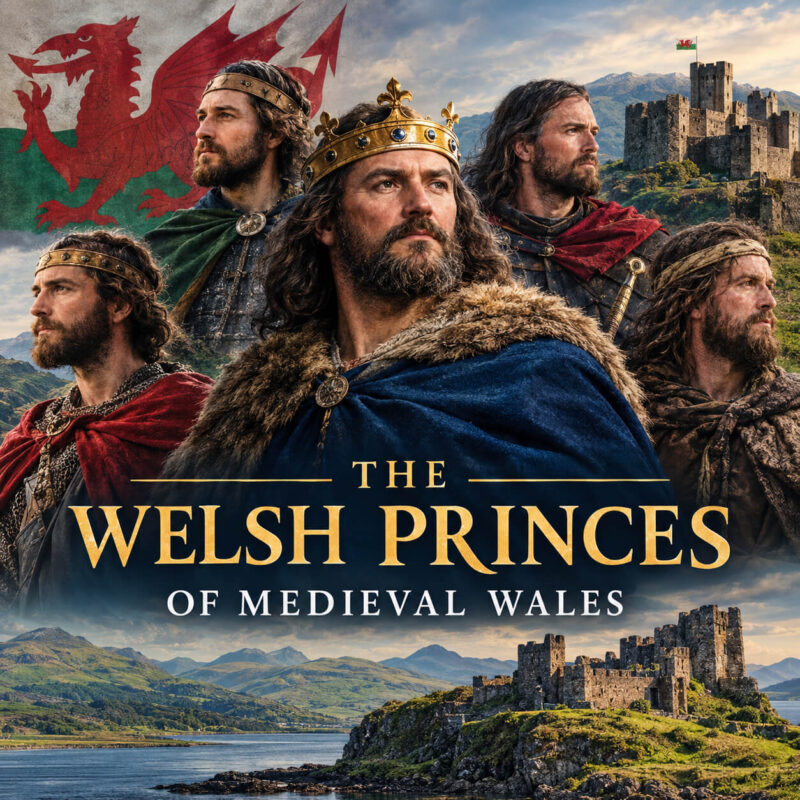
During the medieval period, powerful Welsh princes fought to defend their lands, resist English expansion and unite Wales. From the mountainous strongholds of Gwynedd to the ancient kingdom of Powys, their legacy lives on in the castles and ruins scattered across the country.
The Princes Who Shaped Wales
Following the Norman Conquest of England in 1066, Wales became a battleground between native Welsh rulers and ambitious Anglo-Norman lords. Unlike England, Wales was not governed by a single king. Instead, it was divided into several principalities, the most influential being Gwynedd in the north-west, Powys in the east and Deheubarth in the south-west.
The princes who ruled these territories frequently fought among themselves, but they also formed alliances and united against English invasion. Their power depended on controlling strategic valleys, mountain passes and fortified settlements, while their courts acted as centres of government and Welsh culture.
Gruffudd ap Llywelyn (c. 1010–1063)
Gruffudd ap Llywelyn was one of the most powerful Welsh rulers of the early medieval period and the only ruler to unite virtually all of Wales under his authority. The son of Llywelyn ap Seisyll and Angharad ferch Maredudd, he became King of Gwynedd in 1039 and gradually extended his influence across the other Welsh kingdoms through military victories and political alliances.
By 1055, he had established himself as ruler of Wales, earning recognition as a formidable leader who defended Welsh interests against English expansion. His campaigns included attacks on English forces along the border, and he successfully resisted several attempts to challenge his authority. However, his rule came to an end in 1063, when he was killed following an invasion led by Harold Godwinson, the future King Harold II of England. Following his death, his kingdom fragmented, and Wales once again became divided between competing rulers.
Gruffudd ap Cynan (c. 1055–1137)
One of the most important early rulers of Gwynedd, Gruffudd ap Cynan spent much of his life fighting to regain and secure his inheritance. With connections to both Wales and the Norse-Gaelic world of Ireland, he brought valuable military experience to his struggles against rival Welsh rulers and Norman forces.
After years of conflict and imprisonment, Gruffudd established himself as ruler of Gwynedd. His long reign strengthened the position of his dynasty and helped lay the foundations for the later dominance of the princes of Gwynedd.
Owain Gwynedd (c. 1100–1170)
The son of Gruffudd ap Cynan, Owain Gwynedd became one of the most formidable Welsh rulers of the 12th century. He defended Gwynedd against English campaigns and expanded his influence across neighbouring territories, taking advantage of divisions among his opponents.
Owain was also an ambitious diplomat. He is particularly notable for using the title Prince of the Welsh in correspondence with the French king Louis VII, demonstrating his desire to be recognised as a leading ruler of Wales. His reign helped establish Gwynedd as the most powerful Welsh principality of its time.
Madog ap Maredudd (d. 1160)
A major ruler of Powys, Madog ap Maredudd governed much of the territory during a period of intense rivalry between Welsh princes and Anglo-Norman lords. He worked to preserve Powys’s independence while maintaining influence over neighbouring regions.
Although Powys had once been a substantial and unified kingdom, it was increasingly vulnerable to internal divisions and external pressure. Following Madog’s death, his lands were divided among his successors, weakening Powys as a political force. Nevertheless, its ruling dynasties continued to play an important role in Welsh affairs.
Rhys ap Gruffudd – The Lord Rhys (c. 1132–1197)
Although associated with Deheubarth rather than Gwynedd or Powys, Rhys ap Gruffudd deserves a place among medieval Wales’s greatest princes. Known as the Lord Rhys, he became one of the most influential Welsh rulers of the 12th century.
Through military campaigns, negotiation and strategic alliances, Rhys strengthened his authority across south-west Wales and challenged Anglo-Norman control. He was also a notable patron of the church and Welsh culture. His court at Cardigan is traditionally associated with an important gathering of poets and musicians in 1176, often regarded as an early precursor of the Welsh Eisteddfod tradition.
Llywelyn ab Iorwerth – Llywelyn the Great (c. 1173–1240)
Few medieval Welsh rulers achieved the influence of Llywelyn ab Iorwerth, better known as Llywelyn the Great. Ruling Gwynedd from the late 12th century, he gradually extended his authority over much of Wales through warfare, diplomacy and carefully negotiated agreements with the English crown.
Llywelyn strengthened his position through marriage and political alliances, including his marriage to Joan, the illegitimate daughter of King John of England. He also developed a network of native Welsh castles, including Dolwyddelan Castle, Dolbadarn Castle and Criccieth Castle, which helped protect his territory and demonstrate his authority.
By the end of his reign, Llywelyn had become the leading prince in Wales. His achievements established a powerful legacy for his descendants.
Llywelyn ap Gruffudd – Llywelyn the Last (c. 1223–1282)
The grandson of Llywelyn the Great, Llywelyn ap Gruffudd continued his family’s ambition to unite Wales under native rule. His position was formally strengthened in 1267 when King Henry III recognised him as Prince of Wales under the Treaty of Montgomery.
Llywelyn built Dolforwyn Castle from 1273 to 1277 to assert control over the Severn Valley. He also strengthened and expanded several existing castles originally built by his grandfather, including Criccieth Castle, Dolwyddelan Castle and Ewloe Castle.
His relations with the English crown deteriorated following the accession of Edward I. English military campaigns in 1277 and 1282 progressively dismantled Llywelyn’s authority. He was killed near Builth Wells in December 1282, bringing an end to the independent rule of the princes of Gwynedd. His brother Dafydd ap Gruffudd continued the resistance briefly before being captured and executed in 1283.
Owain Glyndŵr (c. 1354–1416)
More than a century after Llywelyn the Last’s death, Owain Glyndŵr emerged as the most famous Welsh leader of the later Middle Ages. In 1400, he launched a rebellion against English rule and proclaimed himself Prince of Wales.
Glyndŵr’s uprising attracted widespread support and achieved remarkable early successes. His forces captured important castles, including Harlech Castle and Aberystwyth Castle, and he convened a Welsh parliament at Machynlleth in 1404. He also sought international support for an independent Wales.
Despite these achievements, English military pressure gradually weakened the rebellion. Glyndŵr eventually disappeared from the historical record, and his final fate remains unknown. He is remembered as a powerful symbol of Welsh independence and national identity.
The legacy of the Welsh princes
The medieval Welsh princes ruled during centuries of political rivalry, military resistance and cultural achievement. From the early struggles of Gruffudd ap Cynan and Owain Gwynedd to the ambitions of Llywelyn the Great and the rebellion of Owain Glyndŵr, their stories reveal a persistent determination to preserve Welsh autonomy.
Their castles, strongholds and former royal courts remain important reminders of this history. Exploring places such as Dolforwyn Castle and Criccieth Castle offers a glimpse into the world of the princes who shaped medieval Wales and whose legacy continues to influence the country’s identity today.
Did you enjoy this post?
I hope you found this post useful. I put a great deal of time and effort in to building, maintaining and populating the website. If you like, you could say a small thank you by buying me a coffee. You don't have to, but it would be nice :)
Buy me a coffee
Stay up to Date
Follow me on my journey and get notified whenever a new post is published by following Kings & Castles on Facebook.
Follow MeExplore The Map
Discover the hundreds of castles, churches, monasteries, cathedrals and other historic locations that I've personally visited across England and Wales. Search by location, explore nearby sites and plan your next historical adventure.
Share: