The Battle of Brunanburh
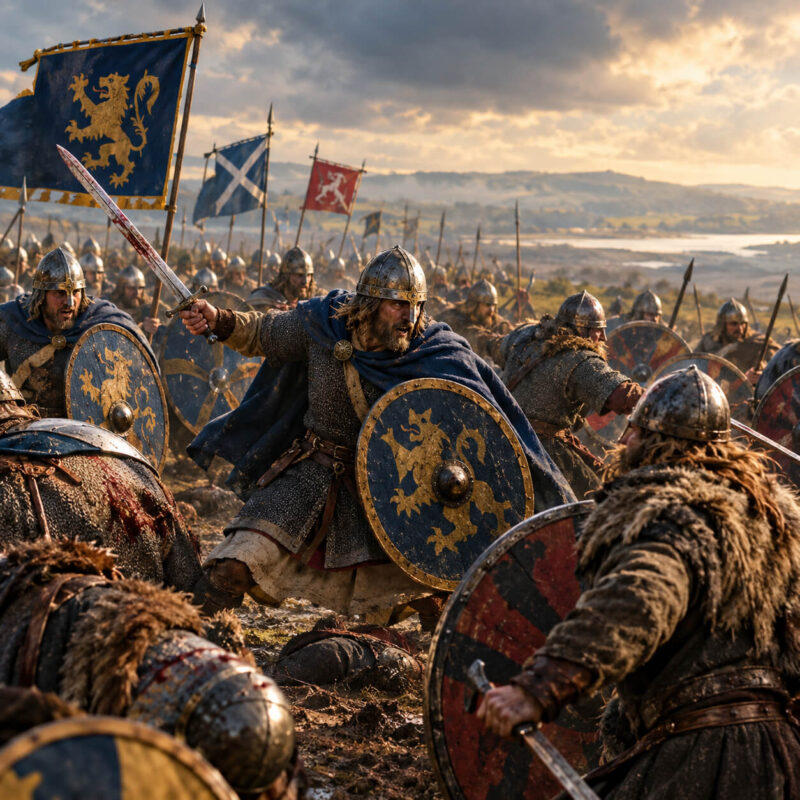
Fought in 937, the Battle of Brunanburh was a decisive victory for King Æthelstan, who defeated an alliance of Scots, Vikings and other northern forces. The battle helped secure the future of a united English kingdom and became one of the most celebrated victories in Anglo-Saxon history.
A Kingdom Under Threat
In the early 10th century, England was still emerging as a unified kingdom. King Æthelstan, grandson of Alfred the Great, had expanded his authority across much of the country and established himself as one of the most powerful rulers in Britain. However, his growing influence threatened neighbouring kingdoms and Viking leaders who feared the expansion of English power.
In 937, a formidable alliance gathered against him. It included King Constantine II of Scotland, Olaf Guthfrithson, a Viking ruler associated with Dublin, and forces from other parts of Britain. Their combined armies sought to challenge Æthelstan’s dominance and potentially break apart the kingdom he had worked to unite.
The Battle of Brunanburh
The opposing armies met at a place recorded in contemporary sources as Brunanburh. The exact location remains uncertain, although Bromborough on the Wirral Peninsula is one of the leading candidates.
The battle was exceptionally bloody. Æthelstan fought alongside his brother, Edmund, and their English army faced a powerful coalition with substantial fighting experience. According to the Anglo-Saxon Chronicle, the English forces won a decisive victory, inflicting heavy losses on their opponents.
The fighting was so fierce that several prominent leaders and members of royal families were killed. Constantine’s son was among the dead, while Olaf and Constantine were forced to retreat. The scale of the casualties and the defeat of such a formidable alliance made Brunanburh one of the defining military encounters of the period.
A stirring Old English poem preserved in the Anglo-Saxon Chronicle celebrated the victory, praising the English warriors and presenting the battle as a triumph for the English people.
Why Was Brunanburh Important?
The victory strengthened Æthelstan’s position and helped preserve the unity of his kingdom against powerful external challengers. Although the battle did not end every dispute between England and its neighbours, it demonstrated that the English kingdom could withstand a major coalition of rival rulers.
Brunanburh is often regarded as a landmark in the formation of England. Æthelstan had already brought much of the country under his rule, but his victory helped defend that achievement at a critical moment.
The battle’s precise location, the movements of the armies and many details of the fighting remain subjects of historical debate. Nevertheless, its significance is clear: in 937, the struggle for control of Britain produced a victory that helped shape the future of the English kingdom.
Today, the Battle of Brunanburh remains a powerful reminder that the making of England was not inevitable. It was shaped by ambition, alliances and bloody conflicts that determined the balance of power across Britain.
Did you enjoy this post?
I hope you found this post useful. I put a great deal of time and effort in to building, maintaining and populating the website. If you like, you could say a small thank you by buying me a coffee. You don't have to, but it would be nice :)
Buy me a coffee

Stay up to Date
Follow me on my journey and get notified whenever a new post is published by following Kings & Castles on Facebook.
Follow MeExplore The Map
Discover the hundreds of castles, churches, monasteries, cathedrals and other historic locations that I've personally visited across England and Wales. Search by location, explore nearby sites and plan your next historical adventure.
Share: