Edmund Ironside
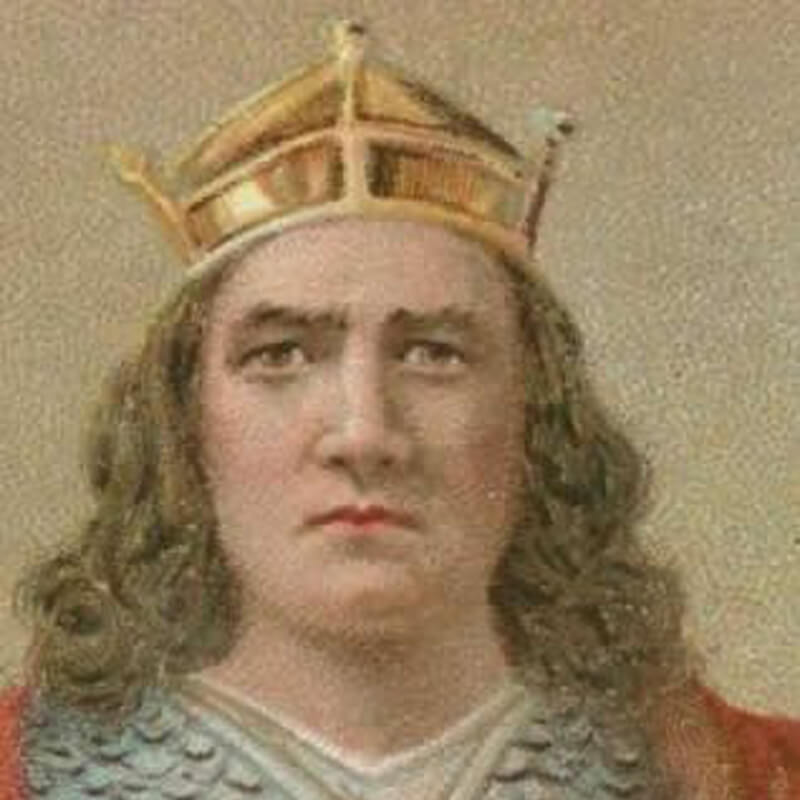
Edmund II, also known as Edmund Ironside was King of the English from April 1016 to November 1016. He was the son of King Æthelred the Unready and the brother of King Edward the Confessor. Edmund’s reign was marred by a war he had inherited from his father. He was given the name “Ironside” for his staunch resistance to a massive invasion led by the Danish king Cnut.
Quick
Facts.
- Born: c. 990
- Died: 1016
- Reign: 1016
- House: House of Wessex
- Predecessor: Æthelred the Unready
- Successor: Cnut the Great
Edmund was born some time around 989 – 993. He was the son of King Æthelred the Unready and his first wife Ælfgifu of York. He had several siblings including two older brothers, three younger brothers, and four sisters. Edmund wasn’t expected to be king of England, however, by 1014 his two elder brothers had died making him heir apparent.
At the end of 1013 England was conquered by Sweyn Forkbeard, who died shortly afterwards in February 1014. Edmund’s father King Æthelred the Unready returned from exile in Normandy and was able to reclaim the throne. Sweyn’s son Cnut (also spelled Canute) returned to Denmark where he assembled an invasion force to reconquer England which would take place a year later.
In 1015 Edmund defied his father’s orders by marrying the widow of one of the Danish lords occupying English territory and made himself ruler in the Danelaw, independent of his father. With Æthelred and Edmund now engaged in a power struggle, Cnut chose the perfect timing in which to launch his raid on England.
When Cnut invaded England later in 1015, Edmund raised an army in northern England and ravaged regions that would not rally to his cause. Cnut quickly made significant progress and brought about the speedy submission of Northumbria, forcing Edmund to return to London.
When Edmund’s father King Æthelred the Unready died due to ill health in the midst of the fighting in April 1016, the fate of the kingdom was left in Edmund’s hands. The general public and a small number of councillors proclaimed Edmund as their ruler, however, a larger number of nobles declared for Cnut.
Edmund then launched a series of offensives against his rival. He recovered Wessex and relieved London of a siege before being decisively defeated by Cnut at Assandun (or Ashington), Essex, in October 1016. After this, the two rivals swore friendship, a peace treaty was agreed and a division of the kingdom was effected, which allowed Edmund to rule in the south and Cnut to rule in the north.
Soon afterwards, in November 1016 Edmund Ironside died. It isn’t clear if he died from natural causes or if he was murdered. Cnut assumed his succession rights which had been agreed by the treaty, and King Cnut became sole ruler of England.
It is believed that Cnut sent Edmund’s two sons, Edward the Exile and Edmund Ætheling to the King of Sweden to be murdered. However, their lives were apparently spared by the King of Sweden and they were sent to Hungary instead where they spent the rest of their lives.
Did you enjoy this post?
I hope you found this post useful. I put a great deal of time and effort in to building, maintaining and populating the website. If you like, you could say a small thank you by buying me a coffee. You don't have to, but it would be nice :)
Buy me a coffee
Stay up to Date
Follow me on my journey and get notified whenever a new post is published by following Kings & Castles on Facebook.
Follow MeExplore The Map
Discover the hundreds of castles, churches, monasteries, cathedrals and other historic locations that I've personally visited across England and Wales. Search by location, explore nearby sites and plan your next historical adventure.
Share: