Cnut the Great
Cnut the Great – a Viking warrior, descendant of fierce Viking rulers, king of three countries and ruler of an extensive empire; Cnut was called “the Great” for a reason. He was King of England from 1016, King of Denmark from 1018, and King of Norway from 1028 until his death in 1035. The three kingdoms under his rule are collectively referred to as the North Sea Empire.
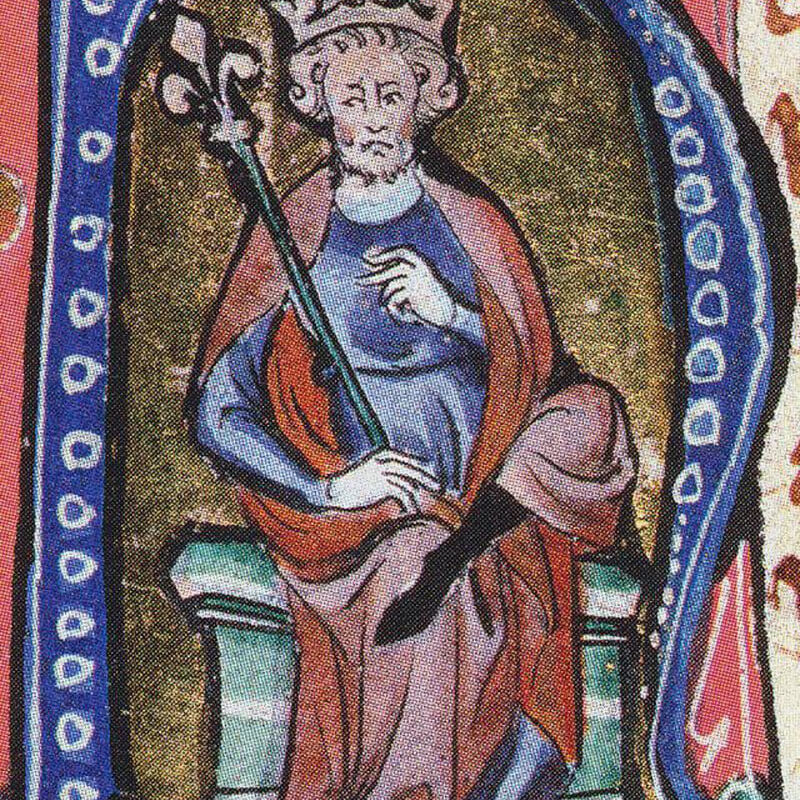
Quick
Facts.
- Born: c. 990
- Died: 1035
- Reign: 1016 - 1035
- House: House of Denmark
- Predecessor: Edmund Ironside
- Successor: Harold Harefoot
We don’t know exactly when Cnut (also spelled Canute) was born, but it was some time between 980 and 1000 AD, although it is commonly said to be around 990 – 994. He was born into a long line of Scandinavian rulers. His father was the Danish King (and for a brief time King of England) Sweyn Forkbeard, his mother was a Polish princess, and his grandfather was Harald Bluetooth, who was King of Denmark before his father.
Cnut was apparently a very tall, well-built and handsome man. He was described as a brave and fierce Viking warrior, politically brilliant and possessed strong leadership skills. Cnut is generally regarded as a successful ruler who brought peace to the people over whom he ruled. England was so peaceful during his reign that he frequently was able to leave the British shores to deal with affairs elsewhere, although England was his base.
Little is known about Cnut’s life before 1013. He was less than 20 years old when he accompanied his father on his successful invasion of England in 1013. While King Sweyn was conquering England, Cnut was left in charge of the remainder of the Danish forces at Gainsborough.
At the end of 1013 Cnut’s father, Sweyn Forkbeard, overthrew the king of England, Æthelred the Unready, and became King of England himself, but only for a brief period as he died shortly afterwards in February 1014. King Æthelred returned from exile in Normandy and was able to reclaim the throne. Cnut returned to Denmark where he assembled an invasion force to reconquer England which would take place a year later.
Cnut invaded England in the summer of 1015 and quickly made significant progress and brought about the speedy submission of Northumbria. In April 1016 during Cnut’s invasion, King Æthelred the Unready died due to ill health, and the fate of the kingdom was left in the hands of his son and new king of England, Edmund Ironside. Whilst the general public and a small number of councillors proclaimed Edmund as their ruler, a larger number of nobles declared for Cnut.
Cnut and Edmund were at war, each winning and losing battles, and at times they were even, until Edmund was decisively defeated by Cnut at the Battle of Assandun, Essex, in October 1016. After this, the two rivals swore friendship, a peace treaty was agreed and a division of the kingdom was effected, which allowed Edmund to rule in the south and Cnut to rule in the north.
Soon afterwards, in November 1016 Edmund Ironside died, and Cnut assumed his succession rights which had been agreed by the treaty, and King Cnut became sole ruler of England.
It is believed that Cnut sent Edmund’s two sons, Edward the Exile and Edmund Ætheling to the King of Sweden to be murdered. However, their lives were apparently spared by the King of Sweden and they were sent to Hungary instead where they spent the rest of their lives. To further establish his sovereignty he also had Edmund’s brother, Eadwig Ætheling killed, eliminating further threats to his crown. He also had some prominent Englishmen killed or outlawed.
One of the first things that Cnut did when he took the English throne was to give Englishmen’s estates to his Danish followers as rewards. However, Cnut didn’t rule like a foreign conqueror for long. By 1018 Englishmen were once again holding earldoms in Wessex and Mercia, and the Danish elements in his entourage steadily decreased.
In 1017 Cnut consolidated his power even further by marrying Emma of Normandy, the widow of Æthelred the Unready. Cnut already had a wife before Emma called Ælfgifu of Northampton, who resided in Scandinavia. Ælfgifu and Cnut had two sons, including Harold Harefoot. Cnut and Emma would go on to have two children; one daughter, Gunhilda, and one son, Harthacnut. Emma still had surviving sons from her marriage with Æthelred who were sent to live in Normandy, including the future king of England, Edward the Confessor.
In 1018 Cnut succeeded his elder brother Harold II as King of Denmark and made his son Harthacnut Crown Prince of Denmark. In 1028 he claimed the crown of Norway. He remained king of his three kingdoms of England, Denmark and Norway, collectively referred to as the North Sea Empire, until he died. Cnut had succeeded in the mission which his father Sweyn Forkbeard had tried to achieve, to rule over a vast North Sea Empire.
Cnut proved to be an effective ruler who brought internal peace and prosperity to the land. He emulated the best of his English predecessors, especially King Edgar. Cnut was a second-generation Christian for reasons of politics as well as faith, and became a strong supporter and a generous donor to the church. He even went on pilgrimage to Rome in 1027 – 1028 which was inspired by religious and diplomatic motives.
Cnut died in November 1035 in Shaftesbury, Dorset, and was buried at Winchester. In Norway he was succeeded by Magnus the Good. In Denmark he was succeeded by his son Harthacnut. And in England he was succeeded by his other son Harold Harefoot. However, his sons would prove to be much less effective as rulers as their father and their rules didn’t last very long, as they were both dead within seven years of Cnut’s passing.
Cnut is generally regarded as a wise and successful king of England. Whilst he dealt with threats to his kingship in England with a forceful nature, exiling or in some cases killing his rivals, in time, Cnut established a more stable form of governance which allowed the Saxon and Viking communities to co-exist, bringing England more than two decades of peace and prosperity.
Did you enjoy this post?
I hope you found this post useful. I put a great deal of time and effort in to building, maintaining and populating the website. If you like, you could say a small thank you by buying me a coffee. You don't have to, but it would be nice :)
Buy me a coffee
Stay up to Date
Follow me on my journey and get notified whenever a new post is published by following Kings & Castles on Facebook.
Follow MeExplore The Map
Discover the hundreds of castles, churches, monasteries, cathedrals and other historic locations that I've personally visited across England and Wales. Search by location, explore nearby sites and plan your next historical adventure.
Share: