Harthacnut
Harthacnut (also spelled Hardicanute) was the King of Denmark from 1035 to 1042 and King of the English from 1040 to 1042. He was the son of King Cnut the Great and Emma of Normandy, the half-brother of his predecessor Harold Harefoot, and the half-brother of his successor Edward the Confessor. Harthacnut reigned for a short time over his inherited kingdoms in Denmark and England, unitl his death in 1042 from a suspected stroke brought on by copious amounts of drinking.
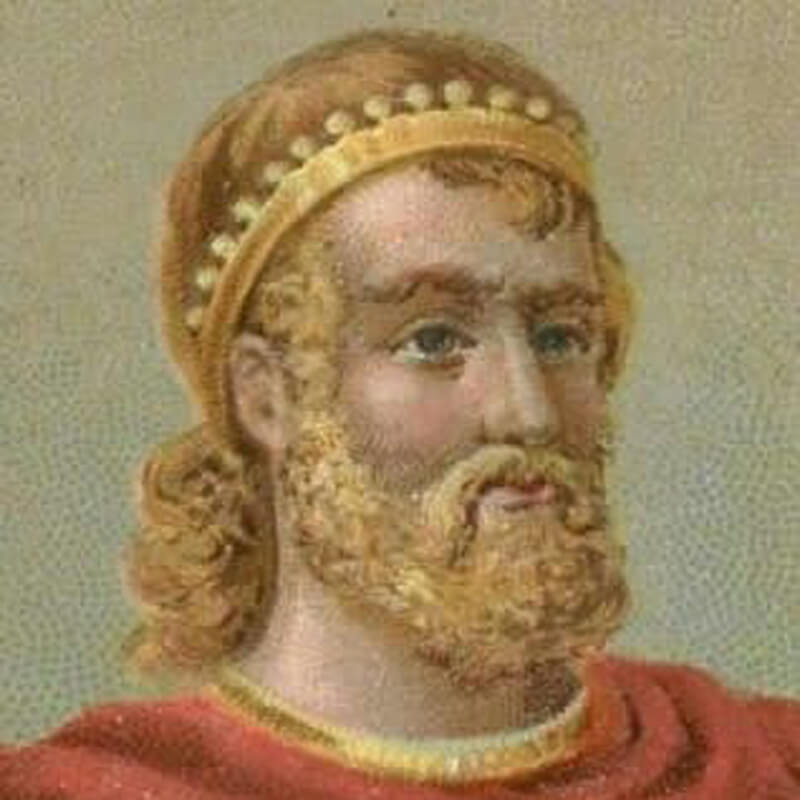
Quick
Facts.
- Born: c. 1018
- Died: 1042
- Reign: 1040 - 1042
- House: House of Denmark
- Predecessor: Harold Harefoot
- Successor: Edward the Confessor
When Cnut the Great died in November 1035, he was succeeded by his three sons; Harold Harefoot and Svein Knutsson by his first wife Ælfgifu of Northampton, and Harthacnut by his second wife Emma of Normandy.
Before Harthacnut was born, Harold and his brother Svein looked set to inherit the vast kingdom that their father Cnut was amassing across northern Europe. This however all changed in 1017 when Cnut successfully conquered England and married Emma of Normandy, the widow of King Æthelred the Unready. Cnut and Emma went on to have two children; Harthacnut and a daughter called Gunhilda. Emma of Normandy already had two sons from her previous marriage to King Æthelred; Alfred Ætheling and Edward the Confessor, who spent much of their youth in exile in Normandy.
With the birth of Harthacnut to the English queen Emma of Normandy, the succession rights greatly altered, as it became Harthacnut’s destiny to inherit their father’s position, and Harold and Svein were bypassed for succession.
By the time their father died in 1035, King Cnut had built an extensive North Sea Empire including England, Denmark, Norway, and parts of Sweden. Upon Cnut’s death, Harthacnut was legitimate heir to the thrones of both the Danes and the English. However, Harthacnut was preoccupied with his new kingdoms in Scandinavia where he was now King. He was busy dealing with threats from King Magnus of Norway who had ousted their brother Svein. Unable to leave his Scandinavian domain, England’s Crown was vulnerable.
With Harthacnut remaining stuck in Scandinavia, Harold Harefoot took the opportunity to seize the English Crown and was installed temporarily as regent, though Godwin, the earl of Wessex, and Queen Emma were against it. Emma was amassing a strong support base and managed to retain her power in Wessex thanks in large part to the support of the Wessex nobility, particularly Earl Godwin. Emma acted as regent in Wessex where she fought hard to gain the throne for her son and heir, Harthacnut.
However, upon observing Harold’s assent to power, Earl Godwin eventually switched his allegiance to that of Harold Harefoot and betrayed Emma of Normandy in the most horrific way. In 1036 Emma’s two sons from her previous marriage to King Æthelred; Alfred Ætheling and Edward the Confessor, made their way to England from exile in Normandy to visit their mother, and Harold planned to eliminate Emma’s exiled sons with the help of Earl Godwin.
Emma’s sons should have been under the protection of their half-brother Harthacnut. Godwin acted on the orders of Harold Harefoot, and with a group of men loyal to Harold, he captured Alfred Ætheling and had his eyes gouged out. Alfred later died from his injuries, but his brother Edward managed to escape and fled back to Normandy.
In 1037 Harold became effective sole ruler and was accepted as King of England, and he quickly banished Emma of Normandy. Emma met with her son Harthacnut on the continent and together they planned a strategy to remove Harold from the throne. However, Harold’s rule over England was short-lived and he didn’t live long enough to see Harthacnut launch his invasion. Harold died a few weeks before the planned invasion from a mysterious illness in March 1040.
Harold Harefoot was initially buried at Westminster Abbey. However, when Harthacnut assumed the English throne in June 1040 he had Harold’s body exhumed, beheaded and thrown into the River Thames as punishment for ordering the murder of his other half-brother Alfred Ætheling.
Harthacnut struggled to retain his father’s possessions and became an unpopular king in England, with his short reign being marked by great oppression and cruelty. He exacted heavy taxes for the support of his foreign fleet, and in Worcestershire a general uprising took place against those sent to collect the taxes, whereupon he burned the city of Worcester to the ground and devastated the surrounding country. In 1041 he permitted Edwulf, earl of Northumbria, to be treacherously murdered after having granted him a safe-conduct, which caused Harthacnut to be described as a pledge breaker in the Anglo-Saxon Chronicle.
Also in 1041 he summoned his half-brother, the surviving son of his mother Emma and Æthelred the Unready, Edward the Confessor from exile in Normandy and designated him as his heir.
Harthacnut died suddenly in 1042 at a feast, believed to have been brought on suddenly by excessive drinking. He was succeeded by Magnus the Good in Denmark and Edward the Confessor in England. Harthacnut was the last Dane to rule England.
Did you enjoy this post?
I hope you found this post useful. I put a great deal of time and effort in to building, maintaining and populating the website. If you like, you could say a small thank you by buying me a coffee. You don't have to, but it would be nice :)
Buy me a coffee
Stay up to Date
Follow me on my journey and get notified whenever a new post is published by following Kings & Castles on Facebook.
Follow MeExplore The Map
Discover the hundreds of castles, churches, monasteries, cathedrals and other historic locations that I've personally visited across England and Wales. Search by location, explore nearby sites and plan your next historical adventure.
Share: