John
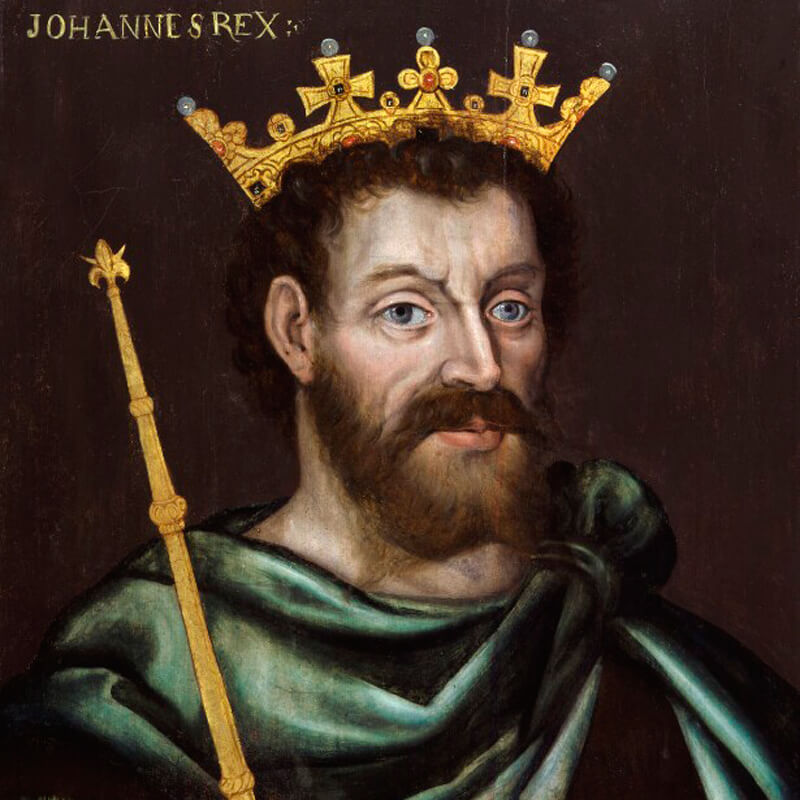
King John has become known to history as an evil tyrant and one of England’s worst kings; becoming the infamous “bad King John”, villain of every Robin Hood tale. He is also famous for the signing of the Magna Carta which is widely regarded as the first step towards England’s constitutional monarchy. He was the first king of England since the Norman invasion in 1066 to be born in England and to die in England. Except for his language, he died an English king.
Quick
Facts.
- Born: 1166
- Died: 1216
- Reign: 1199 - 1216
- House: House of Plantagenet
- Predecessor: Richard the Lionheart
- Successor: Henry III
John, also called John Lackland due to his lack of inheritance of land, was born around Christmas in 1166 in Oxford, England. He was the youngest of four sons born to King Henry II of England and Eleanor of Aquitaine, and Henry’s favourite son.
John’s father, King Henry II, ruled over a vast empire which stretched from the Scottish border to the Pyrenees, which was known as the Angevin Empire. As John and his brothers grew up, the relationship between his brothers and their father grew more and more fractured as he struggled to find ways to satisfy his sons desires for land and immediate power. John’s older brothers, Richard, Henry and Geoffrey became greedy and impatient and tensions rose over the future inheritance of the Angevin empire. Several battles ensued between his brothers and father over many years, and their mother, Eleanor would always side with his brothers. She attempted to overthrow her husband in favour of John’s brothers and for this she was locked up for 16 years. John was more loyal to his father and didn’t participate as much in the rebellions against their father, and for this he was Henry’s favourite son.
John’s father made plans for him to have some land, and in 1177 he was granted the lordship of Ireland. But when he wanted to give Aquitaine to him, his older brother Richard refused as that was his inheritance, and in 1189 Richard joined forces with King Philip II of France against their father, and for obscure reasons, John deserted Henry for Richard. The discovery of John’s treason broke his father’s heart, and together they hounded their ageing father to a premature death in 1189. When Henry II died in 1189, Richard became the king of England, and also became Duke of Normandy as well as Aquitaine, and Count of Anjou and Maine.
When John’s brother Richard became king in 1189, John married Isabella of Gloucester, received titles, lands and money, but this was not enough. Richard refused to give Aquitaine to John as he had promised his father he would. Additionally, in 1190 Richard recognised his nephew, Arthur, as his heir. These things only exacerbated the rivalry between the two brothers.
Richard went on the Third Crusade in 1190 to recapture the Holy Land from Saladin and the Muslims. On his way back from the failed crusade a couple of years later he was captured by Duke Leopold of Austria, and then handed over to the German emperor Henry VI, who ransomed King Richard for a huge sum of money. Meanwhile, in England, John tried to seize control of England and prepared an invasion of England by Flemish mercenaries. However, John’s rebellious schemes collapsed when Richard’s ransom was paid and he was set free and returned to England in 1194. John was banished and deprived of all his lands, but the two were soon reconciled, and when Richard’s nephew and heir, Arthur was captured by King Philip II of France in 1196, Richard named John his heir.
As the youngest son, John was never expected to inherit the throne. However, when John’s older brother King Richard I died childless defending his Angevin-Plantagenet lands in France in 1199, John took the throne and was crowned in May 1199 at Westminster Abbey.
War with France was renewed, triggered by John’s second marriage to Isabella, Countess of Angoulême in 1200. John was asked to intervene and mediate between the rival families of Lusignan and Angoulême, but instead he married the Angoulême heiress Isabella, who had been betrothed to a French count, Hugh de Lusignan. This marriage provoked a rebellion to break out and John was ordered to appear before his overlord, King Philip II of France. His failure to answer the summons resulted in war. John’s treachery cost him the support of many French barons, and with it, his English lands in France. Philip II successfully invaded Normandy, and by 1206 John had retreated to England and lost the French lands of Normandy Anjou, Maine, and parts of Poitou, resulting in the collapse of the Angevin Empire.
These failures were a damaging blow to King John, and as a result he ended up resided almost permanently in England. He was determined to win his lands back and reverse his continental failure, but it required a lot of money. John became increasingly ruthless with his financial administration; taxes soared and he began to exploit his feudal rights more harshly. These measures provided the material basis for the charges of tyranny later brought against him.
By this point, John was managing to make himself one of the most unpopular kings in English history. John believed in the idea that the king was chosen by God to rule, the so-called divine right of kings. He even managed to get embroiled in a dispute with the Pope, Pope Innocent III, which resulted in the church abandoning him. The Pope excommunicated John in 1209 and even went so far as to declare that John no longer had any legal right to call himself King.
Unsuccessful attempts to recover his French possessions made him very unpopular. The heavy taxes levied for his failed campaigns was becoming increasingly frustrating for the powerful barons. Then in 1214, after another defeat to the French, John attempted to raise more money, and this was the final straw for the barons and many of them refused to pay. The barons no longer believed that John was capable of regaining his lost lands.
Many of King John’s barons rebelled and civil war broke out, and in 1215 they forced him to sign a peace treaty called Magna Carta, accepting their reforms. Magna Carta was a significant legal document in English history, and its terms limited royal power, gave the barons more say in the government and protected their feudal rights, and restated English law. It was the first formal document stating that monarchs had limited powers and had to follow certain laws. That the monarch was as much under the rule of law as his people, and that the rights of individuals were to be upheld even against the wishes of the sovereign.
The king could no longer seize lands at will or impose unreasonable taxes without first consulting the barons. Also, all freemen were now protected from royal officers and had the right to a fair trial. In return for these concessions, King John was allowed to keep his crown and was absolved of his excommunication by Stephen Langton, Archbishop of Canterbury.
King John failed to honour his promise and went back on his word and ignored what he had signed in the Magna Carta, rendering it impractical and claimed that it was signed under duress. Pope Innocent sided with John and another civil war broke out, often called the First Barons’ War. John captured Rochester Castle and laid waste to the northern counties and the Scottish border. The barons then asked Prince Louis of France to be their king instead of John, and invited him to invade England.
Louis landed in Kent in May 1216 and took southeast England, including the Tower of London, and proclaimed himself king in May 1216. He also managed to take Rochester Castle back from John for the rebel cause. The hapless John even managed to lose some of the Crown Jewels in a river as he fled with his baggage train.
John continued to wage war until he succumbed to dysentery and died in October 1216 at Newark Castle aged just 48, leaving the issues undecided. He was buried in Worcester Cathedral as requested in his will, where his effigy still survives. The death of King John enabled a compromise peace, including the restoration of the rebels, the succession of his son Henry III, and the withdrawal of Louis.
John and his first wife never had any children, but he had five children with his second wife and many illegitimate children. John was succeeded by his son Henry who was crowned Henry III, King of England in October 1216. Despite being only nine years old and having to pick up the pieces of a broken kingdom, Henry III went on to defeat the remaining rebel barons and reigned for 56 years until his death in 1272.
Overall, King John has a reputation as an evil tyrant and a useless monarch. Thought of as one of England’s worst ever kings and known as the infamous villain, “bad King John”, of every Robin Hood tale. As a young man, John already had a reputation for treachery. He conspired sometimes with and sometimes against his elder brothers. But, he wasn’t all bad. He was extraordinarily active with a great love of hunting. He took a personal interest in judicial and financial administration, and his reign saw important advances at the Exchequer, in the administration of justice, and in the grant of chartered privileges to towns. During the civil wars, many barons, including some of the most distinguished, fought on his side. He resisted the incursions of William the Lion, King of Scotland into the north of England and forced him to accept John as his feudal overlord in 1209. He quashed the Irish rebellion of 1210. John gained another impressive victory against the troublesome Welsh prince Llywelyn of Gwynedd, aka Llywelyn the Great in 1211. So, even though the medieval chroniclers painted a dark picture of an evil and useless king, he did actually get some things right.
Did you enjoy this post?
I hope you found this post useful. I put a great deal of time and effort in to building, maintaining and populating the website. If you like, you could say a small thank you by buying me a coffee. You don't have to, but it would be nice :)
Buy me a coffee
Stay up to Date
Follow me on my journey and get notified whenever a new post is published by following Kings & Castles on Facebook.
Follow MeExplore The Map
Discover the hundreds of castles, churches, monasteries, cathedrals and other historic locations that I've personally visited across England and Wales. Search by location, explore nearby sites and plan your next historical adventure.
Share: