The First Barons’ War
The First Barons’ War was a civil war fought in England between 1215 and 1217. It was mainly a conflict between rebellious English barons and King John, although the struggle eventually involved the French prince Louis. The war was caused by disputes over royal authority, taxation and the rights of the nobility. It was one of the most important political conflicts of medieval England and played a significant role in the development of constitutional government.
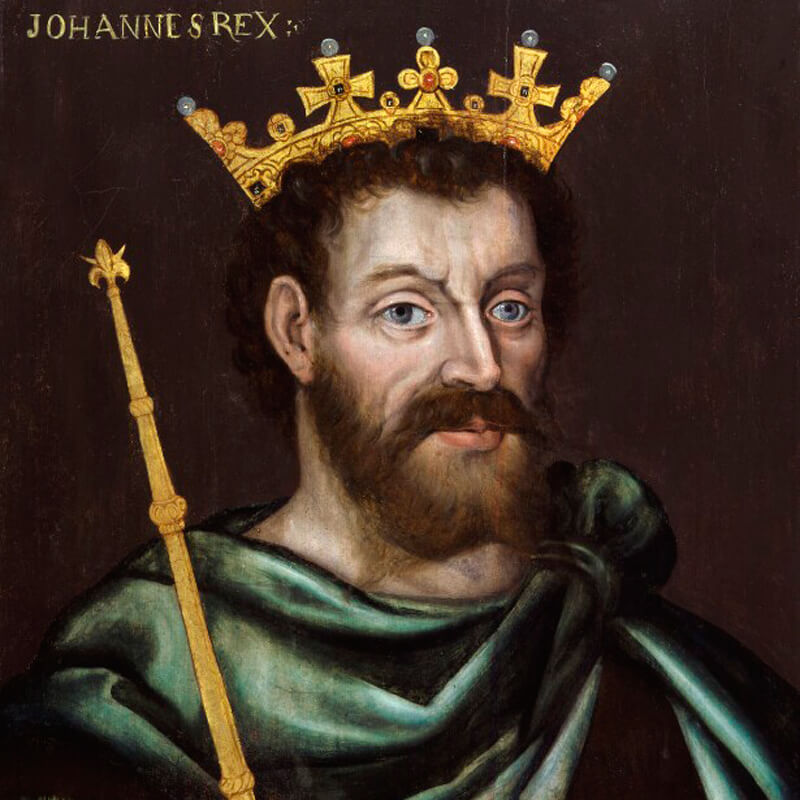
Causes of the War
The roots of the conflict lay in growing opposition to King John. John had become king in 1199 following the death of his brother, Richard I. His reign was troubled by military failures, heavy taxation and disputes with powerful nobles.
John had lost much of the English-controlled territory in France after military campaigns against Philip II of France. These failures were expensive, and John increased taxation to finance his attempts to recover his lands.
John also frequently came into conflict with the Church and the barons. His dispute with Pope Innocent III resulted in England being placed under an interdict, and John was eventually excommunicated. Although he later reconciled with the pope, his reputation among his subjects had suffered.
The barons particularly objected to John’s demands for money and his interference with traditional feudal rights. They wanted the king’s powers to be restricted and sought guarantees that the law would apply to the monarch as well as his subjects.
Magna Carta
In 1215, the rebellious barons forced King John to negotiate. At Runnymede, near the River Thames, John agreed to the Magna Carta in June 1215.
The document contained promises concerning taxation, justice and the rights of the barons and the Church. One of its most famous principles was that the king was subject to the law.
However, neither side was satisfied with the agreement. John appealed to Pope Innocent III, who declared the Magna Carta invalid. The barons responded by continuing their rebellion.
The Civil War
Open warfare began in 1215. The rebels captured several important towns and castles, including London, which gave them a major advantage.
Unable to defeat the rebels on his own, John turned to foreign mercenaries for support. Meanwhile, the barons sought assistance from Louis, the son of Philip II of France. Louis accepted their invitation and invaded England in 1216, claiming the English crown.
The conflict therefore became more than a dispute between the king and his barons. It developed into a struggle involving English rebels, royal forces and French troops.
The Death of King John
The war changed dramatically when King John died in October 1216. His son, Henry III, was only nine years old.
The royal government was now led by supporters of the young king, particularly William Marshal, one of the most respected knights in England. They presented Henry as a legitimate alternative to the French-backed Louis and reissued a revised version of the Magna Carta.
Many barons gradually returned to Henry’s side, while Louis lost support.
The End of the War
Royal forces defeated Louis’s supporters at the Battle of Lincoln in May 1217. A second English victory at the Battle of Sandwich in August weakened French forces and forced Louis to abandon his claim to the English throne.
The conflict ended with the Treaty of Lambeth in September 1217. Louis agreed to leave England, and Henry III remained king.
Legacy
The First Barons’ War was important because it established the principle that the English monarchy could be challenged when the king violated accepted laws and customs. Although the Magna Carta was initially unsuccessful in preventing conflict, later versions became highly influential.
Over the centuries, Magna Carta came to symbolise the principles of the rule of law, limits on government power and individual rights. The First Barons’ War therefore represents an important stage in the development of England’s political institutions and the gradual movement towards constitutional government.
Did you enjoy this post?
I hope you found this post useful. I put a great deal of time and effort in to building, maintaining and populating the website. If you like, you could say a small thank you by buying me a coffee. You don't have to, but it would be nice :)
Buy me a coffee
Stay up to Date
Follow me on my journey and get notified whenever a new post is published by following Kings & Castles on Facebook.
Follow MeExplore The Map
Discover the hundreds of castles, churches, monasteries, cathedrals and other historic locations that I've personally visited across England and Wales. Search by location, explore nearby sites and plan your next historical adventure.
Share: