Magna Carta
Magna Carta (‘great charter’ in Latin) is a royal charter of rights agreed to by King John of England on 15th June 1215, and is one of the world’s most important documents. It was written by a group of 13th-century barons to protect their rights and property against the unpopular and tyrannical King John. It was the first document to put into writing that the king and his government was not above the law. It sought to prevent the king from exploiting his power, and placed limits of royal authority by establishing law as a power in itself.
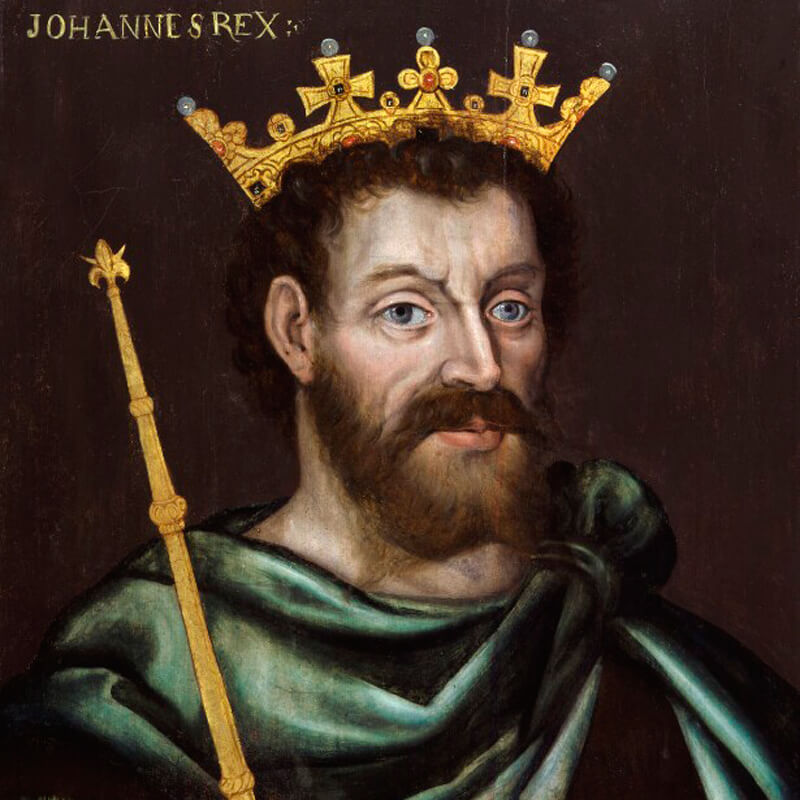
Origins of Magna Carta
From 1199 to 1216 England was ruled by King John, the third of the Angevin kings. King John was ruthless with his financial administration; taxes soared and he exploited his feudal rights harshly. John believed in the idea that the king was chosen by God to rule, the so-called divine right of kings. He made himself one of the most unpopular kings in English history, to the point that the church abandoned him, and he was excommunicated in 1209 by Pope Innocent III.
The barons became tired of John’s tyranny, heavy taxes and constant defeats against the French, and so they rebelled and civil war broke out, and in 1215 they forced him to sign a peace treaty, accepting their reforms. On 15th June 1215 King John and the barons met at Runnymede in Surrey and agreed a charter of liberties that would change the course of history – Magna Carta.
Magna Carta was a significant legal document in English history, and its terms limited royal power, gave the barons more say in the government and protected their feudal rights, and restated English law. It was the first formal document stating that monarchs had limited powers and had to follow certain laws. That the monarch was as much under the rule of law as his people, and that the rights of individuals were to be upheld even against the wishes of the sovereign. It promised the protection of church rights, protection for the barons from illegal imprisonment, access to swift and impartial justice, and limitations on feudal payments to the Crown, to be implemented through a council of 25 barons.
The king could no longer seize lands at will or impose unreasonable taxes without first consulting the barons. Also, all freemen were now protected from royal officers and had the right to a fair trial. In return for these concessions, King John was allowed to keep his crown and was absolved of his excommunication.
However, King John failed to honour his promise and went back on his word and ignored what he had signed in the Magna Carta, rendering it impractical and claimed that it was signed under duress. The charter was therefore annulled by Pope Innocent III who sided with John and another civil war broke out – the First Barons’ War.
Magna Carta was reissued several times and evolved over the years with various amendments and newer versions, including the 1217 Charter of the Forest, 1225 Charter of the Forest, and the 1258 Provisions of Oxford which was an extension of Magna Carta.
Magna Carta Today
Although Magna Carta is over 800 years old it is still a powerful symbol of social justice to this day. Many of its clauses are no longer relevant to modern life but the concept of a document proclaiming the freedoms and rights of individuals under the rule of law has been adopted across the globe. Magna Carta established the right of trial by jury and ensured that no one, including the king, was above the law.
Throughout history Magna Carta has inspired human rights legislation including the Universal Declaration of Human Rights, adopted by the United Nations in 1948. Magna Carta holds a particularly prominent place in the history of the United States where its concepts of equality under the law is enshrined in the Declaration of Independence, the Constitution and the US Bill of Rights.
Four original copies of the charter of 1215 still exist, two of them held by the cathedral churches in which they were originally delivered — Lincoln and Salisbury, and the other two in the British Library. The Lincoln charter is now at Lincoln Castle, on permanent loan from Lincoln Cathedral. Lincoln Castle is now the only place in the world where an original 1215 Magna Carta and 1217 Charter of the Forest can be seen side by side.
Did you enjoy this post?
I hope you found this post useful. I put a great deal of time and effort in to building, maintaining and populating the website. If you like, you could say a small thank you by buying me a coffee. You don't have to, but it would be nice :)
Buy me a coffee
Stay up to Date
Follow me on my journey and get notified whenever a new post is published by following Kings & Castles on Facebook.
Follow MeExplore The Map
Discover the hundreds of castles, churches, monasteries, cathedrals and other historic locations that I've personally visited across England and Wales. Search by location, explore nearby sites and plan your next historical adventure.
Share: