Boudica, Queen of the Iceni
Britain has produced many fierce and noble warriors through the ages who have fought to keep Britain free, but there was one formidable woman in history whose name will never be forgotten – Boudica.
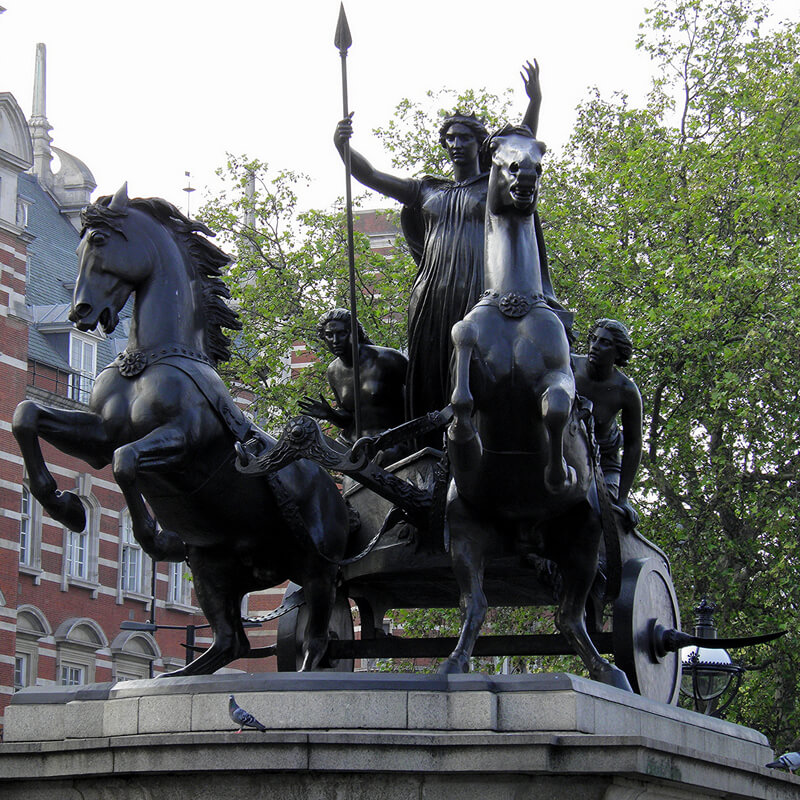
Boudica (or Boudicca, or Boadicea) was born in Roman Britain in the year 30 AD. She was a queen of the ancient Celtic British Iceni tribe, who led a failed uprising against the conquering forces of the Roman Empire in 60 AD or 61 AD. She is considered a British national heroine and a symbol of the struggle for justice and independence.
Her appearance was said to be terrifying. She was tall, the glance of her eye most fierce, and a harsh voice.
At the time of the Roman conquest of Britain, Queen Boudica ruled the Iceni tribe of East Anglia alongside her husband King Prasutagus.
The trouble started when Prasutagus hoped to curry favour with the Romans by making the Roman Emperor Nero co-heir with his daughters. He hoped that by doing this he would keep his kingdom and household free from attack. Unfortunately the Roman Governor of Britain at that time, Suetonius Paulinus, had other ideas on the subject of lands and property.
After King Prasutagus’s death, his lands and household were plundered by the Roman officers. Not content with taking all the property and lands, Suetonius had the newly widowed Boudica publicly flogged, and her daughters raped.
Other Iceni chiefs suffered the same, and their families were treated like slaves. Not surprisingly, these outrages provoked the Iceni and other tribes to rebel against the Romans. This uprising would become known to history as the Boudican revolt. The Britons at first had great successes. They first captured the Roman settlement at Camulodunum (modern Colchester in Essex). Boudica and her allies then sacked and burned the Roman settlements of Londinium (London) and Verulamium (St. Albans).
Finally, Suetonius decided to challenge Boudica, and he assembled an army of 10,000 Roman troops and met Boudica and her army of native Celtic Britons in battle. The Romans were hugely outnumbered. Boudica’s army was said to have numbered anywhere from 120,000 to 230,000. However, the Roman soldiers were well trained, well armed and heavily armoured.
Boudica and her daughters rode around in her chariot telling her people to be brave. Telling them she was fighting as an ordinary person for her lost freedom, her bruised body and outraged daughters. Reminding them that life was much better before the Roman occupation, stressing that wealth cannot be enjoyed under slavery and placing the blame upon herself for not expelling the Romans as they had done when Julius Caesar invaded.
The Britons attacked the Roman defensive line. The order was given and a volley of several thousand heavy Roman javelins was thrown into the advancing Britons, followed quickly by a second volley. The lightly armed Britons suffered massive casualties within the first minutes of the battle. The Romans moved in for the kill, attacking in tight formation and stabbing with their short swords.
Although their numbers were many, massively outnumbering their foes, the Britons stood little chance. To ensure success, the Roman cavalry was released, which promptly encircled the enemy and began their slaughter from the rear.
Seemingly mad with blood lust, records show that 80,000 Britons; men, women and children, were killed. Boudica’s army was crushed. The Roman losses amounted to 400 dead, with a slightly larger number wounded.
Boudica wasn’t killed in the battle. She instead chose to end her life with poison rather than be taken alive by the Romans.
Boudica has secured a special place in British folk history, and is remembered for her courage, as the warrior queen who fought the might of Rome.
In 1902, a bronze statue of her riding high in her chariot was placed on the Thames embankment, next to the Houses of Parliament, in the old Roman capital of Britain, Londinium.
Did you enjoy this post?
I hope you found this post useful. I put a great deal of time and effort in to building, maintaining and populating the website. If you like, you could say a small thank you by buying me a coffee. You don't have to, but it would be nice :)
Buy me a coffee
Stay up to Date
Follow me on my journey and get notified whenever a new post is published by following Kings & Castles on Facebook.
Follow MeExplore The Map
Discover the hundreds of castles, churches, monasteries, cathedrals and other historic locations that I've personally visited across England and Wales. Search by location, explore nearby sites and plan your next historical adventure.
Share: