Edward the Black Prince
Edward of Woodstock, known to history as the Black Prince, was a 14th-century warrior prince that never became king. He died before his father and so his son, Richard II, succeeded to the throne instead. He is remembered as a great medieval military hero, with notable victories against the French in the Hundred Years’ War.
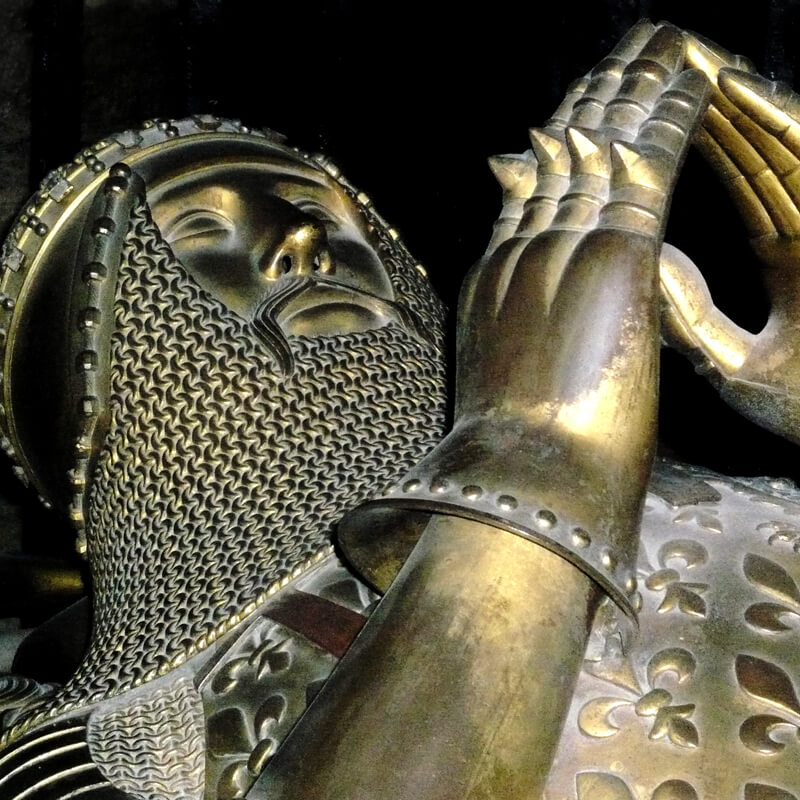
Edward of Woodstock was the eldest son and heir apparent of King Edward III of England and his queen Philippa of Hainault. He was born in 1330 at Woodstock Palace, Oxfordshire, England. He was created Earl of Chester in 1333, Duke of Cornwall in 1337, Prince of Wales in 1343, and he was Prince of Aquitaine from 1362 to 1372.
There are several theories as to why Edward was referred to as the Black Prince, with the most popular theory being that he wore distinctive black armour. Another theory was for his brutal Siege of Limoges, and that it was this supposed massacre that led to Edward being known as the Black Prince. However, he wasn’t actually referred to as the Black Prince until the 16th century, over 150 years after his own death.
Edward grew up the quintessential medieval prince, being taught the duties of both a soldier and a knight from an early age. He was instructed in the codes of chivalry, showed military brilliance and was an avid jouster. He received his first suit of armour aged just seven years old and he would turn out to be one of the greatest warriors England ever produced. He was also a founding member of the Order of the Garter, an English order of chivalry started by his father in 1348, which remains the oldest and most prestigious order of knighthood in Britain.
A tall and imposing figure, Edward would fight with distinction at both of England’s great victories against the French during the first phase of the Hundred Years’ War. He played a key role in the defeat of the French army at the Battle of Crécy in 1346 when he was only 16, then in 1356 he gained another significant victory against the French at Poitiers.
The Hundred Years’ War started in 1337 when his father Edward III of England wanted to expand his lands in France and claim a right to the French throne. Prince Edward’s first campaign was served under his father in northern France in 1346 at the Battle of Crécy, where his father intentionally left him to win the battle, resulting in a total victory for the English. The Prince was then sent to France with independent command in 1355, winning his most famous victory over the French at Poitiers in 1356, and even took the French king prisoner.
In 1361 Edward married his cousin, Joan of Kent, and together they had two legitimate sons, Edward and Richard. The older son, Edward, died of plague when he was only six, but the younger son, Richard, went on to become King Richard II on his grandfather’s death in 1377, only a year after his father’s death.
When his father made him Prince of Aquitaine in 1362, Edward and his wife went to live in his new French domains. Although his powers and opportunities in his new French lands were great, his rule was a failure. He was seen as a foreign conqueror, his nobles were unfriendly and hostile towards him, and the heavy taxes he raised to fund his wars angered his people.
In 1367, Edward famously led a combined Gascon and English army to Spain to restore the deposed King Pedro of Castile, and proved himself again with victory at the Battle of Najera in northern Castile. Although this was a great military victory, the campaign was a financial disaster for the Black Prince, it also ruined his health and any prospect of sound rule in Aquitaine.
Edward returned to Aquitaine where he had made himself unpopular with the nobility for levying taxes to pay for his Spanish expedition. He had also alienated the towns and peasantry as well as the nobles, and by 1369 hundreds of towns and castles had declared against him. He was betrayed by a Bishop called Johan De Cross, and the nobility rose in revolt against Edward. The turncoat Bishop welcomed a French garrison into the town of Limoges and they promptly took it from the English in August 1370. Edward ruled over the town as Prince of Aquitaine, but he was swift to retaliate. Edward besieged the city of Limoges in October of the same year, but he did lasting damage to his reputation, at least in France where it was low already. Edward ordered the execution of some 3,000 civilians, including men, women and children, and then the city was torched. This massacre could well have contributed to Edward’s chilling moniker; the Black Prince.
A year later in 1371, Edward returned to England a sick and broken man, his health deteriorating, and the following year he resigned his principality of Aquitaine and Gascony to his father.
The last five years of the Black Princes’ life are obscure. Edward knew he was dying, and he was most likely seeking the best means to ensure the succession of his second but only surviving son, Richard of Bordeaux, who was selected as Edward III‘s official heir, and he was crowned Richard II of England when Edward III died in 1377, just one year after his beloved son, the Black Prince.
The Black Prince died in 1376 aged 46. How he died is in dispute as he suffered from many illnesses, but he most likely died from dysentery. He was buried in great splendour in Canterbury Cathedral, in a medieval chest tomb topped with a bronze effigy of the prince, adorned with his heraldic achievements, where his black helmet, shield, and gauntlets are still preserved. A space was kept beside him for his wife, although sadly she was actually buried next to her first husband. He was very particular as to what was to happen after his death, one instruction was that the inscription below be visible to all those passing by his final resting place…
“Such as thou art, sometime was I.
Such as I am, such shalt thou be.
I thought little on th’our of Death
So long as I enjoyed breath.
On earth I had great riches
Land, houses, great treasure, horses, money and gold.
But now a wretched captive am I,
Deep in the ground, lo here I lie.
My beauty great, is all quite gone,
My flesh is wasted to the bone”
Although illness struck the prince down before he could be crowned the great king everyone hoped he would become, the Black Prince nevertheless earned distinction as one of the most successful English commanders during the Hundred Years’ War, being regarded by his English contemporaries as a model of chivalry and one of the greatest knights of his age. Edward’s years may have been limited, but this prolific and successful medieval warrior remains famous for his achievements even to this day. One of the Black Prince’s emblems was three white ostrich feathers set against a black background, and still today, the ostrich feathers are used as the symbol of the Prince of Wales.
Did you enjoy this post?
I hope you found this post useful. I put a great deal of time and effort in to building, maintaining and populating the website. If you like, you could say a small thank you by buying me a coffee. You don't have to, but it would be nice :)
Buy me a coffee
Stay up to Date
Follow me on my journey and get notified whenever a new post is published by following Kings & Castles on Facebook.
Follow MeExplore The Map
Discover the hundreds of castles, churches, monasteries, cathedrals and other historic locations that I've personally visited across England and Wales. Search by location, explore nearby sites and plan your next historical adventure.
Share: