Mary Queen of Scots
Mary, Queen of Scots is perhaps the best known figure in Scotland’s history. Her life provided much tragedy and romance. Mary was the Queen of Scots, a close relative of the Tudors, a potential heir to the English throne, and the Mother of a King of England and Scotland. She was pious, peaceful, intelligent, and considered very beautiful for the time.
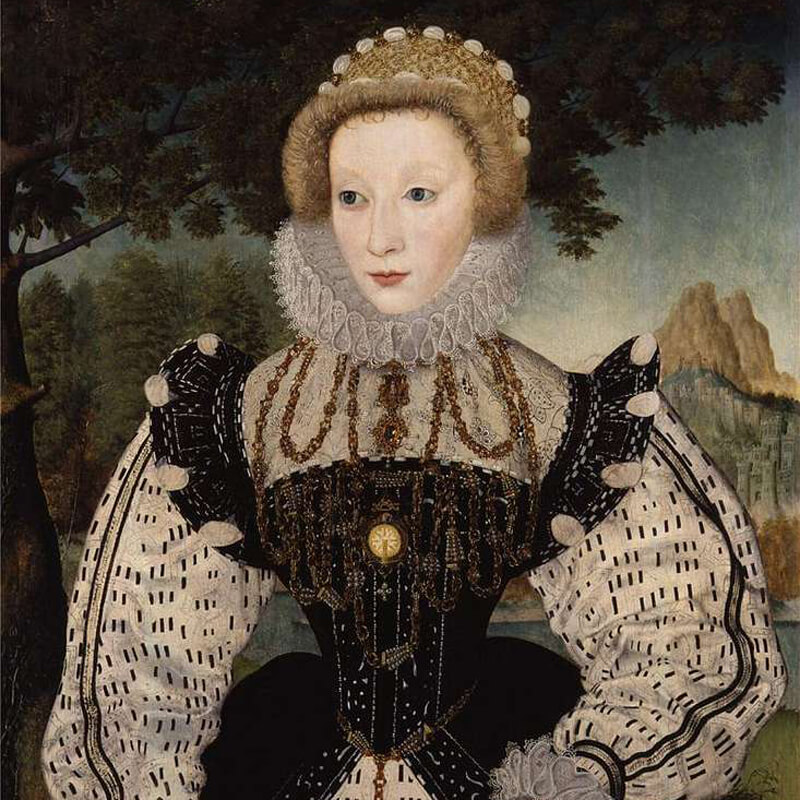
Mary, Queen of Scots, also known as Mary Stuart or Mary I of Scotland, was born in 1542 in West Lothian, Scotland. She was the only surviving legitimate child of King James V of Scotland, and when Mary was just six days old, her father died and she inherited the throne of Scotland. She was Queen of Scotland from 1542 until her forced abdication in 1567.
It was initially arranged for Mary to marry the English King Henry VIII’s son Prince Edward, however, the Scots refused to approve the agreement. Henry was furious by this and sought to change their minds through a show of force; a war between Scotland and England that would be named the ‘Rough Wooing’. In the middle of this, Mary was sent to France aged five in 1548 to be the bride of the Dauphin, the young French prince, in order to secure a Catholic alliance against Protestant England. There she was brought up at the court of the French King Henry II and his queen Catherine de Médicis, assisted by relations on her mother’s side, the powerful Guises. Mary had a taste for music and poetry and had a childhood of much luxury, including frequent hunting and dancing, both of which she excelled at. She also received an excellent education, she was taught Latin, Italian, Spanish and Greek. French became her first language, and in every way Mary grew into a Frenchwoman rather than a Scot.
Mary was sincerely fond of her boy husband, however, in 1561 the Dauphin, still in his teens, died, and Mary reluctantly returned to rule Scotland a young and beautiful widow. She was said to have had remarkable beauty, with her tall, slender figure, red-gold hair and amber-coloured eyes.
In 1565 Mary fell passionately in love with, and married, her half-cousin, Henry Stuart, Lord Darnley, and in 1566 they had a son, James, who would become the future king of both England and Scotland. Their marriage was not a success. Darnley was a weak man and soon became a drunkard as Mary ruled entirely alone and gave him no real authority in the country. He became jealous of the relationship between Mary and her Italian secretary, close friend and favourite, David Rizzio. So he had him murdered, after which their marriage soured. In 1567, Darnley’s residence was destroyed by an explosion and he was found murdered in the nearby garden. James Hepburn, 4th Earl of Bothwell, was generally believed to have orchestrated Darnley’s death, but he was acquitted of the charge in April 1567, and the following month he married Mary.
Her unwise marital and political actions provoked rebellion among the Scottish nobles and she became a hate figure of the Scottish people. Following an uprising against Mary and her new husband, she was imprisoned in Lochleven Castle. In July 1567, she was forced to abdicate in favour of her one-year-old son, James VI. Mary escaped from Lochleven Castle in 1568, only to be defeated at the Battle of Langside near Glasgow, and after an unsuccessful attempt to regain the throne, she fled southward to England seeking the protection of her cousin Queen Elizabeth I of England, where she would eventually be beheaded as a Roman Catholic threat to the English throne.
Mary was Elizabeth’s first cousin once removed and an heir to the English throne through her Tudor grandmother, Margaret, Henry VIII’s older sister. Though they were cousins, Elizabeth and Mary never actually met.
Fleeing south after her escape from Lochleven and her defeat at the Battle of Langside, she sought shelter in England, believing that Elizabeth would support her cause, but instead she was kept in captivity in England for 19 years. Elizabeth saw Mary as a threat to her throne for several reasons. Being the great-granddaughter of Henry VII, she was next in line to the throne after Henry VIII’s children. Also, many people believed Elizabeth to be illegitimate, as her father, Henry VIII, had divorced his first wife and so felt she had no right to be on the throne. Elizabeth also saw her presence as a threat because Mary could become a figure to her Catholic opponents, so Elizabeth imprisoned her and gave her no hint on whether she would ever be released.
Elizabeth’s reluctance to execute Mary was partly because of how it would make her look to everyone by taking direct responsibility for killing a fellow queen and a close relative. It was also partly because she didn’t want turn Mary into a Catholic martyr. However, it was a plot to kill Elizabeth and start a Catholic uprising that became Mary’s undoing. After 19 years in captivity Mary was found guilty of plotting the assassination of her cousin, Queen Elizabeth I, and she was executed on 8th February 1587 at Fotheringhay Castle in Northamptonshire.
Did you enjoy this post?
I hope you found this post useful. I put a great deal of time and effort in to building, maintaining and populating the website. If you like, you could say a small thank you by buying me a coffee. You don't have to, but it would be nice :)
Buy me a coffeeMore People Profiles
View all People Profiles
Stay up to Date
Follow me on my journey and get notified whenever a new post is published by following Kings & Castles on Facebook.
Follow MeExplore The Map
Discover the hundreds of castles, churches, monasteries, cathedrals and other historic locations that I've personally visited across England and Wales. Search by location, explore nearby sites and plan your next historical adventure.
Share: