Lady Godiva
Lady Godiva is one of the most celebrated women from Middle Age Britain. A noblewoman, the wife of the Earl of Mercia, and a patron of various churches and monasteries; legends say that she rode naked through the streets of Coventry in England. Nowadays, her name is associated with a brand of Belgian chocolates, the Cockney rhyming slang for “fiver”, and is the subject of several modern songs – but who was the real person behind the legend?
Who Was Lady Godiva?
Lady Godiva, or Godgifu in Old English meaning “gift of God”, was a late Anglo-Saxon noblewoman and the wife of Leofric, Earl of Mercia and Lord of Coventry, a man of great power and importance, with whom she founded and endowed a monastery at Coventry.
It is not known when or where she was born, but according to some historical accounts she married Leofric in around 1035, becoming Godiva, Countess of Mercia. She was a wealthy woman in her own right and owned land in several areas including Coventry and Warwickshire.
She became famous for her legendary naked ride on horseback through the city of Coventry. Although some historians and sources consider her nude horseback ride a myth, she was indeed a real person from the 11th century.
She was very religious and was known for her generous gifts to the church, and, with her husband, paid for churches and religious houses in Worcester, Evesham, Leominster, Stowe, Chester and others. Most famously, they founded a Benedictine monastery in Coventry on the site of a nunnery that was destroyed by the Danes in 1016. She even had her jewellery melted down and made into religious images and crosses.
After her husband’s death in 1057, Lady Godiva lived on until her mid-50s and died sometime between the Norman Conquest of 1066 and 1086. Contemporary accounts of her life note that “Godgifu” was one of only a few female landowners in England in the 1000s. She is mentioned in the 1086 Domesday Book as one of the few Anglo-Saxons and the only woman to remain a major landholder shortly after the conquest.
The Legend
So what is the truth behind the story of Lady Godiva’s naked ride through Coventry? The legend has been handed down over many centuries, so the line between fact and fiction may be a little blurred. The story goes…
Lady Godiva was troubled by the crippling taxes that her husband Leofric, Earl of Mercia had levied on the citizens of Coventry. She begged her husband many times to lower the taxes, until he finally became weary of her repeated requests and agreed with one condition. Leofric quipped that he would lower the taxes only if she rode naked on horseback through the streets of the town.
Lady Godiva took him at his word and sent a message through the town ordering the people of Coventry to remain inside their homes, close their shutters and not peek. She stripped off her clothes, mounted her horse and galloped through the town centre with only her long flowing hair to cover herself. But one man, a tailor named Tom, couldn’t resist peeking. Upon doing so, this “Peeping Tom” was struck blind or dead for his wrongdoing. However, the legend of the “Peeping Tom” originated from later versions of the legend.
With her naked ride completed, Lady Godiva then confronted her husband and demanded that he hold up his end of the bargain. True to his word, Leofric fulfilled his promise to abolish the heavy taxes and freed the town from all tolls except those on horses. An inquiry made during the reign of Edward I confirms that no tolls were paid in Coventry except on horses during this period.
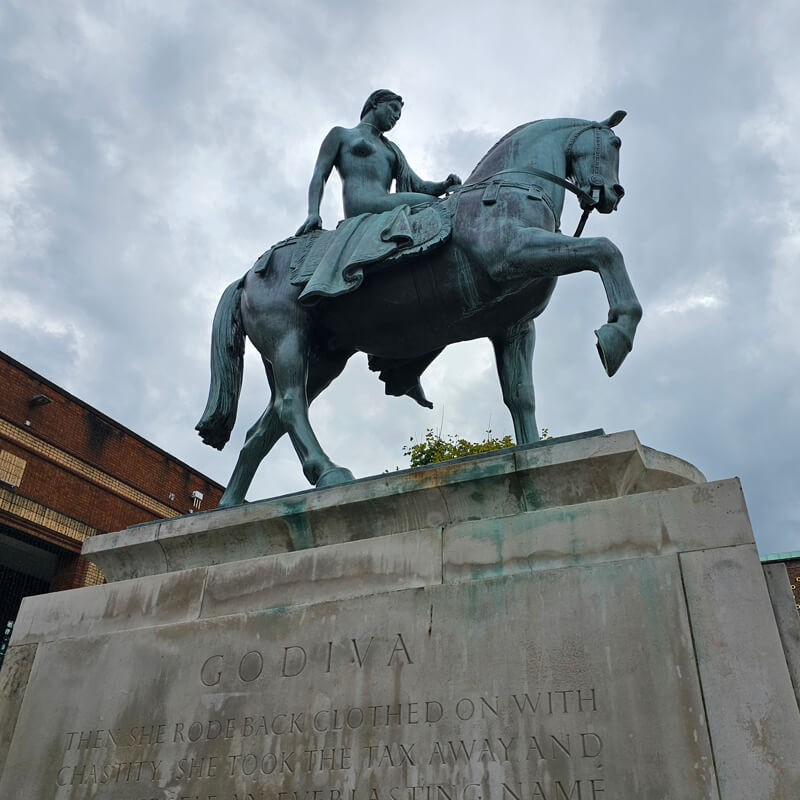
There were many celebrations to remember Lady Godiva’s courage. A pageant is held annually in Coventry to re-enact Lady Godiva’s original route through the town, which has been held in Coventry since the 17th century. A striking statue of Lady Godiva stands in Coventry’s central square, Broadgate, which was unveiled in 1949 and is listed Grade II.
Did you enjoy this post?
I hope you found this post useful. I put a great deal of time and effort in to building, maintaining and populating the website. If you like, you could say a small thank you by buying me a coffee. You don't have to, but it would be nice :)
Buy me a coffeeMore People Profiles
View all People Profiles
Stay up to Date
Follow me on my journey and get notified whenever a new post is published by following Kings & Castles on Facebook.
Follow MeExplore The Map
Discover the hundreds of castles, churches, monasteries, cathedrals and other historic locations that I've personally visited across England and Wales. Search by location, explore nearby sites and plan your next historical adventure.
Share: