Henry VII
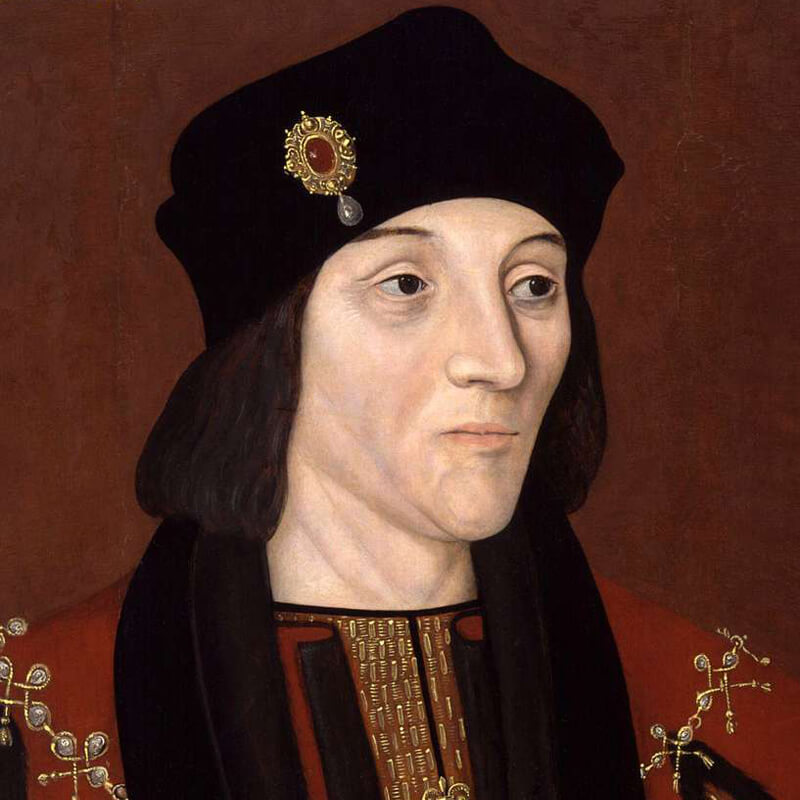
Henry VII, also known as Henry Tudor, was King of England from 1485 until his death in 1509. He was a Lancastrian and the founder of the Tudor dynasty, unifying the warring houses of York and Lancaster in the Wars of the Roses by defeating Richard III at the Battle of Bosworth Field in 1485, and through his marriage to Elizabeth of York. The first of the Tudor monarchs, he was succeeded by his son, the infamous Henry VIII.
Quick
Facts.
- Born: 1457
- Died: 1509
- Reign: 1485 - 1509
- House: House of Tudor
- Predecessor: Richard III
- Successor: Henry VIII
Early Life
Henry VII was born at Pembroke Castle, Pembrokeshire, Wales in 1457, during the turbulent reign of Henry VI. His parents were Edmund Tudor, Earl of Richmond, and Margaret Beaufort. He was born into the Lancastrian cadet branch of the House of Plantagenet. His father was a half-brother of King Henry VI, and was the son of Owen Tudor, a Welsh squire, and Catherine of Valois, the widow of King Henry V. His mother was the great-granddaughter of John of Gaunt, Duke of Lancaster, one of Edward III‘s younger sons.
Although Henry’s claim was a weak one, is was still legitimate. With the deaths of Henry VI and his only son, Edward of Westminster (also known as Edward of Lancaster) during the Wars of the Roses, Henry Tudor became the sole surviving male with any ancestral claim to the house of Lancaster, but he would have to wait a long time for his chance to take the throne.
Henry’s father died shortly before he was born, leaving his 13-year-old mother as his only parent, who soon married again. Henry was therefore raised by his uncle Jasper Tudor, the earl of Pembroke and a Lancastrian.
A series of civil wars known as the Wars of the Roses broke out in the 1450s, started by a Yorkist rebellion against King Henry VI and the Lancastrians. During Henry’s early years, his uncles and the Lancastrians fought against the Yorkist claimant, Edward IV. When the Lancastrians were defeated at the Battle of Tewkesbury in 1471, Edward IV took the throne for the second and final time, but this time killing Henry VI and his son, firmly establishing the house of York on the throne.
Fearing that Henry’s position as the strongest remaining Lancastrian claimant to the English throne made it too dangerous for him to remain, Jasper was forced to take young Henry Tudor out of the country and sought refuge in the duchy of Brittany, where Henry spent 14 years in exile. The Wars of the Roses continued throughout Henry’s exile, but support still existed for a Lancastrian to take the throne from the Yorkist Edward IV and his younger brother Richard III.
Henry’s Opportunity to be King
Edward IV died of an undiagnosed illness in April 1483 and was succeeded by his young teenage son, Edward V. Edward IV’s younger brother, Richard III, was made protector of the realm until young Edward was old enough to rule on his own. However, Richard usurped his young nephew before he could be crowned and took the throne or himself shortly afterwards in June 1483. Edward V and his younger brother were both locked in the Tower of London and mysteriously disappeared, likely murdered by their uncle Richard III. The two young princes become known as ‘The Princes in the Tower‘.
The usurpation of Richard III and the death of his only son split the Yorkist party and gave Henry his opportunity when the Lancastrian forces chose him as their representative for the succession of the English throne. Keen to bring an end to Richard’s reign and the house of York, Henry and Jasper raised an army made up of professional French troops and landed in Pembrokeshire in south Wales; their homeland and a stronghold of support for their forces. Furthermore, to unite the opponents of Richard III, Henry promised to marry Elizabeth of York, the eldest daughter of Edward IV, and thus unite the two warring houses and bring peace to the realm.
Henry was able to amass more support and recruit more soldiers as he marched through south Wales and travelled further towards London. Henry’s and Richard’s armies finally met and fought each other in a two-hour battle at the Battle of Bosworth Field, near the Leicestershire town of Market Bosworth on 22nd August 1485. Henry’s stepfather, Lord Thomas Stanley, held the crucial power of deciding which side he would support. He defected his support from Richard and changed his allegiance to Henry, taking with him his private army of around 7,000 soldiers and joined in later in the battle.
Although Richard’s army still outnumbered Henry’s forces, Henry won the battle and Richard was killed, though not by Henry himself. Richard III was the last English king to die in battle, and his death brought an end to the reign of the Yorkists and the Plantagenets, and the start of a new dynasty: the Tudors.
King Henry VII
Henry was crowned as the new monarch on the battlefield but was officially crowned on 30th October 1485 as Henry VII, and he ascended to the throne as the first monarch of the Tudor dynasty, a line which ruled England for over a century. Having established his claim to be king in his own right, Henry’s first task was to secure his position through his marriage to Elizabeth of York, the daughter of Edward IV and niece of Richard III in 1486, uniting the Plantagenet houses of Lancaster and York.
Unfortunately for Henry it would take many years for him to see a period of security for him and his throne. Not only was his claim weak, but he had also gained the throne by force. Nevertheless, Henry was determined to be able to pass the crown to a legitimate and incontrovertible heir through inheritance.
A Troubled Reign
Henry’s reign was troubled by revolts, conspiracies, pretenders, disgruntled Yorkists and threats from foreign powers, all of which he managed to overcome through careful political manoeuvring and decisive military action. Henry formed a personal bodyguard from his followers known as the ‘Yeomen of the Guard’, which is the oldest military corps in existence today.
Henry’s biggest threat came from a young boy called Lambert Simnel who claimed to be Edward, Earl of Warwick, the son of George, Duke of Clarence and nephew of Richard III and Edward IV. The real Earl of Warwick was in fact Henry’s prisoner, but this did not stop other people from believing that Lambert was him. Following Henry’s victory at the Battle of Bosworth in 1485, the Earl of Warwick, then ten years old, was imprisoned in the Tower of London as his claim to the throne posed a potential threat to Henry’s new Tudor dynasty.
The pretender gained the formidable support of the Yorkist John de la Pole, Earl of Lincoln, who was previously nominated as Richard III’s heir when Richard’s only son and heir died. John de la Pole took the oath of allegiance to Henry VII following the Battle of Bosworth instead of claiming the throne for himself. Still, he raised an army in support of the young pretender and rebelled against Henry, but they were defeated at the Battle of Stoke Field in 1487, decisively ending the Wars of the Roses for good. The Earl of Lincoln was killed and Lambert Simnel was captured, but, because he was only a child and had been a mere dupe, Henry spared his life and employed him as a royal servant. In order to prove that Lambert Simnel was an impersonator, Henry had the real Earl of Warwick paraded through the streets of London. He was then returned to the Tower where he remained a prisoner of Henry VII and was denied all contact with the outside world for the rest of his short life.
Then in the 1490s appeared another pretender: Perkin Warbeck, claiming to be Richard of Shrewsbury, Duke of York, who was the second son of Edward IV and one of the so-called ‘Princes in the Tower‘. With support from powerful men from the Continent, Ireland, England and James IV of Scotland, Perkin invaded England with small armies three times but met strong resistance from the King’s men before he was finally captured in Hampshire in 1497, and subsequently executed in November 1499.
Further plots were made against Henry, encouraged by the deaths of his sons in 1500 and 1502 and of his wife in 1503. Henry became suspicious of John de la Pole’s younger brother and leading Yorkist claimant to the throne, Edmund de la Pole, Earl of Suffolk, who was the eldest surviving son of Edward IV’s and Richard III’s sister, Elizabeth of York. It wasn’t until 1506 when he imprisoned the earl of Suffolk in the Tower of London that Henry could at last feel safe, and in the last years of his reign he finally gained confidence in his position.
Family and Death
Henry used dynastic royal marriages to establish his dynasty in England and help maintain peace, especially with Spain and Scotland. Henry and his wife had seven children, but only four survived infancy. As the eldest son, Arthur Tudor was to be King of England after the death of Henry, and in 1501 he married Catherine of Aragon, a princess from Spain, but he died a few months later in 1502. His eldest daughter, Margaret Tudor, was married to James IV of Scotland (from whom Mary Queen of Scots and her son James I of England were descended). This marriage concluded the 1499 Treaty of Perpetual Peace with Scotland, which was the first treaty between England and Scotland for almost two centuries, finally bringing peace between the two nations. Another daughter, Mary Tudor, the youngest of his children to survive infancy, was betrothed to Archduke Charles (later the Holy Roman emperor Charles V) but the match never came to fruition. Mary became the maternal grandmother of Lady Jane Grey, who was queen of England for nine days in July 1553.
Henry’s life took a difficult and personal turn in the early 1500s when two of his sons, his newborn daughter and his wife all died in quick succession. His youngest son, Edmund Tudor, died in 1500. Then in 1502 his first son and heir apparent, Arthur, Prince of Wales, died suddenly at Ludlow Castle, likely from the sweating sickness. And then in 1503, Henry’s wife gave birth to a daughter who died a few days later, followed by the death of his wife on 11th February, on her 37th birthday. Henry was devastated by the death of his wife and he mourned her deeply, shutting himself away for several days, refusing to speak to anyone. According to one biographer, the death of Elizabeth “broke the heart” of her husband and “shattered him”.
Henry’s younger son, also named Henry (Henry VIII), became heir to the throne when his older brother Arthur died. Henry VII died of tuberculosis at Richmond Palace in April 1509 and was buried in the chapel he commissioned in Westminster Abbey next to his wife, Elizabeth. He was succeeded by his only surviving son, Henry VIII in April 1509, who married Arthur’s widow, Catherine of Aragon. And just as Henry VII had hoped, his son succeeded him without a breath of opposition.
Henry VII’s Legacy
Henry VII was the last king of England to win his throne on the field of battle, and his 24-year-reign was a crucial turning point in British history. This often forgotten but truly pivotal and extremely intelligent monarch was able to strengthen the power of the monarchy by using traditional methods of government to tighten royal administration and increase revenues, making his country very prosperous and powerful. Henry was diligent about keeping detailed records of his personal finances, even down to the last halfpenny, enabling him to leave behind a fortune when he died.
Henry’s youth had been spent in conditions of adversity, often in danger of betrayal and death, and usually in a state of poverty. These experiences, together with the uncertainties of his reign, taught him to be secretive, wary and scrupulous, and to always be patient and vigilant. A lifetime of caution kept him from involvement in war, and instead used his diplomacy not only to safeguard his dynasty but to enrich his country, using every opportunity to promote English trade by making commercial treaties.
As Henry got older he started to suffer from poor health and began to look a little delicate. Many portraits and descriptions of him suggest a tired and anxious-looking man. Henry was a doting father and husband, completely devoted to his family. He is said to have been a high-spirited man, affable and gracious, displaying a friendly and pleasant manner. His biographer said of him – “he had a high degree of personal magnetism, ability to inspire confidence, and a growing reputation for shrewd decisiveness”. His experiences and needs had also made him acquisitive, a trait that increased with age and success, and one that was opportune for both the crown and the realm.
Did you enjoy this post?
I hope you found this post useful. I put a great deal of time and effort in to building, maintaining and populating the website. If you like, you could say a small thank you by buying me a coffee. You don't have to, but it would be nice :)
Buy me a coffee
Stay up to Date
Follow me on my journey and get notified whenever a new post is published by following Kings & Castles on Facebook.
Follow MeExplore The Map
Discover the hundreds of castles, churches, monasteries, cathedrals and other historic locations that I've personally visited across England and Wales. Search by location, explore nearby sites and plan your next historical adventure.
Share: