The Harrying of the North
The Harrying of the North (1069–1070) was one of the most devastating events in medieval English history. Ordered by William the Conqueror just three years after the Norman victory at the Battle of Hastings, the campaign aimed to crush rebellion in northern England through overwhelming force.
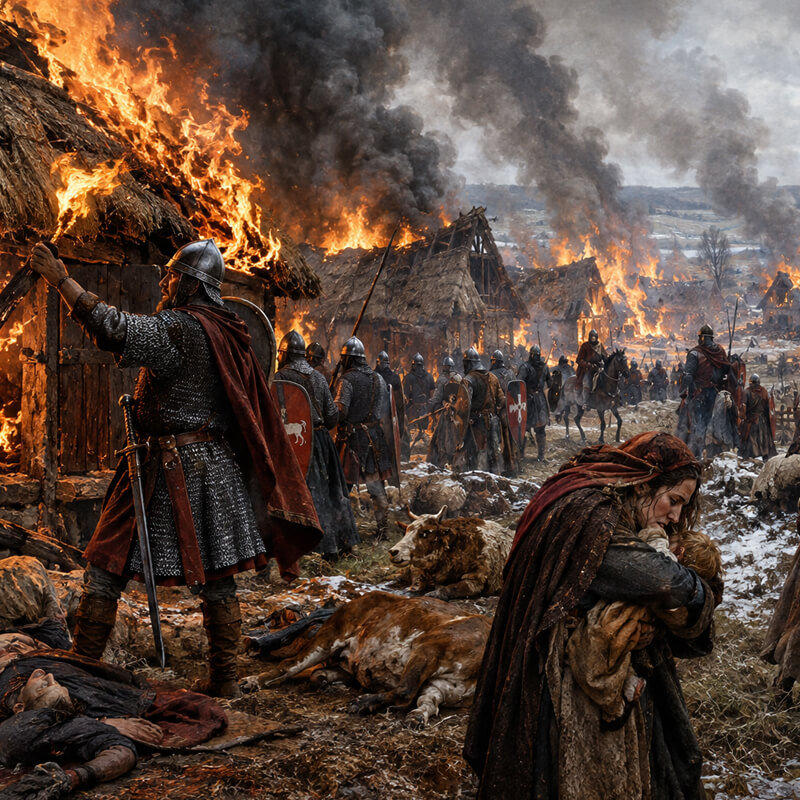
Why Did it Happen?
Although William the Conqueror had secured the English throne in 1066, his control over the country remained fragile. The north was particularly resistant to Norman rule, with Anglo-Saxon nobles repeatedly rebelling against the new king. Matters worsened when Danish forces arrived to support the rebels in 1069, capturing York and threatening William’s authority.
Determined to prevent further uprisings, William abandoned attempts at compromise. Instead, he launched a brutal campaign designed not simply to defeat rebels but to destroy their ability to resist.
The Campaign
During the winter of 1069–1070, Norman armies swept across Yorkshire, Durham, and parts of Cheshire and Northumbria, destroying entire villages. Soldiers burned homes, destroyed food stores, killed livestock, and ruined farmland. The timing was especially cruel; by striking during winter, William ensured that surviving people would face starvation.
The medieval chronicler Orderic Vitalis condemned William’s actions, writing that innocent men, women, and children suffered alongside rebels. Even some Norman writers viewed the campaign as exceptionally harsh.
One of the most famous accounts comes from the Anglo-Saxon Chronicle, which described widespread famine so severe that people resorted to desperate measures to survive.
How Many Died?
The true death toll remains debated. Medieval sources claimed that around 100,000 people died, but most modern historians believe this figure is exaggerated, as England’s population at the time was much smaller.
Even so, archaeological evidence and later records suggest that the destruction was enormous. The Domesday Book of 1086 recorded many northern settlements as “waste,” meaning they produced little or no taxable value years after the campaign. Whether every “waste” entry reflected direct destruction is debated, but the evidence points to long-lasting economic damage across much of the region.
Consequences
The Harrying of the North had lasting consequences for England.
- Norman control was strengthened. The rebellion effectively ended, allowing William to tighten his grip on northern England.
- Castles multiplied. The Normans built more fortifications, including castles at York and Durham, to prevent future revolts.
- The northern economy suffered. Many communities took decades to recover from famine and destruction.
- A legacy of fear emerged. The campaign became a symbol of William’s willingness to use extreme violence to secure his rule.
Was it Genocide?
Modern historians generally avoid describing the Harrying as genocide, as William’s primary aim was to destroy resistance rather than eliminate an ethnic group. Instead, it is more commonly described as a scorched-earth campaign or an act of medieval warfare marked by extraordinary brutality.
However, the scale of civilian suffering has made it one of the most controversial episodes of William’s reign. Historians continue to debate whether the destruction was as widespread as medieval chroniclers claimed or whether some accounts were exaggerated for dramatic effect.
Legacy
Nearly a thousand years later, the Harrying of the North remains a defining moment in the Norman Conquest. It demonstrated both William’s military effectiveness and the immense human cost of establishing Norman rule. While castles and cathedrals came to symbolise the new Norman England, the burned villages and abandoned fields of the north revealed the darker side of conquest — one where victory was secured through terror as much as through battle.
Did you enjoy this post?
I hope you found this post useful. I put a great deal of time and effort in to building, maintaining and populating the website. If you like, you could say a small thank you by buying me a coffee. You don't have to, but it would be nice :)
Buy me a coffee
Stay up to Date
Follow me on my journey and get notified whenever a new post is published by following Kings & Castles on Facebook.
Follow MeExplore The Map
Discover the hundreds of castles, churches, monasteries, cathedrals and other historic locations that I've personally visited across England and Wales. Search by location, explore nearby sites and plan your next historical adventure.
Share: