The Peasants’ Revolt
The Peasants’ Revolt of 1381 was one of the most important popular uprisings in medieval England. Thousands of peasants, labourers and townspeople took part, protesting against heavy taxation, unfair laws and the restrictions imposed by the feudal system.
Causes of the Revolt
One of the main causes was the social and economic impact of the Black Death, which had reached England in 1348. The disease killed a large proportion of the population, creating a shortage of workers. Surviving labourers could therefore demand higher wages and better conditions.
The government attempted to control these changes through laws such as the Statute of Labourers of 1351, which restricted wages and made it difficult for workers to leave their traditional employers. Many labourers believed these laws were unfair.
Taxation was another major cause. England was fighting the Hundred Years’ War against France, and the government needed large amounts of money. It introduced a series of poll taxes, requiring people to pay a fixed amount regardless of their wealth. The third poll tax, introduced in 1380, was particularly unpopular among poorer people.
The rebellion was also encouraged by resentment towards local officials, landlords and the legal system. Some people wanted greater freedom from feudal obligations and an end to the privileges enjoyed by the wealthy.
The Revolt Begins
The revolt began in Essex and Kent in June 1381. Resistance to tax collectors quickly developed into a wider rebellion. Tax records and legal documents were destroyed because they were seen as symbols of the system that oppressed ordinary people.
A preacher named John Ball became associated with the movement. He questioned the inequalities of medieval society and famously asked: “When Adam delved and Eve span, who was then the gentleman?”
In Kent, Wat Tyler emerged as an important leader. Thousands of rebels followed him towards London, hoping to present their demands directly to the young king, Richard II.
The Rebels in London
The rebels entered London in June. Some Londoners supported them, and the rebels attacked buildings and individuals associated with royal government and the legal system.
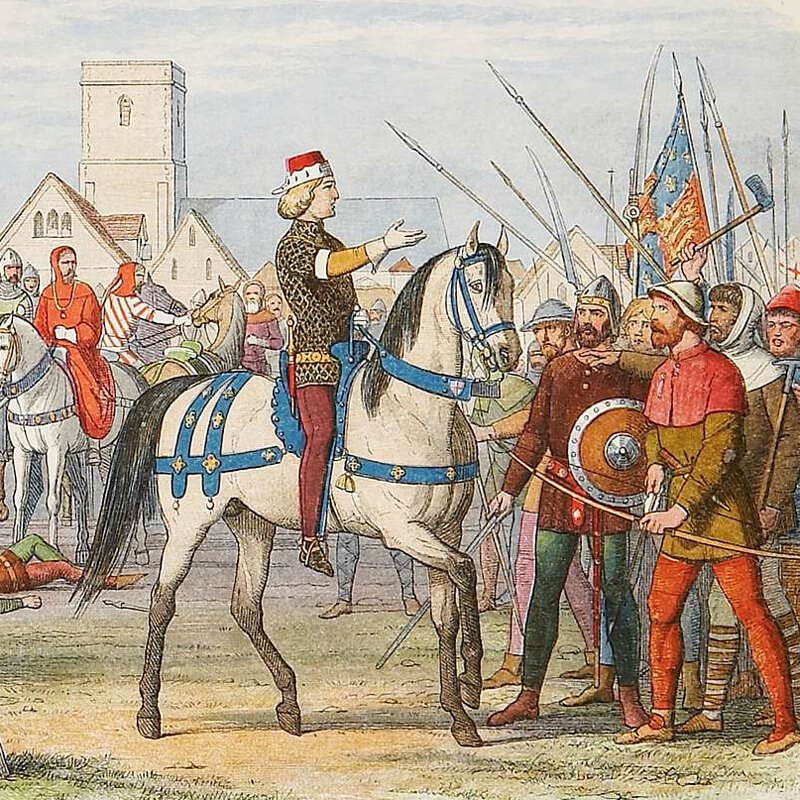
On 14th June, Richard II met the rebels at Mile End. The 14-year-old king promised reforms, including the abolition of certain feudal obligations and the granting of pardons. Many rebels believed their demands had been accepted and began returning home.
However, Wat Tyler and a large group remained in London. They wanted further changes, including greater social equality and reform of the Church and legal system.
The Death of Wat Tyler
On 15th June, Tyler met Richard II at Smithfield. During the meeting, an argument developed between Tyler and William Walworth, the Lord Mayor of London. Walworth attacked Tyler, who was fatally wounded.
Richard then addressed the rebels and promised to grant their freedom. The rebels gradually dispersed, believing the king’s promises.
Once the immediate danger had passed, however, the government withdrew many of its concessions. Royal forces hunted down the remaining rebels. Wat Tyler was dead, and John Ball was captured and executed. Hundreds of other rebels were also executed.
Consequences and Legacy
The Peasants’ Revolt failed to bring about the immediate reforms demanded by its leaders. The feudal system survived, and the government continued to enforce its authority.
However, the revolt demonstrated the growing power of ordinary people and revealed serious tensions within medieval society. The government abandoned the unpopular poll tax system, while the long-term decline of serfdom continued during the following centuries.
The revolt is remembered not simply as a rebellion by peasants, but as a widespread protest against taxation, inequality and political injustice. The events of 1381 showed that even a powerful medieval government could be challenged when large numbers of ordinary people united against it.
Did you enjoy this post?
I hope you found this post useful. I put a great deal of time and effort in to building, maintaining and populating the website. If you like, you could say a small thank you by buying me a coffee. You don't have to, but it would be nice :)
Buy me a coffee
Stay up to Date
Follow me on my journey and get notified whenever a new post is published by following Kings & Castles on Facebook.
Follow MeExplore The Map
Discover the hundreds of castles, churches, monasteries, cathedrals and other historic locations that I've personally visited across England and Wales. Search by location, explore nearby sites and plan your next historical adventure.
Share: