The Princes in the Tower
In 1483, the two young sons of the deceased Edward IV, aged 12 and 9 years old, were held in the Tower of London by their uncle Richard, Duke of Gloucester, in preparation for Edward V’s forthcoming coronation. But instead, the young princes mysteriously disappeared and were never seen again, and their uncle Richard was conveniently crowned instead, as Richard III.
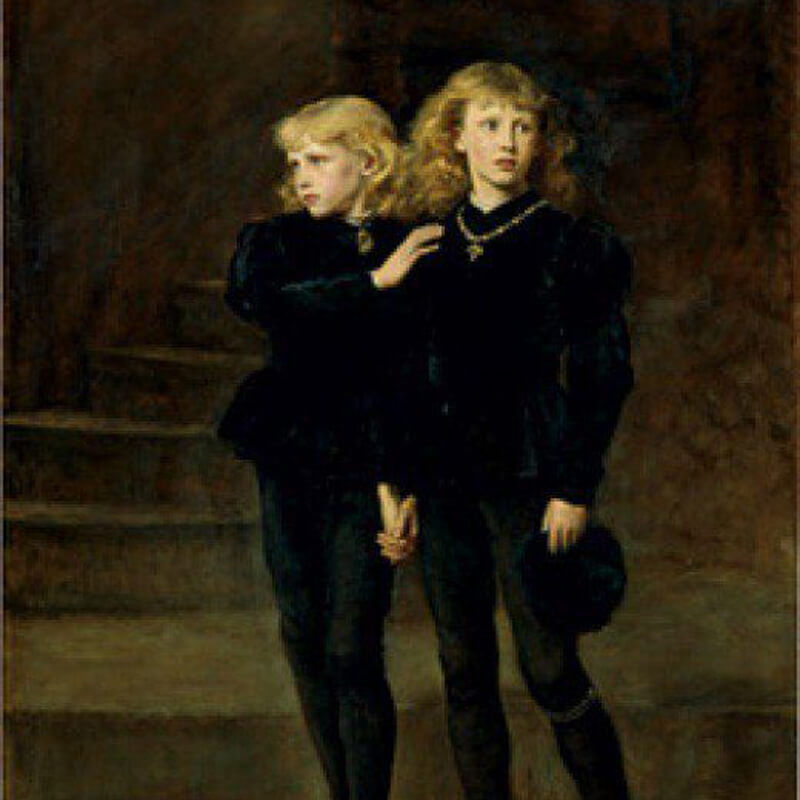
The Yorkist king Edward IV was the king of England twice, from 1461 to 1470, then again from 1471 until his death in 1483. He and his wife Elizabeth Woodville had several children, including two princes and heirs to the throne, Edward, Prince of Wales, and Richard of Shrewsbury, Duke of York.
The two princes had been born into tumultuous times, in the midst of the epic dynastic battle known as the Wars of the Roses, between the warring houses of York and Lancaster. Edward was born in London in 1470, and his brother Richard was born in 1473 in Shrewsbury. When their father, King Edward IV died suddenly in April 1483, his eldest surviving son was proclaimed Edward V at Ludlow, aged just 12 years old. But the young king would have the shortest reign of any English monarch, lasting only two months and seventeen days.
Edward’s uncle, his father’s brother, Richard, Duke of Gloucester (the future Richard III), was appointed as protector of the realm, to serve as Edward’s protector until young Edward was old enough to rule on his own. But this marked the beginning of a power struggle between Richard and the Woodvilles over Edward V and his ascendancy to the throne.
The Woodville nobles, who were Edward’s family on his mother’s side, dominated the royal council and wanted Edward to be crowned immediately, which would avoid the protectorate under his uncle Richard, and instead place more power in the hands of the Woodvilles by attempting to replace Richard with a regency council. As a result of the attempted power grab, tensions began to rise and Richard grew suspicious of the Woodville faction. For Richard, such influence from Edward’s mother and extended family was unacceptable and thus he hatched a plan that would secure the fate of the Yorkist throne with himself. Richard had many of the Woodville nobles arrested, and some were even executed.
Arrangements were then made for the new young king to travel to London for his coronation, but his uncle Richard had more sinister ideas. Richard intercepted Edward on the way to London and had him lodged in the Tower of London, apparently for his own safety. Then, instead of arranging a coronation for his nephew, Richard decided to take the throne for himself. Edward was soon joined in the Tower by his younger brother, Richard of Shrewsbury, who was aged just 9 years old. They were told to stay at the Tower for their own safety to wait for Edward’s coronation, but the two royal boys were instead held in captivity, heavily guarded at the new royal lodgings.
Richard convinced Parliament that the two young princes, his nephews, were not the legal heirs to the throne, claiming that Edward IV’s marriage was invalid and his children illegitimate. After Edward IV had died, it was revealed that he was contracted to marry someone else before his marriage to Elizabeth Woodville, so Edward IV’s marriage to Elizabeth was therefore seen as bigamy. This was very convenient for Richard and very strange that it was only mentioned after Edward IV’s death, so it was likely false. Nevertheless, Parliament accepted Richard’s claims, and in June 1483 Edwards V’s brief reign came to an end. Richard successfully deposed his nephew and was crowned King Richard III in July 1483.
The two boys then mysteriously disappeared without a trace, never seen alive again. They have since become known as the ‘Princes in the Tower’. What happened to them still remains a mystery today, but it is most likely and widely accepted that they were murdered on the orders of their uncle, Richard III.
In 1674 during building work at the Tower of London, a wooden chest was found under a staircase in the White Tower that contained the bones of two young boys. It has never been proved that these were the missing princes, but King Charles II stated that they were, and had the bones buried in Westminster Abbey. In 1933 the bones were looked at again by scientists who believed that they were the two princes. More recently, further evidence was discovered in historical documents which connected Richard III and people close to him to the murders of the two boys.
We may never know the definitive truth about what happened to the two young princes, but Richard III definitely had means, motives and prior for killing rivals. But we discredit so much as Tudor propaganda when a lot of it is most likely true.
Did you enjoy this post?
I hope you found this post useful. I put a great deal of time and effort in to building, maintaining and populating the website. If you like, you could say a small thank you by buying me a coffee. You don't have to, but it would be nice :)
Buy me a coffee
Stay up to Date
Follow me on my journey and get notified whenever a new post is published by following Kings & Castles on Facebook.
Follow MeExplore The Map
Discover the hundreds of castles, churches, monasteries, cathedrals and other historic locations that I've personally visited across England and Wales. Search by location, explore nearby sites and plan your next historical adventure.
Share: