Richard III
Richard III was the King of England from 1483 until his death in 1485. He deposed and possibly murdered his nephew, the young Edward V. Richard III was the last king of the Plantagenet dynasty and its cadet branch, the House of York. His defeat and death at the Battle of Bosworth Field to Henry Tudor (thereafter Henry VII) marked the end of the Wars of the Roses, the end of the Middle Ages in England, and the start of the Tudor period.
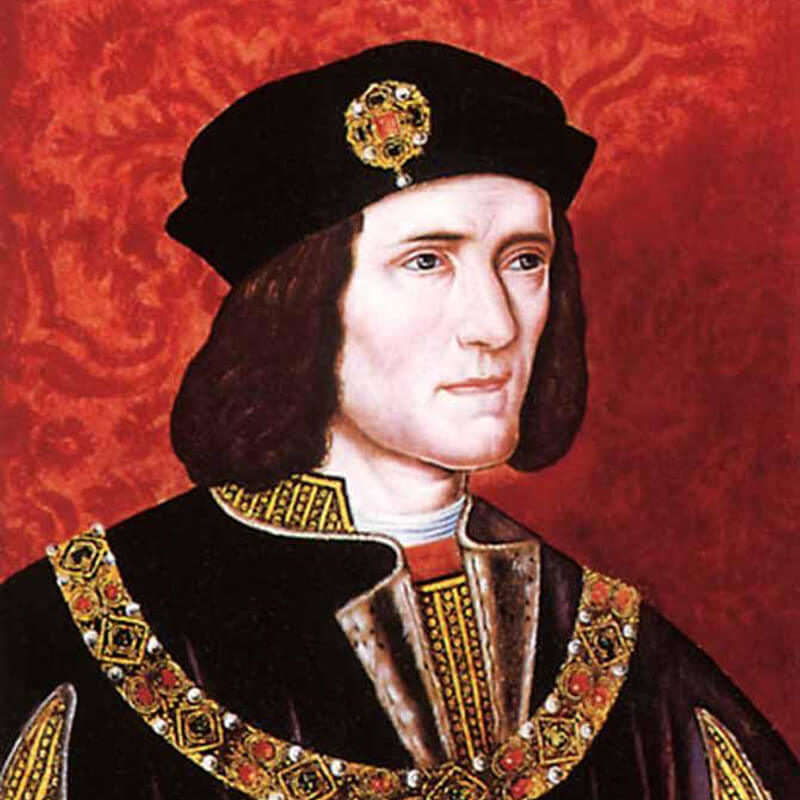
Quick
Facts.
- Born: 1452
- Died: 1485
- Reign: 1483 - 1485
- House: House of Plantagenet
- Predecessor: Edward V
- Successor: Henry VII
Early Life
Richard III was born in 1452 at Fotheringhay Castle in Northamptonshire, just a few years before the the Yorkist-Lancastrian conflict known as the Wars of the Roses began. He was the youngest son of Richard Plantagenet, Duke of York, and his wife, Cecily Neville. His father was the most prominent duke in England, of royal descent, and the most powerful nobleman of his day. Richard had three elder brothers, Edward (Edward IV), Edmund and George. Both his parents were direct descendants of King Edward III, giving Richard and his brothers a potential claim to the throne.
As a child, Richard fell under the influence of his cousin, Richard Neville, Earl of Warwick, who would guide and tutor him in his training as a knight. The earl would later become known as ‘the Kingmaker’ for his involvement in the power struggles emerging out of the War of the Roses.
Richard’s family belonged to the House of Plantagenet, and his ancestors had sat on the English throne since 1154. However, the house of Plantagenet had split into two opposing factions; the House of Lancaster and the House of York, both keen to claim the throne for themselves. The Lancastrian line had ruled since 1399, but Henry VI‘s weak rule and subsequent mental illness prompted Richard’s father, as a descendent of Edward III via the Yorkist line, to pursue his own claim to the throne in 1455.
Richard’s cousin, King Henry VI of the House of Lancaster, sat on the throne of England but was mentally unstable and proved to be a weak ruler, and Richard’s father believed that he had a better claim to the throne. In the 1450s, Henry VI suffered a series of mental breakdowns and severe depression. Henry collapsed mentally and physically, unable to speak and unable to rule, so in 1454 after months of crisis Richard’s father, the Duke of York, became Protector of the Realm.
The Wars of the Roses Begins
Soon after, tensions mounted between the Duke of York and the Lancastrians over control of the incapacitated King’s government, and war inevitably broke out. The Yorkists and the Lancastrians began to prepare for battle, recruiting soldiers and making preparations for war, with supporters choosing either a Red Rose to represent the House of Lancaster or a White Rose for the House of York.
Richard’s father, the Duke of York, led a revolt against the king, and the first battle of the civil war took place on 22nd May 1455 at St Albans, marking the start of the War of the Roses. After five years of civil war between the Lancastrian and Yorkist factions, with a great loss of life on both sides, Henry VI was captured at the Battle of Northampton in July 1460, imprisoned in the Tower of London, and was forced to accept the Act of Accord which disinherited his own son in favour of Richard’s father, the Duke of York.
In December 1460 Richard’s father was killed at the Battle of Wakefield alongside one of their older brothers, Edmund. The eldest brother, Edward, who was a very good soldier and an able commander, became the new duke of York and inherited their father’s claim and took up the fight. With the support of the powerful Earl of Warwick (the Kingmaker), Edward defeated the Lancastrians in a series of battles, culminating in the Battle of Towton in 1461 when Henry VI was overthrown and Edward was crowned King Edward IV on 28th June 1461. Edward remained on the throne for the next nine years. As a result of their elder brother’s ascension to the throne, Richard and George both became powerful men; Richard became a royal prince, he was created Duke of Gloucester and a knight of the Most Noble Order of the Garter.
With Edward now in power, the Earl of Warwick began to strategise, arranging for his daughters advantageous marriages. George, Duke of Clarence, married Warwick’s daughter Isabel. Believing he could control the king, Warwick was keen to negotiate a foreign marriage for him, but in 1464 Edward secretly married Elizabeth Woodville, a commoner and widow of a Lancastrian supporter. Warwick was furious by Edward’s decision and switched his allegiance to the Lancastrians, leading George to side with his new father-in-law whilst Richard remained loyal to his his brother, the King, Edward IV.
George was recruited to the cause when Warwick promised him that he would be next in line to the throne after Henry VI’s son, should he support the Lancastrians against his brother. Warwick and George became allies and fled to France where they joined Margaret of Anjou, wife of Henry VI. They then led a revolt against the king, and their Lancastrian army invaded England in September 1470. However, Warwick had his own agenda for the throne and after marrying his other daughter, Anne Neville, to Henry VI’s son he managed to overthrow his fellow Yorkists with the support of the Lancastrian army, allowing Henry to reclaim the throne in October 1470.
Richard and Edward fled to the Continent where the Duke of Burgundy, Charles the Bold, sided with Edward and the Yorkists and provided the support he needed to reclaim his throne. Richard and Edward returned to England in March 1471 with the support of Charles and their brother George, who decided to become loyal to them once more.
Richard would prove instrumental despite being only 18 years old. Whilst not as robust as his brothers, his training as a knight held him in good stead and he proved himself to be a good soldier. Richard, Edward and the Yorkists defeated and killed the Earl of Warwick at the Battle of Barnet in April 1471 before defeating the Lancastrians and killing Henry VI’s son and heir, Edward of Westminster, at the Battle of Tewkesbury in May. Richard was slightly wounded during the Battle of Barnet but he was a prominent figure in both battles.
Henry VI was put to death in the Tower of London and Edward took the throne for the second and final time in 1471, and remained king of England and the first Yorkist king until his death in 1483.
The Rise of Richard III
In 1472, Richard married Anne Neville, the daughter of the now deceased Earl of Warwick (the Kingmaker), and the widow of Henry VI’s son. Richard and Anne lived at Middleham Castle in North Yorkshire. They had one son, who was named Edward after Richard’s brother, but he died before the age of 10.
Richard’s marriage to Anne Neville made him one of the greatest landowners in the country, controlling large swathes of the north of England and effectively, but not officially, becoming ‘Lord of the North’. Richard’s share of the Neville inheritance gave him substantial financial gain, but also great responsibility. Edward IV delegated significant authority to Richard in the region, where Richard became the dominant magnate in the north of England until Edward’s death. Richard once again proved himself by handling the administration of the region as an intelligent tactician, and also proved himself as a leader and military figure when he led a series of successful campaigns into Scotland in the early 1480s.
The Neville lands centred on the castles of Middleham in Richmondshire (now North Yorkshire), Barnard in Durham, and Penrith in Cumbria. But Richard massively extended his estates, adding the castles of Helmsley, Richmond, Scarborough, and Skipton, all in Yorkshire. He recruited a large retinue and asserted himself over the other northern peers. Even the earls of Northumberland and Westmorland accepted his superiority, but he was especially highly regarded in the city of York.
But what of Richard’s treacherous brother George of Clarence? Having realised his mistake and rejoining his brothers to defeat the Lancastrians at the Battle of Barnet, he was nevertheless tried for treason against the restored King and was executed in private at the Tower of London on 18th February 1478. However, there is a widely held belief that George was drowned in a casket of wine (also purported to be true by Shakespeare in his plays Henry VI and Richard III), thought to be a humorous reference to the fact that George was fond of a drink or two.
Richard, demonstrating his ability to handle responsibilities separate from his brother, made himself more dominant than the king had originally intended. His self-advancement and achievements in the north gave him great power, and this would be the power base for Richard as King.
Richard Usurps the Throne
Edward IV died of an undiagnosed illness in April 1483 and was succeeded by his 12-year-old son, Edward V. His father had already made arrangements to have Richard to serve as Edward’s protector by appointing him protector of the realm until young Edward was old enough to rule on his own. This would mark the beginning of a power struggle between Richard and the Woodvilles over Edward V and his ascendancy to the throne.
The Woodville nobles, who were Edward’s family on his mother’s side, dominated the royal council and wanted Edward to be crowned immediately, which would avoid the protectorate under his uncle Richard, the Duke of Gloucester, and instead place more power in the hands of the Woodvilles. For Richard, such influence from his mother, Elizabeth Woodville and her extended family was unacceptable and thus he hatched a plan that would secure the fate of the Yorkist throne with himself.
A conflict between Richard and the Woodville nobles broke out and Richard had them arrested. Arrangements were then made for the new young king to meet with Richard so they could journey down to London together for Edward’s coronation on 24th June, but his uncle Richard had more sinister ideas.
Edward’s other uncle, Earl Rivers, and Richard Grey, an older half-brother to the uncrowned king, were taken north and executed by Richard in June at Pontefract Castle. Then, instead of arranging a coronation for his nephew, Richard decided to take the throne for himself. Edward and his younger brother, Prince Richard of Shrewsbury, who was aged just 9 years old, were both sent to live in the Tower of London and wait for Edward’s coronation, but the two royal boys were instead held in captivity, heavily guarded at the new royal lodgings at the Tower, and were never seen again.
The Reign of Richard III
Richard convinced Parliament that the two young princes, his nephews, were not the legal heirs to the throne, claiming that Edward IV’s marriage was invalid and his children illegitimate. After Edward IV had died, it was revealed that he had been engaged to a woman named Eleanor Butler, so Edward IV’s marriage to Elizabeth Woodville was seen as bigamy. Parliament accepted Richard’s claims, and on 26th June 1483 Edwards V’s brief reign came to an end. Richard successfully deposed his nephew and was crowned King Richard III, alongside his wife Anne, on 6th July 1483, marking the beginning of a turbulent two-year reign.
Soon afterwards, the two princes disappeared from the Tower, and what happened to them is still a mystery today. They have since become known as ‘The Princes in the Tower‘. It is most likely they were murdered by their uncle, Richard III. But it has also been suggested that they may have been murdered by Henry VII, who would overthrow Richard and become king two years later. During his two years as reigning monarch, Richard would have to face threats and challenges to his position as king, and some devastating personal losses.
After only a year on the throne, his only son Edward died in July 1483, leaving Richard with no natural heirs. This opened up speculation and attempts to claim the throne, and things were made worse for Richard when his queen, Anne, also passed away whilst he was still grieving his son. Also, as people started to believe that Richard had ordered the two young princes to be killed, many people turned against him, one of them was Richard’s friend, the Duke of Buckingham, who started a failed rebellion. Having lost his son and heir, Richard chose to nominate John de la Pole, Earl of Lincoln as his successor, but this led the Lancastrian forces to choose their own representative for the succession: Henry Tudor. Henry Tudor’s personal claim to the throne was through the legitimate but weak Beaufort line; he was a direct descendant through his mother Margaret Beaufort, who was a descendant of John of Gaunt, one of Edward III‘s younger sons.
The Fall of Richard III
Henry Tudor was a distant relative of the House of Lancaster who became Richard’s main enemy and most effective opposition, keen to bring an end to Richard’s reign and the House of York. In August 1485, Henry Tudor and his uncle, Jasper Tudor, raised an army made up of professional French troops and landed in south Wales, recruiting more soldiers as they marched through Pembrokeshire.
Richard’s and Henry’s armies finally met and fought each other in a two-hour battle at the Battle of Bosworth Field, near the Leicestershire town of Market Bosworth on 22nd August 1485. Another important figure in the battle was Henry Tudor’s stepfather, Lord Thomas Stanley who held the crucial power of deciding which side he would support. In the end he defected his support from Richard and changed his allegiance to Henry, taking with him his private army of around 7,000 soldiers and joined in later in the battle. This was a critical moment for Richard as the battle would define his future as king.
Although Richard’s army still outnumbered Henry’s forces, Henry won the battle and Richard was killed, though not by Henry himself. He suffered thirteen head wounds, with two so severe that they would have killed him almost immediately. After the battle, his body was stripped of clothing and carried naked on the back of a horse to Leicester, where he was buried at Greyfriars Franciscan Friary.
Richard III was the last English king to die in battle, and his death brought an end to the reign of the Yorkists and the Plantagenets, and the start of a new dynasty: the Tudors, when Henry Tudor ascended the throne as Henry VII and married Elizabeth of York, the daughter of Edward IV, uniting the houses of Lancaster and York.
Richard III’s Legacy
There has been discussion for many years about whether Richard III was a good king or a bad king. For almost 500 years after his death, he was generally depicted as the worst and most wicked of kings. After Henry VII won the Battle of Bosworth Field, Richard III was often treated as a villain in writings and stories. For example, in Shakespeare’s play Richard III, he is shown to be totally evil. However some writers from the time of Richard’s reign make him a hero and ignore his flaws. Nowadays, Richard’s evilness is regarded as excessive, the work of his enemies, and his supporters have attempted to rehabilitate his image, with modern scholars taking a more balanced approach that avoids the extremes of either side.
More recently, his supporters have argued for his merits as a good husband, a pious Christian, a loyal subject, and a king committed to good governance. He possessed many qualities expected of a medieval king: courage, competence as a general and administrator, generosity, an interest in chivalry, and conventional piety. However, ultimately Richard usurped his young nephew (and likely murdered him) and took the crown because of self-interest, and afterwards he appeared to be fighting for his own benefit only.
Richard was also known for his disfigured appearance. Rumours of his unnatural birth occurred after his death, such as a difficult labour, a breech birth, and his emergence with teeth and hair, all of which were likely made up. However, apparently a small man, Richard did suffer from scoliosis (a type of curvature of the spine). But he wasn’t a hunchback nor physically incapacitated as generally believed, as he prove himself to be a great and very capable soldier. In 2012 a skeleton exhibiting signs of mortal injury inflicted in battle and of scoliosis was uncovered by archaeologists in a Leicester car park, and in 2013 genetic testing confirmed that the skeleton was that of Richard III.
Did you enjoy this post?
I hope you found this post useful. I put a great deal of time and effort in to building, maintaining and populating the website. If you like, you could say a small thank you by buying me a coffee. You don't have to, but it would be nice :)
Buy me a coffee
Stay up to Date
Follow me on my journey and get notified whenever a new post is published by following Kings & Castles on Facebook.
Follow MeExplore The Map
Discover the hundreds of castles, churches, monasteries, cathedrals and other historic locations that I've personally visited across England and Wales. Search by location, explore nearby sites and plan your next historical adventure.
Share: