The Wars of the Roses
The Wars of the Roses were a series of civil wars fought between the Plantagenet cadet houses of York and Lancaster over control of the English throne between the years 1455 and 1487. The wars were named for the emblems of the two houses, the white rose of York and the red rose of Lancaster, both of which claimed the throne through descent from Edward III.
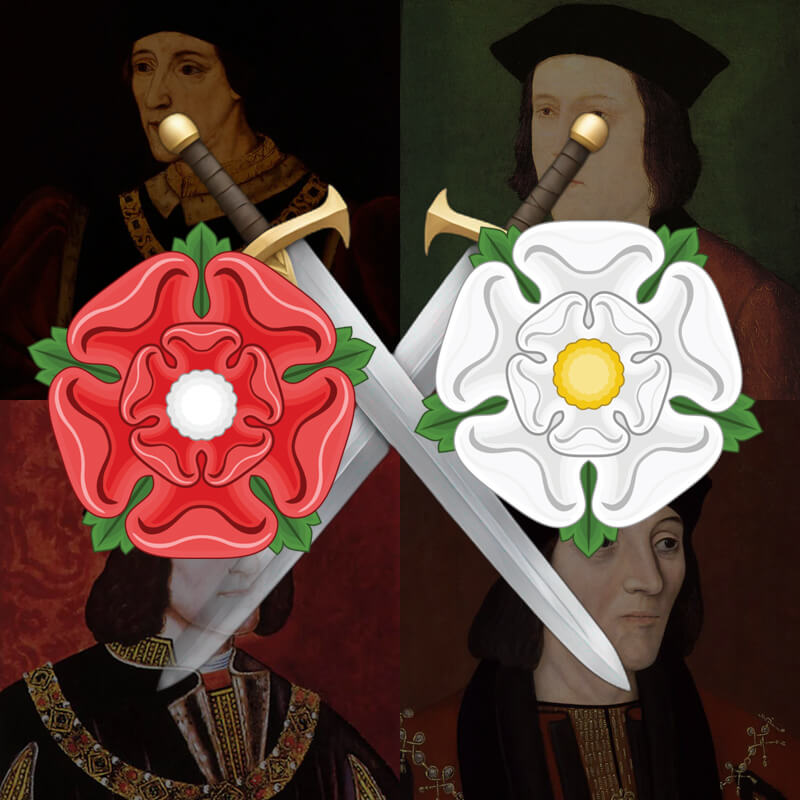
The Wars of the Roses is a very long and complicated story. In short, it is all centred around usurpation and the complicated line of succession through generations of Edward III‘s descendants. The civil wars took place in 15th century, starting with the reign of Henry VI and ended with the reign of Henry VII, but to fully understand this dynastic feud we need to know about the origins of the wars, and to do that we need to travel back several generations to the reign of Edward III in the 1300s.
NOTE: This is a very long post, possibly the longest post I’ll ever write as I go into a lot of detail. If you want to skip the origins of the events that led to the Wars of the Roses then you can click here to skip this section. But, if you want to learn about the origins or the wars, understand who’s who and the line of succession and what led the relatives to fight over the throne, read on…
Setting the Stage
Edward III
Edward III was King of England for an impressive 50 years, from 1327 until his death in 1377. He was a powerful king and arguably the greatest of all the Plantagenet kings of England. He was an able soldier, an inspiring leader, builder of castles, conqueror of French lands, and the founder of the Order of the Garter. His reign saw the beginning of the Hundred Years’ War against France, at which time he gained a significant amount of French lands. Edward III was the progenitor of both the Plantagenet cadet houses of York and Lancaster, and the descendants of his children contested the throne for generations, culminating in the Wars of the Roses.
Edward III and his wife, Philippa of Hainault, had eight sons and five daughters, but not all survived to adulthood. His five surviving adult sons all became very powerful magnates, and it was the descendants of these five sons that fought over the throne of England for several generations. Each branch of the family had competing claims through seniority, legitimacy, and/or the sex of their ancestors, despite patriarchal rule of the day.
The surviving sons of Edward III
- Edward of Woodstock, Prince of Wales, more famously known as the Black Prince, was the eldest son and heir apparent of Edward III. However, he died before his father and so his son, Richard II, succeeded to the throne instead when Edward III died.
- Lionel of Antwerp, 1st Duke of Clarence, was the third son (second surviving) of Edward III. However, he also died before his father.
- John of Gaunt, Duke of Lancaster, was the fourth son (third surviving) of Edward III, and the father of King Henry IV. John of Gaunt was the eldest surviving son at the time of Edward III’s death.
- Edmund of Langley, 1st Duke of York, was the fifth son (fourth surviving) of King Edward III.
- Thomas of Woodstock, Duke of Gloucester, was the seventh son (fifth surviving) and youngest child of Edward III.
House of Lancaster
John of Gaunt married the wealthy heiress, Blanche of Lancaster, and so was granted her father’s entire Lancastrian inheritance including lands and the title of Duke of Lancaster upon his death. This was the creation of the Plantagenet cadet house of Lancaster, which passed down through John of Gaunt’s descendants. All the Lancastrian kings therefore claimed descent through John of Gaunt as the third surviving son of Edward III. The Lancastrian kings; Henry IV, V and VI, ruled England from 1399 to 1461, and again from 1470-71.
In 1399 John of Gaunt’s only surviving legitimate son, Henry Bolingbroke, seized the throne from his cousin, Richard II, and became King Henry IV, the first Lancastrian king. Henry IV’s son, King Henry V, the second Lancastrian king, reignited the Hundred Years’ War with France and was so successful that he was declared heir to the throne of France. However, he died when his only son was still a baby. That baby was Henry VI, the third and final Lancastrian king, whose reign was dominated by conflict between his closest relatives. This conflict, and the loss of the French kingdom, eventually led to the Wars of the Roses.
An important branch of the House of Lancaster was the House of Beaufort, whose members were descended from John of Gaunt by his mistress, Katherine Swynford. Originally illegitimate, they were legitimised by an Act of Parliament when Gaunt and Katherine later married. However, Henry IV excluded them from the line of succession to the throne, but this didn’t stop Henry VII from claiming the throne several generations later which put an end to the Wars of the Roses. Henry VII’s father was a Tudor, but he traced his claim to the English crown through a female line by his mother, Margaret Beaufort, great-granddaughter of John of Gaunt.
House of York
The House of York were descended from Edmund of Langley, 1st Duke of York (founder of the House of York), fifth son (fourth surviving) of Edward III. All three of Edmund of Langley’s children became embroiled in plots against the Lancastrian kings between 1399 and 1415. The last of these children, Richard, Earl of Cambridge, married into the family of Edward III’s second surviving son, Lionel of Antwerp, 1st Duke of Clarence. It was this connection that eventually gave the House of York their claim to the throne of England.
The second duke of York died at the Battle of Agincourt and had no children, so the title passed to his nephew, Richard Plantagenet, who became the third duke of York. Richard Plantagenet was the son of Richard, Earl of Cambridge and his wife, Anne Mortimer. Both his parents were descended from Edward III: his father was the son of Edmund of Langley, 1st Duke of York (founder of the House of York), fourth surviving son of Edward III, whereas his mother, Anne Mortimer, was a great-granddaughter of Lionel of Antwerp, 1st Duke of Clarence, Edward III’s second surviving son.
It was Richard of York’s conflict with Henry VI’s Lancastrian advisors in the 1450s that led to the Wars of the Roses. Although Richard died in battle in 1460 without claiming the throne, his eldest son succeeded in taking the throne from the Lancastrians and was crowned Edward IV in 1461, the first Yorkist king. Edward’s son, Edward V, had a very brief reign as the second Yorkist king, and finally, Edward IV’s younger brother, Richard III, was the third and final Yorkist king.
The Usurpation of Richard II
When Edward III died in June 1377, he outlived his eldest son and heir, Edward the Black Prince, and was therefore succeeded by his ten-year-old grandson, Richard II, son of the Black Prince. However, Richard’s uncle, John of Gaunt, wielded most of the power and took a leading role in the ruling of the country, along with another of Richard’s uncles, Thomas of Woodstock, Edward III’s youngest son.
Richard II proved to be a terrible king. He ignored the advice of his most important nobles and failed in his responsibilities as a king. He had his uncle, Thomas of Woodstock, arrested for treason and murdered. When his other uncle, John of Gaunt, died in February 1399, Richard confiscated the vast Lancastrian estates, which should have passed to his son, Henry Bolingbroke, Richard’s cousin, who he had exiled the year before. Richard’s actions only exemplified his tyrannical image and ultimately led to his downfall.
Henry, disinherited and exiled, was furious. Henry seized his opportunity and invaded England in June 1399 with a small force that quickly grew in numbers. Within a matter of months he deposed Richard who surrendered without a fight. Richard was captured and persuaded to give up the throne to his cousin Henry, as most of the nobility were keen to support Henry as king. He had himself crowned King Henry IV, thus, the House of Lancaster began its rule with a usurpation of the English throne.
The senior Plantagenet line was ended with the death of Richard II, and the heirs presumptive through Lionel of Antwerp were passed over in favour of the powerful Henry IV, descendant of Edward III through John of Gaunt. Richard II was a bad king who’s downfall was of his own doing, and it is widely accepted that Richard’s misrule, tyranny and his deposition were responsible for the Wars of the Roses several decades later.
The Lancastrian Kings
Henry IV’s first task was to consolidate his position, and he used his descent from Edward III to justify his usurpation of the throne. He spent much of his reign fighting to keep control of his lands, defending himself against plots, rebellions and assassination attempts, most of which were quashed easily.
Henry faced many challenges throughout his reign, and despite the successful defeats of rebellions and plots against him, his continuous battle to remain on the throne took its toll on him. His reign was difficult, continually challenged and questioned, and in 1413 Henry IV died weary and exhausted. He was succeeded by his son Henry V, also known as Prince Hal, who went on to become one of the great warrior kings of medieval England.
Henry V faced his own challenges. As the son of a usurper he also had to convince people of his legitimacy and his right to be on the throne. In 1415, Richard, Earl of Cambridge, father of Richard Plantagenet, 3rd Duke of York, was executed for organising a plot against Henry V, which planned to replace him in favour of Edmund Mortimer, Earl of March, descended from Edward III’s second son, Lionel of Antwerp.
Despite this, Henry V became one of the most famous kings in English history and made England one of the most powerful kingdoms in Europe. He achieved this through his famous St Crispin’s Day speech, his legendary victory at the Battle of Agincourt which is one of England’s most celebrated victories and was one of the most important English triumphs in the Hundred Years’ War, for gaining the largest holding of French territory by an English king since the Angevin Empire, and by becoming the heir to the French throne through his marriage to Princess Katherine of France.
Henry V died in August 1422, probably of dysentery, and was succeeded by his nine-month-old son, who was crowned Henry VI of England and Henry II in France. He succeeded to both the thrones of England and France before the age of one, when his father and his grandfather Charles VI of France died within months of one another, making him the only English monarch to have been crowned King of France.
Unfortunately his son’s reign would be a disaster. Henry VI was the complete opposite of his father; shy, timid and prone to mental breakdowns. By now, the Lancastrian dynasty was well established, but Henry VI would go on to lose all the French lands won by his father and find himself at the centre of the Wars of the Roses, turning England into a chaotic nation.
The Rules of Succession
Before we get to the Wars of the Roses, it is important to understand the rules of succession in medieval England when it is inherited through a female line versus a male line, as it played a vital role in the Wars of the Roses.
The preference in medieval England was that the monarch should be male. Henry I in the 12th century and Edward I in the 14th century both made arrangements for a daughter to reign after them. Events turned out otherwise, and until the 16th century only men took the throne. Henry I’s daughter, the Empress Matilda, was famously passed over in favour of Henry’s nephew, Stephen of Blois, who succeeded him as King Stephen, because people didn’t want to be ruled by a woman, which resulted in the civil war known as ‘The Anarchy‘.
In contrast to Henry I and Edward I, Edward III and Henry IV both made arrangements to prevent a woman from inheriting the throne. However, in the 14th century, Edward III claimed the throne of France through his French mother, but this was not accepted in France, and this dispute led to the Hundred Years’ War. Hereditary played an important role in the line of succession, usually from father to eldest son. Whether a royal title could be inherited through a female was a point of disagreement.
Two counter claims were the basis for the Yorkist and Lancastrian feuds. Descendants of Lionel of Antwerp, Duke of Clarence, claimed a stronger right to the throne than the Lancastrian kings via a female line. But the Lancastrian claim was stronger if the right to the throne could not be passed on through female descendants.
Belligerents
Here are the most important and influential houses, people, commanders and leaders that took part in the Wars of the Roses for each side in the conflict. It is important to note that they were all related, either first cousins or distant cousins.
Lancastrians
- House of Lancaster (descendants of John of Gaunt)
- House of Beaufort (a well-connected Lancastrian family)
- House of Tudor (teamed up with the House of Beaufort to get Henry VII on the throne)
- Henry VI
- Margaret of Anjou (wife of Henry VI)
- Henry VII
- Edmund Beaufort, Duke of Somerset (his rivalry with Richard, Duke of York, was a leading cause of the Wars of the Roses)
- Richard Neville, Earl of Warwick (also known as the ‘Kingmaker’, he was initially loyal to the House of Lancaster before he switched his allegiance to the House of York and then back to the Lancastrians again)
Yorkists
- House of York (descendants of Edmund of Langley)
- Edward IV
- Richard III
- Edmund, Earl of Rutland (brother of Edward IV and Richard III)
- George, Duke of Clarence (brother of Edward IV and Richard III)
- Richard Plantagenet, 3rd Duke of York (father of Edward IV, Richard III, Edmund of Rutland and George of Clarence)
- Richard Neville, Earl of Warwick (also known as the ‘Kingmaker’, he was initially loyal to the House of Lancaster before he switched his allegiance to the House of York and then back to the Lancastrians again)
- Richard Neville, Earl of Salisbury (father of the ‘Kingmaker’)
The Lead up to the Wars of the Roses
It can be argued that the Wars of the Roses was caused by Henry VI being a useless and weak ruler. Henry didn’t actually start the war himself or take part in any of the fighting. It was his close relatives and powerful nobles that started the war, but it could likely have been avoided if Henry wasn’t such a weak ruler.
The Child King
Henry VI inherited the throne from his father, Henry V when he was just nine months old and was crowned when he was six. Since Henry was too young to rule, his uncles (brothers of Henry V) were nominated as regents of England and France, and a council was set up to govern in the King’s name until he reached adulthood. His eldest uncle, John, Duke of Bedford, was appointed Regent of France, and in England, the country was ruled by a council of which his younger uncle, Humphrey, Duke of Gloucester was the chief member as ‘Protector and Defender of the Realm’.
Whilst Henry was still a child and England was ruled by a regency government, most of the French lands his father had gained were lost by the time Henry was declared mature enough to rule due to diplomatic mistakes and military failures, and it eventually led to the collapse of English rule in northern France. As well as the military setbacks in France, a political and financial crises in England began to create divisions among the nobility in Henry’s government.
A Weak King and Power-hungry Nobles
When Henry VI finally became old enough to rule on his own, power-hungry nobles were keen to hold on to the control they had during Henry’s childhood and they sought to manipulate him for their own benefit. Henry entrusted the power of his court to a few greedy power-grabbing noblemen who were called his ‘favourites’. It soon became clear that Henry differed quite dramatically from his father; seen as weak with an inability to gain any kind of control over his court, and a desire to avoid conflict.
Henry VI had no brothers and for a long time, no children. Richard Plantagenet, 3rd Duke of York (father of the future Edward IV and Richard III), advised that he should be Henry’s heir because he was descended in the male-only line from Edward III. But Henry had other cousins, the Beauforts, who were a powerful Lancastrian family who thought they should be his heirs, and this led to arguments between the most powerful lords in the land.
As a way to find peace with France, Henry was advised to make a truce via marriage. A truce was made in 1445 where Henry married a French princess called Margaret of Anjou, a niece of King Charles VII of France, who was single-minded and had a forceful personality, becoming his powerful but disruptive queen and a leader of the Lancastrian army in the Wars of the Roses. However, as part of the deal, Henry had to give away more of his French lands including Maine and Anjou which angered many of the nobles.
A Power Struggle
Henry’s lack of interest in politics, picking the wrong advisers, his failures and lost lands in France and domestic unrest, encouraged further factionalism, and power struggles began to develop at court were politics was dominated by the rivalries of a series of powerful nobles. William de la Pole, Earl of Suffolk, was an influential figure and one of Henry’s favourites until he was executed by Yorkist supporters for making too many mistakes and for governing the country in a disorderly and chaotic way. This provoked a major rebellion and factions and favourites encouraged the rise of further disorder in the country.
At this time, the two main contenders for power were the Lancastrian Edmund Beaufort, Duke of Somerset, and Richard Plantagenet, Duke of York. Richard was a descendant of Edward III and a cousin of Henry’s whose claim to the throne, by strict primogeniture, was better than Henry’s. The Duke of Somerset and the Duke of York didn’t like each other. Somerset became Henry’s closest councillor and Henry repeatedly rejected the Duke of York’s attempts to oust him. Those who supported the Duke of York’s challenge to the crown became known as Yorkists, whilst the King, his queen Margaret and their noble supporters became known as the Lancastrians.
Henry’s powerful relatives were eager to grasp power and place themselves at the head of factions in the state, and the council soon became their battleground. As the friction was escalating, with the divisions becoming more visible and rival groups warring between themselves, Margaret of Anjou consolidated her power as she and her supporters in court were growing more powerful whilst Henry withdrew and languished in the shadows. Henry was soon faced by accusations of mismanagement in government and wartime misconduct. This indictment came from none other than Henry VI’s cousin, Richard, Duke of York.
Henry VI’s Downfall
In 1453 Margaret gave birth to a boy named Edward of Westminster (also known as Edward of Lancaster), their only child. However, in the same year news arrived of a catastrophic defeat in Gascony which had been in the hands of the English for centuries. The losses in France and the challenges to his rule led Henry to suffer a series of mental breakdowns and severe depression. Henry collapsed mentally and physically, unable to speak or feed himself, let alone respond to the birth of his son. As Henry looked increasingly unstable, power struggles loomed between Edmund Beaufort, Duke of Somerset and Richard, Duke of York. Somerset was a close personal friend and ally of Margaret of Anjou and his rivalry with Richard of York would soon escalate into war.
Meanwhile, another powerful noble, Richard Neville, Earl of Warwick, would become instrumental. Known as ‘the Kingmaker’, his grievances with Somerset would lead to his support for the Duke of York, although his loyalty and support swayed between both camps at various times. Richard Neville was the 16th Earl of Warwick and was one of the wealthiest landowners outside the Royal Families in the 1450s and 60s. His father was the Earl of Salisbury and one of his aunts, Cecily Neville, married Richard, Duke of York. This meant that Richard Neville was the first cousin of Edward IV and Richard III. The Nevilles were initially loyal to Henry VI but the weakness of royal authority led them to support the Duke of York’s claim to the throne.
Mounting Tensions
Henry was unable to rule, and in 1454 after months of crisis, a new protectorate had to be established to govern England during his illness and the Duke of York became Protector of the Realm. This time of uncertainty worsened the already bad relationships between some of the most powerful families. Tensions mounted between Margaret and the Duke of York over control of the incapacitated King’s government, which developed into a major dispute over the succession to the English throne. Richard Duke of York and Henry’s cousins, the Beauforts, each thought they should be the king’s most important advisor. Henry always sided with the Beauforts and their quarrels eventually broke into open warfare.
The Duke of York and the Lancastrian Duke of Somerset developed a fierce political rivalry and jostled for power. York used his position to purge the Lancastrian supporters in court and threw Somerset into the Tower of London. This action created deep animosity, and when Henry temporarily recovered in 1455, York was dismissed from his role and Somerset was released and restored to power. The arguments gradually developed into battles between the king’s supporters (Lancastrians) and the Duke of York’s supporters (Yorkists).
The Duke of York’s opposition to the Lancastrians was the cause of the famous civil wars between the two houses. The Yorkists and Lancastrians began recruiting soldiers and making preparations for war, with supporters choosing either a Red Rose to represent the House of Lancaster or a White Rose for the House of York, leading to the long period of dynastic conflict known as the Wars of the Roses.
The Wars of the Roses Begins
The Lancastrians were back in power, and when York and his closest allies, the earls of Warwick (the Kingmaker) and Salisbury (the Kingmaker’s father), were excluded from a Great Council summoned in April 1455, it triggered the first battle of the Wars of the Roses when York and the ‘Kingmaker’ led a revolt against the king at St Albans on 22nd May 1455. Henry didn’t participate in the fighting but Somerset was killed and York essentially took control of the government, briefly becoming Protector again, but he was unable to command sufficient support among the nobility.
For the rest of his reign, Henry’s queen, Margaret of Anjou, was determined to fight for the Lancastrian cause of her husband and son rather than negotiate a compromise with the Yorkists. Richard, Duke of York, asserted his legitimate claim to the throne as he was descended, through his mother, from Edward III‘s second surviving son Lionel, Duke of Clarence. Henry was descended from Edward’s third surviving son John of Gaunt, Duke of Lancaster. The Wars of the Roses were therefore a struggle to decide if the succession should keep to the male line or could pass through a female line.
After five years of civil war between the Lancastrian and Yorkist factions, with a great loss of life on both sides, Henry VI was captured at the Battle of Northampton in July 1460 and imprisoned in the Tower of London, and his queen, Margaret, fled to Wales. Now a prisoner, Henry was effectively their puppet king, and in 1460, Richard, Duke of York, formally claimed the throne by right of his mother’s descent from Lionel, Duke of Clarence, and persuaded Parliament to pass the Act of Accord which declared that when Henry died, Richard or one of his sons, would become King, which disinherited Henry’s own son.
Shortly after in December 1460, Henry’s queen, Margaret of Anjou, summoned armies in her son’s name to protect the prince’s inheritance. Her cause was supported by a number of English noblemen, including the earls of Pembroke, Wiltshire and Devon, and the Duke of Exeter. More of her supporters, led by the Earl of Northumberland and the Duke of Somerset, raised armies for her in the north of England. Outnumbered, the Duke of York was killed at the Battle of Wakefield along with his 17-year-old son, Edmund, but his eldest son Edward, Earl of March (future Edward IV), who was an able commander, took up the fight as the new leader of the Yorkist forces and head of the House of York. The Earl of Warwick’s father, the Earl of Salisbury, was also killed at Wakefield and this created a strong bond between their sons, Edward and the ‘Kingmaker’, and they were both out for revenge for their respective father’s deaths and to secure Edward on the throne.
Henry VI is Deposed
Henry VI was rescued after a Lancastrian victory at the Second Battle of St Albans in February 1461. However, York’s son and heir, Edward, defeated the Lancastrians at the Battle of Towton in the following month, Henry was deposed and Edward took the throne as King Edward IV, and he remained on the throne for the next nine years. The Lancaster kings had managed to survive the treason of their Edmund of Langley (Yorkist) cousins until now, but their rule had finally come to an end with the deposition of Henry VI by the merged Lionel of Antwerp / Edmund of Langley line, and replaced with the first Yorkist king, Edward IV.
Henry, Margaret and their son fled to Scotland and went into hiding. Henry and his family returned to England in 1464 to support an unsuccessful Lancastrian rising, but Henry was captured by Edward’s forces in 1465 and imprisoned once again in the Tower of London.
The powerful ‘Kingmaker’ Richard Neville, Earl of Warwick, believed he could control Edward and he was keen to negotiate a foreign marriage for him, but in 1464 Edward secretly married Elizabeth Woodville, a commoner and widow of a Lancastrian supporter. Edward’s secret marriage wrecked Warwick’s plans for a marriage with a French princess which infuriated him, so much that he switched his allegiance to the Lancastrians. From Warwick’s viewpoint the Woodvilles were stealing suitable marriages from his Neville relations, who were keen for advantageous marriages and positions of authority.
Warwick’s response to Edward’s decision was to persuade Edward’s younger brother George, Duke of Clarence, to join his cause by promising to marry him to his elder daughter, Isabel Neville, and also promised him that he would be next in line to the throne after Henry VI’s son, should he support the Lancastrians against his brother.
The Readeption of Henry VI
Warwick and Clarence became allies, and after a failed rebellion against Edward IV they fled to France where they joined Margaret of Anjou, wife of Henry VI, and an alliance was made between them. They then led another revolt against Edward, and Margaret’s Lancastrian army invaded England in September 1470. However, Warwick had his own agenda for the throne, and after marrying his younger daughter, Anne, to Henry VI’s son he managed to overthrow his fellow Yorkists with the support of Margaret’s army, restoring Henry to the throne in October 1470. Whatever the outcome at this point, Warwick had a daughter in both the Yorkist and the Lancastrian camp. Henry VI’s restoration to the throne is referred to as the “Readeption”.
Edward was driven into exile and fled to the Continent with his brother Richard, Duke of Gloucester (future Richard III), where the Duke of Burgundy, Charles the Bold, sided with Edward and provided the support he needed to reclaim his throne. Henry’s restoration was brief, as Edward returned from exile the following year and retook power. Edward returned to England in March 1471 with the support of Charles and his two younger brothers, Richard Duke of Gloucester and George Duke of Clarence (who decided to become loyal to him once more). Edward defeated and killed Warwick at the Battle of Barnet in April 1471 before defeating the Lancastrian forces and killing Henry VI’s son and heir at the Battle of Tewkesbury one month later.
Edward IV’s Second Reign
Shortly after the Battle of Tewkesbury Henry was imprisoned in the Tower of London once again, but was murdered soon afterwards. Margaret of Anjou was captured and remained a prisoner until ransomed by the French King, Louis XI, in 1475. Back in France, no longer the force she once was, she was denied her personal lands and received only a modest pension before she died in 1482.
Edward took the throne for the second and final time in 1471 and remained king of England and the first Yorkist king until his death in 1483. It looked as if the House of York were finally secure on their throne. Despite facing an overseas threat from Henry Tudor (the future Henry VII), the last remaining Lancastrian claimant, the second part of Edward’s reign was a period of relative peace and security. Edward IV was by no means the perfect king, but his greatest achievement as King was to restore a sense of order to a country and government which had lost its sense of purpose during the chaotic days of Henry VI’s rule.
But what of Edward’s treacherous younger brother George of Clarence? Having realised his mistake and rejoining his brothers Edward IV and Richard (future Richard III) to defeat the Lancastrians at the Battle of Barnet, he was nevertheless tried for treason against the restored King and was executed in private at the Tower of London on 18th February 1478. Because of George’s treason, his children were removed from the line of succession.
Edward IV died in 1483 as a result of an undiagnosed illness and was succeed by his 12-year-old son Edward V, although he would only reign for a very brief three months. Edward V became the second Yorkist king, but before he could be crowned he was imprisoned in the Tower of London by his uncle, Richard, Duke of Gloucester. When Edward IV died he left his younger brother Richard to serve as his son’s protector by appointing him ‘Protector of the Realm’ until young Edward was old enough to rule on his own. Richard instead usurped his nephew by having him imprisoned in the Tower of London along with his other nephew, 9-year-old Richard of Shrewsbury.
Richard III Usurps the Throne
Richard convinced Parliament that the two young princes were not the legal heirs to the throne, claiming that Edward IV’s marriage was invalid and his children were illegitimate. Parliament accepted Richard’s claims, and on 26th June 1483 Edwards V’s brief reign came to an end and Richard was proclaimed King Richard III. Soon afterwards, the two princes disappeared from the Tower, and what happened to them is still a mystery today. They have since become known as the ‘Princes in the Tower‘. It is most likely they were murdered on the orders of their uncle, Richard III.
Many people believed that Richard had ordered the two young princes to be killed, and as a result they turned against him. Those who were loyal to Edward V joined a distant relative of Henry VI, called Henry Tudor, the last remaining Lancastrian claimant. His parents were Edmund Tudor, 1st Earl of Richmond, from a prominent Welsh family, and Margaret Beaufort, who was a descendant of John of Gaunt, Edward III’s third surviving son. Henry Tudor was therefore a distant relative of the House of Lancaster via the well-connected Beaufort family, but his claim to the throne was weak, and also through a female line.
The Beaufort family was the product of an adulterous relationship between John of Gaunt and Katherine Swynford. After John and Katherine married in 1396, the Beauforts were declared legitimate both by the king and the pope. When Henry IV became king, he confirmed this, but said the Beaufort’s could not inherit the throne. However, by the 1450s it is clear that many people thought the Beauforts did have a claim. Henry managed to persuade those opposed to Richard III to support him by promising to marry Edward V’s eldest sister, Elizabeth of York, daughter of Edward IV.
Henry Tudor became Richard’s main enemy and most effective opposition, keen to bring an end to Richard’s reign and the House of York. In August 1485, Henry Tudor and his uncle, Jasper Tudor, raised an army made up of professional French troops and landed in south Wales, recruiting more soldiers as they marched through Pembrokeshire.
Richard’s and Henry’s armies finally met and fought each other in a two-hour battle at the Battle of Bosworth Field, near the Leicestershire town of Market Bosworth on 22nd August 1485. Another important figure in the battle was Henry Tudor’s stepfather, Lord Thomas Stanley who held the crucial power of deciding which side he would support. In the end he defected his support from Richard and changed his allegiance to Henry, taking with him his private army of around 7,000 soldiers and joined in later in the battle. This was a critical moment for Richard as the battle would define his future as king.
The End of the Wars of the Roses
Although Richard’s army still outnumbered Henry’s forces, Henry won the battle and Richard was killed, though not by Henry himself. Henry Tudor was the last English king to claim the throne on the battlefield, and Richard III was the last English king to die in battle. Richard III’s death brought an end to the reign of the Yorkists and the Plantagenet kings of England.
Henry Tudor was crowned as the new monarch on the battlefield but was officially crowned on 30th October 1485 as Henry VII, and he ascended to the throne as the first monarch of the Tudor dynasty, a line which ruled England for over a century. Henry had perhaps the least right to the throne of any 15th century king, descending from an illegitimate liaison, but he claimed ‘right of conquest’ as his justification for taking the throne.
Having established his claim to be king in his own right, Henry re-legitimised Edward IV’s children and then secured his position through his marriage in 1486 to Elizabeth of York, the sister of Edward V, daughter of Edward IV and niece of Richard III, uniting the Plantagenet houses of Lancaster and York, a unification that finally brought an end to the Wars of the Roses.
Did you enjoy this post?
I hope you found this post useful. I put a great deal of time and effort in to building, maintaining and populating the website. If you like, you could say a small thank you by buying me a coffee. You don't have to, but it would be nice :)
Buy me a coffee
Stay up to Date
Follow me on my journey and get notified whenever a new post is published by following Kings & Castles on Facebook.
Follow MeExplore The Map
Discover the hundreds of castles, churches, monasteries, cathedrals and other historic locations that I've personally visited across England and Wales. Search by location, explore nearby sites and plan your next historical adventure.
Share: