The Medieval Feudal System
The medieval feudal system is often imagined as a simple pyramid, with the king at the top, followed by nobles, knights and peasants. While this is a useful way of introducing the basic idea, medieval society was far more complicated.
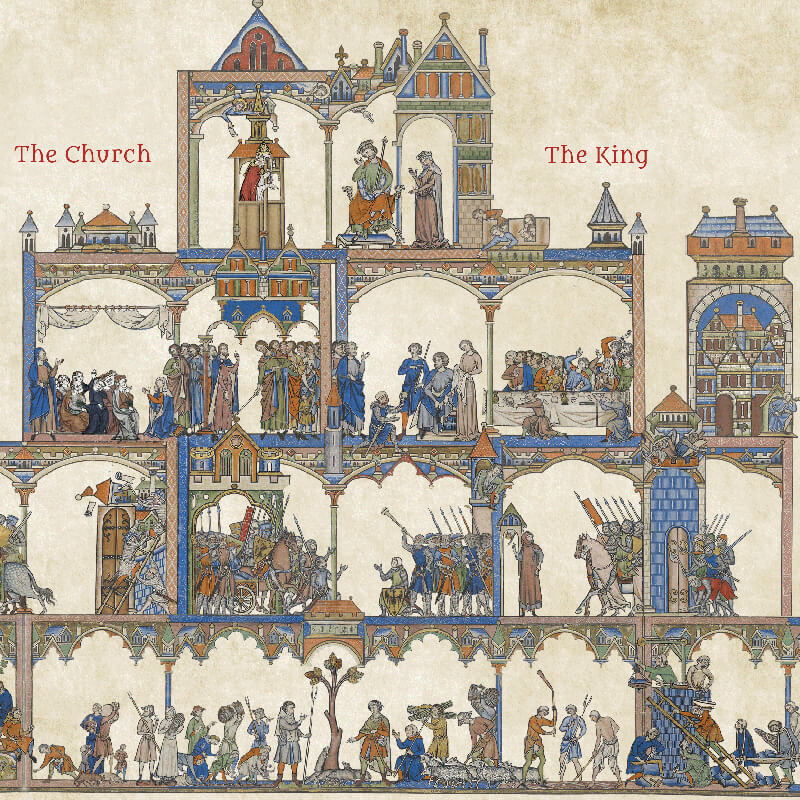
Feudalism describes a collection of relationships based largely on landholding, loyalty and service. In medieval England, these relationships developed over centuries, with some roots in Anglo-Saxon society, before being greatly expanded and reorganised following William the Conqueror’s conquest of England in 1066.
Feudalism in England
After the Norman Conquest, William claimed ultimate ownership of England’s land and redistributed much of it among his followers. In return, these powerful landholders owed loyalty and service to the king.
Large estates were granted to nobles, who could then grant parts of their land to other people in return for service. This created a network of relationships between lords and their vassals, with military service being particularly important.
Castles became an important part of this system, providing powerful landholders with defensive strongholds and helping the Normans establish control over their new kingdom.
Lords, Knights and Peasants
Nobles such as earls and barons held large estates and exercised considerable authority over the people living on them. Knights could hold land in return for military service and were an important part of medieval armies.
At the bottom of this hierarchy were peasants, although even here there were important differences. Some were free tenants who rented or farmed land, while others were villeins or serfs, who were legally unfree and tied to the manor on which they lived.
Serfs were not slaves in the same sense as people who could simply be bought and sold as property. They had obligations to their lord, such as working the lord’s land or providing payments, but they could also have rights and possessions of their own.
The Church
The Catholic Church was another major landholder and power in medieval England. Bishops, monasteries and other religious institutions controlled large estates and could have considerable political and economic influence.
This is one reason why the traditional feudal pyramid can be misleading. Medieval society was not simply divided into four neat levels, and relationships of landholding and service could be complicated.
The Decline of Feudalism
Feudalism gradually changed as medieval society and the economy developed. The Black Death caused a huge loss of life in the 14th century, creating labour shortages and weakening some traditional relationships between landlords and peasants.
The Peasants’ Revolt of 1381 demonstrated growing tensions within medieval society, while the increasing use of paid soldiers and changing forms of landholding reduced the importance of traditional feudal obligations.
By the end of the Middle Ages, the feudal system had changed considerably from the system established after the Norman Conquest. Many feudal tenures were formally abolished by the Tenures Abolition Act of 1660, marking the end of an institution that had shaped English society for centuries.
Did you enjoy this post?
I hope you found this post useful. I put a great deal of time and effort in to building, maintaining and populating the website. If you like, you could say a small thank you by buying me a coffee. You don't have to, but it would be nice :)
Buy me a coffee
Stay up to Date
Follow me on my journey and get notified whenever a new post is published by following Kings & Castles on Facebook.
Follow MeExplore The Map
Discover the hundreds of castles, churches, monasteries, cathedrals and other historic locations that I've personally visited across England and Wales. Search by location, explore nearby sites and plan your next historical adventure.
Share: