William I
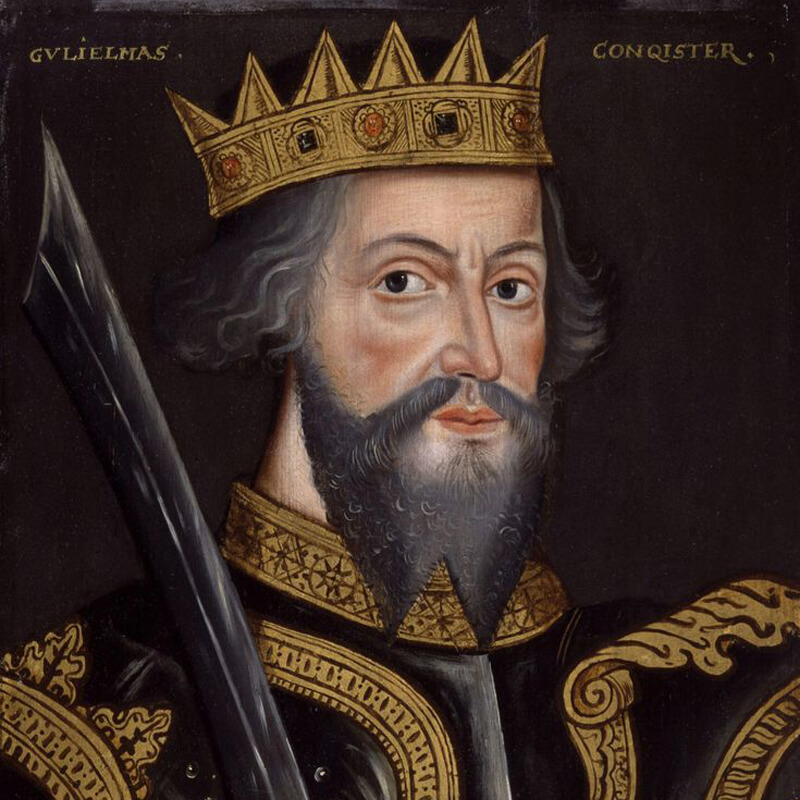
He was one of the greatest soldiers and rulers of the Middle Ages, and the man responsible for possibly the most memorable date in English history… 1066. A descendent of Vikings and England’s first Norman king, he invaded England in 1066, seized the throne after victory at the Battle of Hastings and made the Anglo-Saxons become second-class citizens in their own country. Reigning from 1066 until his death in 1087, he is remembered for the compilation of the Domesday Book and for the building of many castles, most notably the Tower of London.
Quick
Facts.
- Born: c. 1028
- Died: 1087
- Reign: 1066 - 1087
- House: House of Normandy
- Predecessor: Harold Godwinson
- Successor: William II
William I, more commonly known as William the Conqueror, and sometimes called William the Bastard, was the great-great-great-grandson of the great Viking leader and founder of the Norman dynasty, Rollo Ragnvaldsson.
William was born around 1028 in Falaise, Duchy of Normandy, France. The elder of the two children; he was the illegitimate son of Duke Robert I of Normandy and was known as William the Bastard. Even though he was a bastard, he was recognised by his family as the heir when his father died in 1035, at which point he became the Duke of Normandy.
For many years William successfully dealt with rebellions within his duchy of Normandy. But by 1060, following a long struggle to establish his throne, his hold on Normandy was finally secure.
William married Matilda of Flanders, and together they had four sons and six daughters. Their eldest son Robert was given the duchy of Normandy, Richard died young in a hunting accident, William Rufus succeeded him as king of England as William II, and Henry succeeded his brother as Henry I of England.
Edward the Confessor, King of the English from 1042 to 1066, was William’s distant cousin and one of his closest living relatives. It is believed that shortly before his death, Edward named his brother-in-law, Harold Godwinson as his successor, although he may already have promised the crown to William. According to Norman accounts, Edward sent Harold to Normandy in 1064 to confirm his promise to William. Harold swore an oath to William and promised to support his claim to the throne. This inevitably led to conflict and chaos when Edward died without an heir and Harold broke his oath to William and took the throne of England for himself.
Harold was accepted as the new King of the English on 6th January 1066, however, his position was threatened by his brother Tostig who was in exile whilst King Harald Hardrada of Norway also had a claim to the English throne. Meanwhile, with the support of Emperor Henry IV and papal approval, William began making his preparations to invade England and take what had been promised to him.
In May 1066, Harold mobilised his forces to guard the south coast against an expected invasion by William. But by early September, Harold was forced to disband his southern army because they had run out of supplies. This left the coast unguarded and William free to cross the English Channel unopposed. However, more problems arose for Harold in the form of his brother Tostig and Harald Hardrada, King of Norway.
Tostig and the Norweigan King allied themselves and amassed a large army, invaded England and raided the north coast. King Harold received news of his brother’s invasion and raced north with an English army from London, and on 25th September 1066, surprised his brother at Stamford Bridge and defeated them. Hardrada and Tostig were killed, and the majority of their army was wiped out.
Meanwhile, after taking seven months to prepare his invasion force, William crossed the English Channel and landed unopposed the following day at Pevensey on the coast of East Sussex. On 27th September, while Harold was occupied in the north, having just defeated Harald and Tostig, King Harold hastened southward, marching his army 240 miles south where he met William near Hastings.
Harold’s long and exhausting march south gave William and his forces time to rest and raise fortifications in preparation for battle. King Harold gathered inexperienced reinforcements to replenish his exhausted veterans as he marched his army to meet William and his Norman forces.
The two armies clashed at the Battle of Hastings, at Senlac Hill near the present town of Battle close to Hastings on 14th October 1066, where after nine hours of fighting, King Harold Godwinson was killed and his forces defeated. After his victory at Hastings he then moved quickly and marched to London, overcoming local resistance, and was crowned at Westminster Abbey on Christmas Day in 1066. William took the throne as King William I, ushering in a new era of Norman domination and ending the Anglo-Saxon phase of English history.
Now with a vast empire at his disposal, William made arrangements for England and its governance before returning back to Normandy. He introduced the Norman practice of building castles. He replaced almost all Anglo-Saxon nobles and bishops of England with Normans. The Norman church flourished under his reign as he promoted monastic reform by importing Norman monks and abbots.
Early in 1067 William was confident enough to return to Normandy leaving two joint regents (including his half-brother Odo, Bishop of Bayeux, who later commissioned the Bayeux Tapestry) behind to administer the kingdom. However, William’s position did not go unchallenged as a number of rebellions were launched against his kingship and he had to return in December to deal with unrest.
The rebellions reached their peak in the winter of 1069–1070 when William resorted to extreme violent measures, and would carry out what would become known as ‘The Harrying of the North‘. The Harrying of the North was a series of military campaigns waged by William to subjugate Northern England, where the presence of the last Wessex claimant, Edgar Ætheling, had encouraged Anglo-Saxon Northumbrian, Anglo-Scandinavian and Danish rebellions. William and his army’s brutal slaughter and pillaging of Northumbria was so severe, it is thought to have been devastating to the extent that 100,000 people starved to death.
To secure England’s frontiers, William invaded Scotland in 1072 and Wales in 1081, creating defensive ‘marcher‘ counties along the Scottish and Welsh borders, guarded by marcher lords (nobles appointed by the king of England to guard the marcher borders).
During the last 15 years of William’s life, he was more often in Normandy than in England. Sometime in the 1070s, William ordered his half-brother, Bishop Odo to commission the creation of The Bayeux Tapestry. This masterpiece of 11th-century Romanesque art tells the story of the events surrounding the conquest of England by William. The original tapestry still survives and is on display in Bayeux Museum in France.
In the latter years of his reign, William ordered a survey to be made of all land holdings in England, and commissioned the Domesday survey in 1085. In 1086 the results of the survey were completed. The scope, speed and efficiency of the survey was remarkable for its time and resulted in the two-volume Domesday Book of 1086, one of the greatest administrative accomplishments of the Middle Ages, which still exists today.
William left England towards the end of 1086 and spent the remainder of his life in Normandy. However, his last months were spent fighting a counter-offensive against King Philip of France. He was either injured in battle or had fallen ill and was taken to the priory of St. Gervais just outside Rouen, where he lay dying for five weeks until he died on 9th September 1087. William was buried in his abbey foundation of St Stephen at Caen.
Before his death, William divided his Anglo-Norman kingdom between his sons. Normandy went to his eldest son Robert Curthose, William Rufus was to succeed William as King of England, and his third remaining son, Henry (the future Henry I), was left with wealth but no lands.
Did you enjoy this post?
I hope you found this post useful. I put a great deal of time and effort in to building, maintaining and populating the website. If you like, you could say a small thank you by buying me a coffee. You don't have to, but it would be nice :)
Buy me a coffee
Stay up to Date
Follow me on my journey and get notified whenever a new post is published by following Kings & Castles on Facebook.
Follow MeExplore The Map
Discover the hundreds of castles, churches, monasteries, cathedrals and other historic locations that I've personally visited across England and Wales. Search by location, explore nearby sites and plan your next historical adventure.
Share: