The Normans
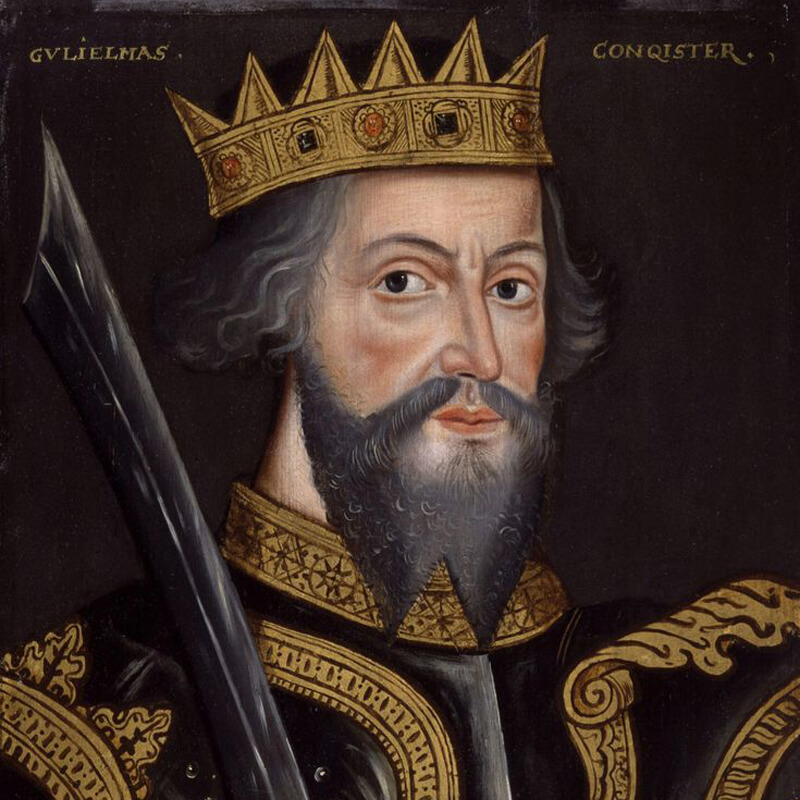
Descendants of vikings, builders of castles and our introduction to hereditary surnames. Duke Willliam of Normandy, also known as William the Conqueror was the last foreign invader to successfully conquer England. When he did, he became the first Norman king of England, another three Norman kings followed after his death which ended with King Stephen.
Origins
The Norman dynasty began with a Viking chieftain by the name of Rollo, who became the founder and the first ruler of Normandy, a region in northern France, from 911 to 927. He landed on French soil as a Norse invader but quickly emerged as the most outstanding warrior among the Norsemen. Charles the Simple, the king of West Francia, granted Rollo and his men lands in what is now Rouen in exchange for Rollo agreeing to end his plundering, to swear allegiance to him, religious conversion and to pledge to defend them from future Viking raiders. Rollo was made Count of Rouen but eventually he would carve out a much larger area for himself and his Norsemen, which would become the Duchy of Normandy, named after themselves. From then on the Normans would genetically be a mix of viking descendants and native Franks, but culturally, entirely French.
The Norman Invasion
William the Conqueror was a descendant of Rollo and he was the current Duke of Normandy when he invaded England. When William defeated the last Anlgo-Saxon king of England, Harold Godwinson in 1066 at the Battle of Hastings, he became William I of England and changed Britain forever, also bringing with him their Norman French language. The Normans provided England with four Norman kings from 1066 to 1154.
William I, William II and Henry I were from the House of Normandy, whereas Stephen came from the House of Blois, but he was still a Norman. For roughly the next 150 years, whoever was King of England also ruled Normandy by default.
William I
William I was crowned King of England on Christmas Day in 1066. He faced many uprisings from the conquered Anglo-Saxons and he retaliated with absolute viciousness and fury, burning villages and killing anyone who stood in his way. He built defensive castles throughout the country, first out of wood as they were quick and easy to erect, and then later rebuilt them in stone. This is the first time we got stone castles in England. William the Conqueror died in 1087 and had three surviving sons.
William II
William the Conqueror’s eldest son was Robert Curthose but he wasn’t to become King of England, instead, he was left to rule Normandy as it’s next Duke. His next eldest son was William Rufus and he was chosen to be the next King of England and became William II. William II died in the year 1100 after being hit by an arrow while hunting. There were suspicions of murder surrounding his death, fingers even pointed towards his younger brother Henry. He never married or had children so he died without an heir. His younger brother Henry then took the throne and became Henry I.
Henry I
Henry I was considered to be a harsh but effective ruler and ruled England for 35 years. He married Matilda of Scotland and they had two children, Empress Matilda and William Adelin. However, in 1120 his son William drowned in the White Ship disaster, throwing the royal succession into doubt. Henry tried to have another son, even with a second wife, but he would never have another. He then declared his daughter Matilda as his heir and married her to Geoffrey of Anjou (the founder of House Plantagenet). The idea of a woman sitting on the throne and ruling over England wasn’t a very popular one, even though many promised Henry that they would support Matilda and her succession. Henry died in 1135 and despite his plans for Matilda, he was succeeded by his nephew Stephen of Blois, resulting in a period of civil war known as ‘The Anarchy‘.
King Stephen and the Anarchy
Stephen‘s claim to the throne was that he was the son of Adela of Normandy, who was the sister of Henry I and daughter of William the Conqueror. The Anarchy was a war of succession caused by the accidental death of Henry I’s son William Adelin in the White Ship disaster, which resulted in a widespread breakdown in law and order. The new King Stephen, Henry’s daughter Empress Matilda, and her eldest son Henry FitzEmpress were at war with each other between 1138 and 1153 in a fight for the throne. Matilda and her son Henry never managed to take the throne from Stephen, but in 1153 Stephen’s only son and heir, Eustace, died of illness. Henry and Stephen then began peace negotiations, a truce was brokered and a treaty was signed, which allowed Stephen to retain the throne until his death and recognised Henry as his successor.
Stephen died of disease in 1154, and Matilda’s son Henry FitzEmpress was crowned as Henry II, the first Angevin king of England from the House of Plantagenet.
Did you enjoy this post?
I hope you found this post useful. I put a great deal of time and effort in to building, maintaining and populating the website. If you like, you could say a small thank you by buying me a coffee. You don't have to, but it would be nice :)
Buy me a coffee
Stay up to Date
Follow me on my journey and get notified whenever a new post is published by following Kings & Castles on Facebook.
Follow MeExplore The Map
Discover the hundreds of castles, churches, monasteries, cathedrals and other historic locations that I've personally visited across England and Wales. Search by location, explore nearby sites and plan your next historical adventure.
Share: