Elizabeth I
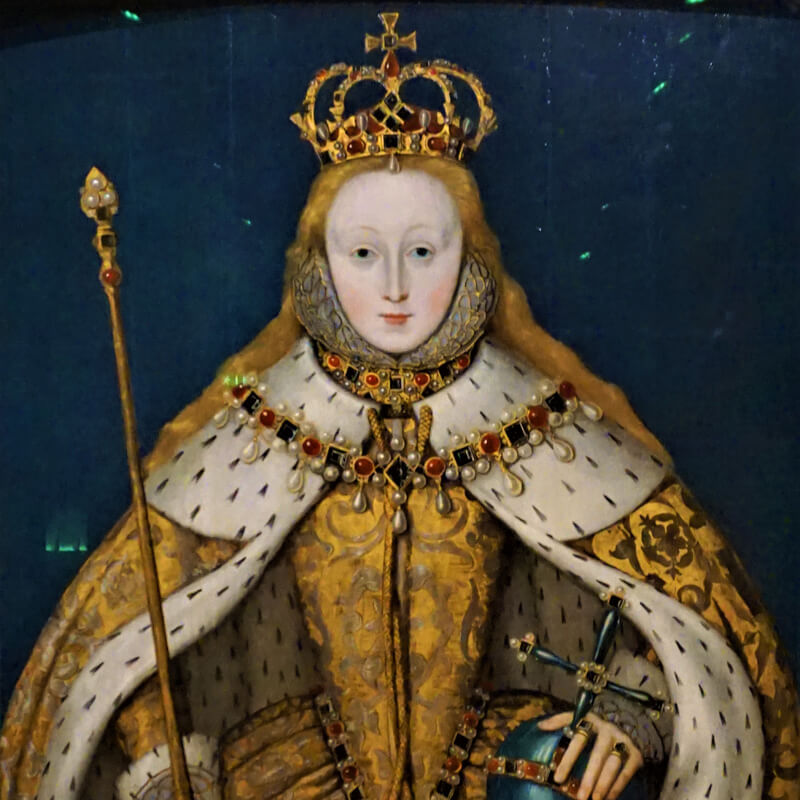
Elizabeth Tudor was the second child of King Henry VIII and his second wife, Anne Boleyn. She was the last Tudor monarch and arguably one of the most glorious and greatest ruling queens in English history. She was very well-educated, fluent in five languages, and had inherited intelligence, determination and shrewdness from both parents.
Quick
Facts.
- Born: 1533
- Died: 1603
- Reign: 1558 - 1603
- House: House of Tudor
- Predecessor: Mary I
- Successor: James I
Elizabeth was the only surviving child of Henry VIII and Anne Boleyn, his second wife, who was executed when Elizabeth was two years old. She was placed in the care of a governess who taught her several languages including French, Dutch, Italian and Spanish.
After her father died, her half-brother Edward VI became king, but would only reign for around six years, dying young due to illness. Before he died, he ignored the Act of Succession and Lady Jane Grey, the granddaughter of Henry VIII’s younger sister Mary Tudor, became Queen. Her reign was heavily contested and lasted just nine days, as Elizabeth’s half-sister Mary had Lady Jane Grey imprisoned and executed. Mary then became Queen Mary I and reigned for three years. She was a devout Catholic and distrusted Elizabeth who was a Protestant, and had her imprisoned.
Mary died in 1558 and Elizabeth succeeded to the throne. She would be Queen of England and Ireland for 45 years, from 1558 until her death in 1603. However, she faced several problems; England was divided between the Protestants and the Catholics, and was also under threat of invasion from Spain, France and Scotland.
During her lengthy reign she presided over a period of exploration and great invention, the defeat of the Spanish Armada in 1588, and a secure Church of England was established as well as a compromise between Roman Catholicism and Protestantism. Elizabeth tried hard to keep England at peace. The country’s navy had become the mightiest in the world led by Sir Francis Drake. When Spain attacked with its Spanish Armada in 1588, it was defeated. It was one of the greatest military victories in English history.
Elizabeth’s reign was termed the ‘Elizabethan Era’, and writers such as William Shakespeare flourished. She had one of the most extensive and lavish wardrobes of all monarchs and she was described as “most gorgeously apparelled”.
Elizabeth was expected to marry and produce an heir, however, despite numerous courtships, she never did, and because of this she was referred to as the “Virgin Queen” who was wedded to her kingdom. Elizabeth often declared that she was married to England and never once left its coasts. The American state of Virginia was named in honor of the “Virgin Queen” by Sir Walter Raleigh, a favourite of hers and one of the most famous explorers of the Elizabethan era.
It’s impossible to talk about Elizabeth I without talking about Mary, Queen of Scots. Though Elizabeth and Mary were cousins, they never actually met. Elizabeth saw Mary as a threat to her throne. Mary was the great-granddaughter of Henry VII, granddaughter of Henry VIII’s older sister, and next in line to the throne after Henry VIII’s children. Elizabeth also saw her presence as a threat because Mary could become a figure to her Catholic opponents. Elizabeth imprisoned her cousin Mary in England for 19 years. She was involved in serveral plots to kill and overthrow Elizabeth and attempted to start a Catholic uprising, which became Mary’s ultimate undoing. Mary, Queen of Scots, was eventually executed in 1587 after being found guilty of plotting Elizabeth’s assassination.
On 24th March 1603 Elizabeth I died, having reigned for 45 years as a very popular queen. As she had no children, and therefore no direct heir to the throne, she was the last monarch of the House of Tudor. Her lack of an heir would bring about the next dynasty to rule over England; the Stuarts, and rather poetically, the first Stuart monarch would be the son of Mary, Queen of Scots, who would become King James VI of Scotland and King James I of England.
Her 45-year reign is generally considered one of the most glorious in English history. Her reign is often defined in terms of her skillful diplomacy, her actions on religious matters, and the defeat of the Spanish Armada. Her reign also saw a brilliant flourishing in the arts. She was interred in Westminster Abbey with her half-sister, Mary.
Did you enjoy this post?
I hope you found this post useful. I put a great deal of time and effort in to building, maintaining and populating the website. If you like, you could say a small thank you by buying me a coffee. You don't have to, but it would be nice :)
Buy me a coffee
Stay up to Date
Follow me on my journey and get notified whenever a new post is published by following Kings & Castles on Facebook.
Follow MeExplore The Map
Discover the hundreds of castles, churches, monasteries, cathedrals and other historic locations that I've personally visited across England and Wales. Search by location, explore nearby sites and plan your next historical adventure.
Share: