Stephen
King Stephen, often referred to as Stephen of Blois, was the King of England from 1135 until his death in 1154. A grandson of William the Conqueror, Stephen usurped the throne on the death of his uncle King Henry I. The majority of his reign was spent in a bitter civil war known as ‘The Anarchy’ between him and his rival for the throne; Henry’s daughter, Stephen’s cousin – the Empress Matilda.
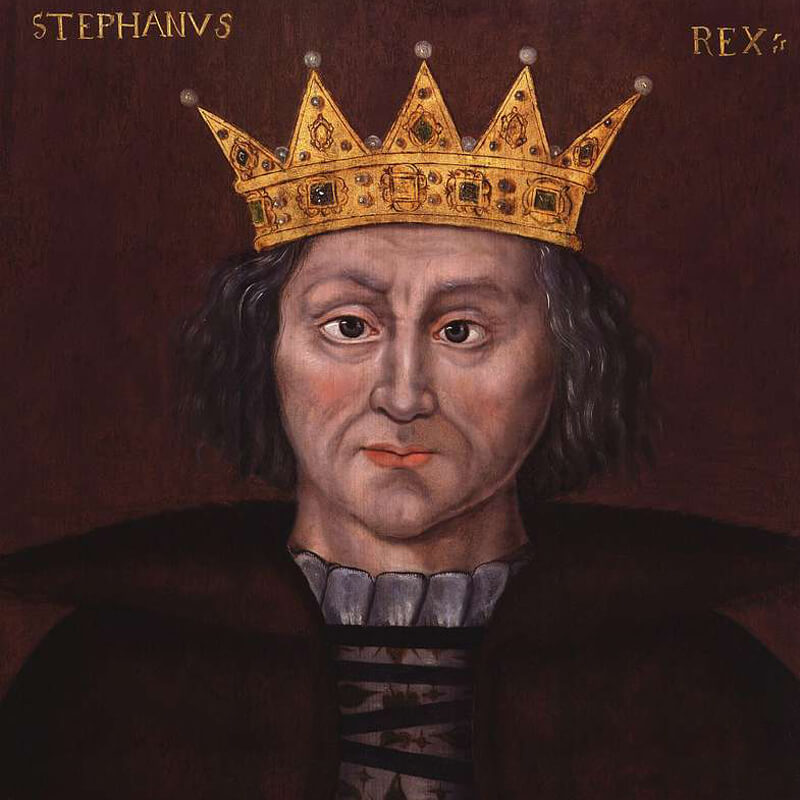
Quick
Facts.
- Born: c. 1092 - 1097
- Died: 1154
- Reign: 1135 - 1154
- House: House of Blois
- Predecessor: Henry I
- Successor: Henry II
Stephen was born in Blois in central France some time around 1092 – 1097 (his date of birth varies between these dates from various sources). He was the son of Stephen II, Count of Blois and Adela of Normandy. His mother, Adela, was the daughter of William the Conqueror and Matilda of Flanders.
Stephen’s father died while he was still young, and he was brought up by his mother and placed into the court of his uncle, King Henry I of England. Reared by his uncle, Stephen became his favourite nephew and rose in prominence and was granted extensive lands in England, Normandy, and the county of Boulogne.
When Henry’s only son and heir, William Adelin, died young in a shipwreck disaster off the coast of Normandy in November 1120, it caused a succession crisis as Henry’s only remaining legitimate child was a daughter; Stephen’s cousin, the Empress Matilda. King Henry demanded that his barons swear their allegiance to his daughter as his heir, and Stephen was also expected to pledge his support to her. In 1128 Matilda married Geoffrey Plantagenet, Count of Anjou, and in 1133 she bore him her first son, the future king Henry II.
When King Henry I died in 1135, Stephen and Matilda argued over who would become the ruler of England. Many English nobles were reluctant to accept a woman ruler, and Henry’s Norman subjects resented Matilda’s marriage into an Angevin family (the Normans and the Angevins were enemies). Many of Henry’s barons broke their vows and chose Stephen as Henry’s successor. Disregarding Matilda’s right of succession, Stephen crossed rapidly from Normandy, seized the English throne and had himself crowned at Westminster within the month.
Stephen usurping his cousin and royal contender to the throne led to a period known as ‘The Anarchy‘, a bitter civil war which lasted until the end of Stephen’s reign when he died in 1154. As the daughter of Henry I, Matilda expected to be queen, an arrangement already made clear by her father before his death. So Matilda invaded England in 1139 to claim the throne, and the country was plunged into civil war.
Stephen wasn’t a natural leader, he failed to consolidate his power during the ensuing civil strife. He was brave and energetic, but his affable, mild-mannered nature prevented him from providing firm leadership, and lacking ruthlessness he failed to inspire loyalty. He could neither control his friends nor subdue his enemies, despite the support of his brother Henry of Blois (Bishop of Winchester) and his wife Matilda of Boulogne.
In 1139, with the support of her half-brother Robert of Gloucester and her uncle, King David I of Scotland, Empress Matilda and her forces invaded England. Meanwhile, her husband, Geoffrey, Count of Anjou concentrated his efforts on Normandy. In a bizarre and foolish display of misplaced chivalry, Stephen declined to take an opportunity of seizing Matilda and instead had her escorted to Bristol where she proceeded to bring most of western England under her control, whilst Stephen retained control over the south east.
In 1141, Matilda’s Angevin supporters surprised and captured Stephen in a battle at Lincoln. However, later in the same year Stephen was exchanged for Matilda’s half-brother who had been captured by forces loyal to the king. Whilst Stephen had his release secured, the war itself continued for several years with both sides unable to initiate significant defeats against each other. Over time, Stephen gradually gained the upper hand, and in 1148 Matilda withdrew from England and reluctantly returned to Normandy, which her husband, Geoffrey Count of Anjou had conquered.
Stephen’s throne was still disputed, but by this point he had only nominal control over most of the kingdom and struggled to enforce the law or mediate between warring nobles. Matilda summoned her eldest son Henry Plantagenet, also known as Henry FitzEmpress, to England to fight for her claim to the throne, and for his inheritance. Henry invaded England in 1149 and again in 1153, but Stephen fought stubbornly against Henry and tried to ensure his son Eustace’s succession by having him crowned in 1152, which the church refused.
The death of Stephen’s son and heir, Eustace, in 1153 helped lead to a negotiated peace under which Henry would inherit the throne after Stephen’s death. So when Stephen died in October 1154, under the Treaty of Wallingford, Henry ascended the throne as Henry II, the first of the Angevin kings.
Did you enjoy this post?
I hope you found this post useful. I put a great deal of time and effort in to building, maintaining and populating the website. If you like, you could say a small thank you by buying me a coffee. You don't have to, but it would be nice :)
Buy me a coffee
Stay up to Date
Follow me on my journey and get notified whenever a new post is published by following Kings & Castles on Facebook.
Follow MeExplore The Map
Discover the hundreds of castles, churches, monasteries, cathedrals and other historic locations that I've personally visited across England and Wales. Search by location, explore nearby sites and plan your next historical adventure.
Share: