The Anarchy
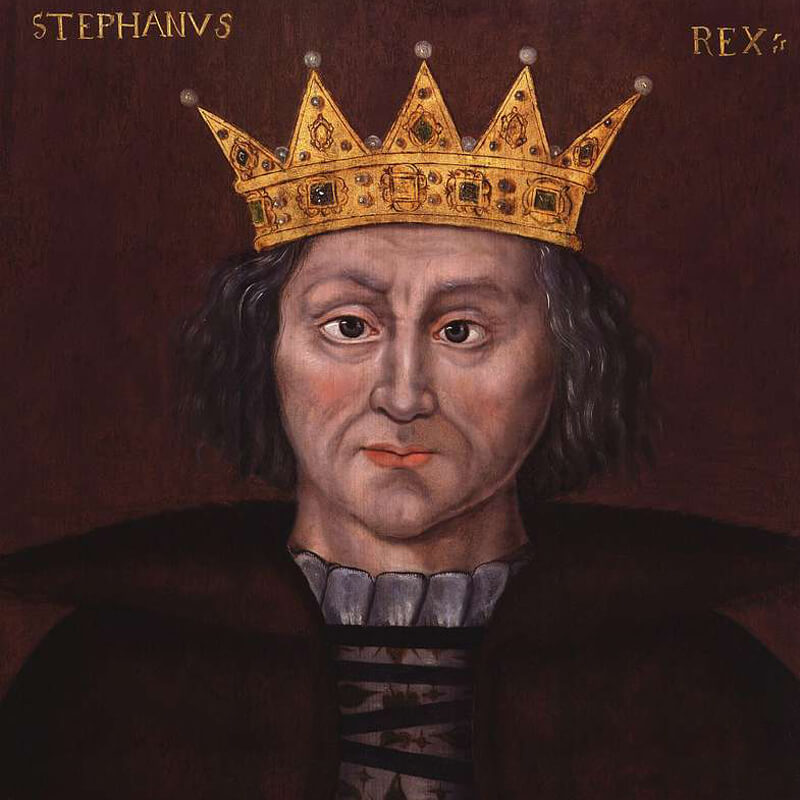
The Anarchy was a bitter 12th-century civil war between two rivals for the English throne after Henry I’s only son and heir died young, causing a succession crisis between two cousins; Stephen of Blois and the Empress Matilda. After the accidental death of William Adelin who drowned in the White Ship disaster of 1120 off the coast of Normandy, Henry I appointed his daughter, the Empress Matilda as his heir, but her cousin Stephen of Blois and many of the powerful barons had other ideas.
Origins of the Conflict
King Henry I was the youngest and most able of William the Conqueror‘s sons. He and his wife Matilda of Scotland had two children, Matilda and William Adelin. William Adelin was heir apparent to the English throne, but he died in the White Ship tragedy of November 1120; a shipwreck disaster off the coast of Normandy, leaving Henry and the realm facing a potential succession crisis.
Matilda became her father’s sole heir, which would have made her the first ever queen of England in her own right. Henry had his barons swear their allegiance to Matila as his heir and attempted to build up a base of political support for her in both England and Normandy, demanding his court to swear several oaths of allegiance between 1127 and 1131, to recognise Matilda as his immediate successor and recognise her descendants as the rightful rulers after her. His nephew, Matilda’s first cousin, Stephen of Blois (the future King Stephen) was among those who took the oath. However, the decision to have Matilda as Queen of England was not popular among Henry’s Anglo-Norman court.
Matilda was married to the Holy Roman Emperor Henry V, and she was therefore referred to as Empress Matilda. When Henry V died in 1125 Matilda married Geoffrey V, Count of Anjou three years later in 1128, and in 1133 she bore him her first son, the future King Henry II.
Stephen of Blois was the son of William the Conqueror’s daughter Adela, and Henry I’s favourite nephew. He was raised in Henry’s court, travelling with him and serving in his campaigns. Stephen was popular with the nobility and rose in prominence and was granted extensive lands in England, Normandy, and the county of Boulogne.
Matilda was popular in Germany, however, she was not that popular in her homeland as she spend most of her childhood in Germany, and was therefore considered “foreign”. Additionally, England had never had a queen, and people back then believed that women were weak. As a result, when Henry I died in 1135 Matilda and her Angevin husband faced opposition from the barons.
Succession
When Henry I died Matilda and Stephen were both in France, arguing over who would become the ruler of England. Not wanting a female ruler, especially a foreigner, along with her Angevin husband (the hated Angevin enemy of Normandy), many of Henry’s barons broke their vows and chose Stephen as Henry’s successor, who was much more popular than Matilda.
With the backing of the English Church and the powerful English barons, Stephen crossed from Normandy, seized the English throne, usurping his cousin, and had himself crowned at Westminster within the month, completely disregarding Matilda’s right of succession.
Anarchy
King Stephen’s reign ushered in a wave of social unrest, political fragmentation and the breakdown of law and order, which became known as ‘The Anarchy’. Stephen wasn’t a natural leader, he failed to consolidate his power, and his inability to make tough decisions led to chaos during his reign as the nobility were able to exploit his weak leadership for their own gain. He was brave and energetic, but his affable, mild-mannered nature prevented him from providing firm leadership, and lacking ruthlessness he failed to inspire loyalty.
He began to alienate many nobles who had been key advisors to Henry I, by promoting his own friends as new earls which irritated the nobles already in court. This led to a time of great social upheaval, where authority broke down and Stephen’s government lost control, resulting in many barons becoming greedy and building unlicensed castles. A number of nobles wanted to regain what they saw as hereditary rights to lands that had changed hands during Henry I’s reign, and some even switched sides frequently to gain advantage.
The Road to War
Matilda didn’t accept this decision quietly and refused to renounce the crown. Stephen faced attacks and rebellions in both England and Normandy immediately after his ascension, which would continue until his death in 1154.
Matilda’s claim was upheld by her half-brother Robert of Gloucester (one of Henry I’s illegitimate sons), as well as her uncle King David I of Scotland. Robert’s declaration of support for Matilda caused a rebellion to rise up across the southwest of England as well as Kent, while her husband Geoffrey of Anjou invaded Normandy and David I attacked northern England.
Civil War Begins
Supported by her half-brother and her uncle, Matilda and her forces crossed the channel to take England by force in 1139, while her husband focused on conquering Normandy. Matilda’s invasion of England plunged the country into civil war which lasted for roughly the next 18/19 years.
Matilda was invited by her stepmother, the Dowager Queen Adeliza, to stay with her at Arundel Castle while her half-brother Robert attempted to rally support for her across the country. Stephen besieged the castle, trapping Matilda inside. As she had not yet declared herself as a threat to him, Stephen foolishly had her escorted to Bristol allowing her safe passage to meet up with Robert. There, she established a base in the southwest, bringing most of western England under her control whilst Stephen retained control over the south east.
Over the next few years there were minor scuffles and an attempt at peace as Stephen tried to reclaim the region. Matilda’s first victory came in 1141 when her Angevin supporters, under the command of Robert and supported by Welsh soldiers, surprised and captured Stephen in a battle at Lincoln, who was later taken to Bristol where he was imprisoned in Bristol Castle. With Stephen imprisoned and the church backing her, Empress Matilda was in command of England, and she became England’s disputed monarch for most of 1141. However, she didn’t get the crown as she had hoped, she had an arrogant and overbearing manner and was disliked by the people. She was therefore never proclaimed ‘queen’ and instead was given the title ‘Lady of the English’.
Later in 1141, Stephen was exchanged for Matilda’s half-brother Robert who had been captured by forces loyal to the king, dashing Matilda’s hopes for ascendancy. Whilst Stephen had his release secured, Matilda refused to give up her claim to the throne and the war continued for several years with both sides unable to initiate significant defeats against each other.
With Stephen back in control of the kingdom, Matilda moved on to Oxford where she had support and based herself and her army at Oxford Castle. Stephen marched to Oxford with the aim of seizing the town and besieging the castle. The siege lasted about three months, however, in December 1142 Matilda was able to flee the castle undetected by being carefully lowered over the walls of the castle at night and escaped before chaos broke out. The castle was surrendered to King Stephen the next day.
The war continued with skirmishes and small victories on both sides, but neither Stephen nor Matilda were able to gain any significant victories. However, Stephen gradually gained the upper hand, and by the late 1140s the civil war was pretty much over, with the exception of the occasional outbreak of fighting. In 1147 Matilda’s half-brother Robert of Gloucester died, and with him the main thrust of Matilda’s military campaign, contributing to the reducing tempo of the war. Stephen retained his crown, and in 1148 Matilda withdrew from England and reluctantly returned to Normandy, which her husband had conquered.
Enter… Henry FitzEmpress
Stephen’s throne was still disputed, but by this point he had only nominal control over most of the kingdom and struggled to enforce the law or mediate between warring nobles. With both sides still struggling to gain the advantage, Matilda passed her claim to the throne to her son, Henry Plantagenet, also known as Henry FitzEmpress. Henry invaded England in 1149 and again in 1153, but Stephen fought stubbornly against Henry and tried to ensure the succession of his son and heir by having him crowned in 1152, which the church refused.
When Stephen’s son and heir died later in 1153, Stephen and Henry negotiated a peace treaty and signed an agreement called the Treaty of Wallingford, under which Henry would inherit the throne after Stephen’s death, officially ending the civil war. So when Stephen died shortly after in October 1154, Henry was crowned King Henry II, the first of three Angevin kings and the first of the Plantagenet line of kings.
Did you enjoy this post?
I hope you found this post useful. I put a great deal of time and effort in to building, maintaining and populating the website. If you like, you could say a small thank you by buying me a coffee. You don't have to, but it would be nice :)
Buy me a coffee
Stay up to Date
Follow me on my journey and get notified whenever a new post is published by following Kings & Castles on Facebook.
Follow MeExplore The Map
Discover the hundreds of castles, churches, monasteries, cathedrals and other historic locations that I've personally visited across England and Wales. Search by location, explore nearby sites and plan your next historical adventure.
Share: