Eleanor of Aquitaine
Eleanor of Aquitaine was one of the most powerful and influential figures of the Middle Ages. Inheriting a vast estate at the age of 15 made her the most sought-after bride of her generation. She was Duchess of Aquitaine from 1137 to 1204, Queen of France from 1137 to 1152 as the wife of King Louis VII, and Queen of England from 1154 to 1189 as the wife of King Henry II. She was also the mother of two kings of England; King Richard I and King John.
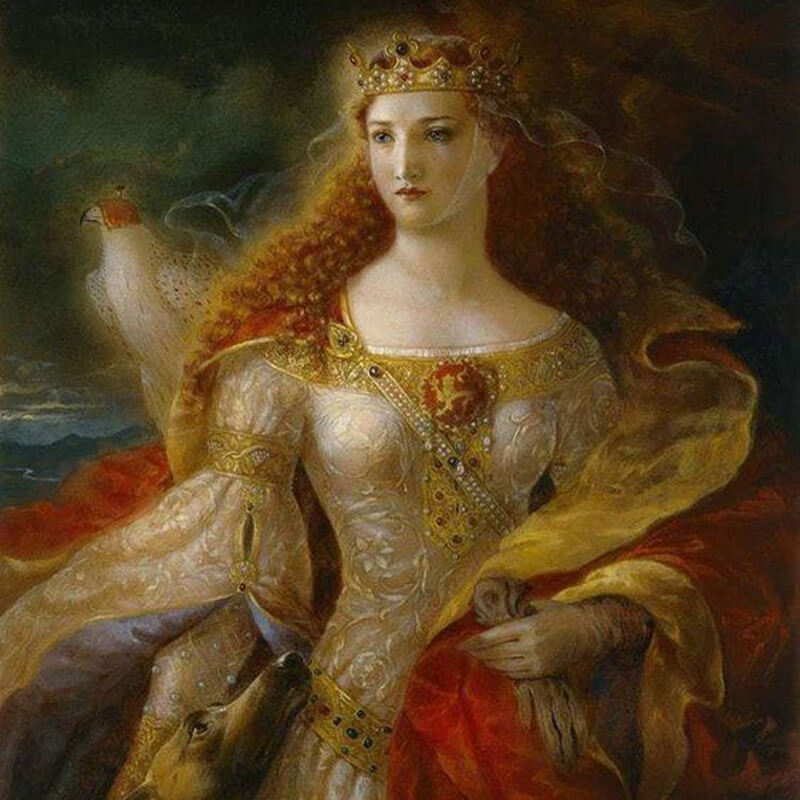
Eleanor of Aquitaine was born in Bordeaux in the year 1122. She was the eldest daughter of William X, Duke of Aquitaine, and Aénor de Châtellerault. This little girl would be considered the most powerful and enlightened woman of her time, if not the entire medieval age.
As a girl, Eleanor was well educated, versed in literature, philosophy, and languages. Her father died when she was 15 years old. She inherited her father’s title and extensive lands, becoming the Duchess of Aquitaine, and by far the most eligible single young woman in Europe.
Eleanor was placed under the guardianship of the King of France, and within hours, the shrewd King had betrothed Eleanor to his son and heir, Louis. Louis and Eleanor were married in July 1137, but before they could become close and get to know each other, Louis’ father the King, fell ill and died. On Christmas Day of the same year, Louis and Eleanor were crowned king and queen of France.
Louis and Eleanor’s first years as rulers were fraught with power struggles within their own family. Louis, still young and inexperienced, made a series of military and diplomatic blunders that set him at odds with the Pope and several of his more powerful lords.
The conflict that ensued culminated in the massacre of hundreds of innocents in the town of Vitry, and a great number of the populace took refuge in a church which was set on fire by Louis’ troops. Louis was besieged by guilt for many years over the tragedy at Vitry, and on the Popes advice, set off on a crusade in 1145. Eleanor joined her husband on the dangerous and ill fated journey.
The crusade did not go well, and Eleanor and Louis grew further and further apart. Eleanor sought an annulment, which was eventually granted on the grounds of consanguinity (being related by blood) in 1152. Their two daughters were left in the custody of their father, the king.
Within two months of her annulment, Eleanor married Henry (later King Henry II of England), Count of Anjou and Duke of Normandy. Within two years Henry and Eleanor were crowned king and queen of England as a result of Henry’s ascension to the throne upon the death of King Stephen.
Henry and Eleanor argued often but the marriage to Henry was more successful than her first, producing eight children together between 1152 and 1166. Eleanor separated from Henry in 1167 and moved her household to her own lands in Poitiers.
In 1173, Eleanor’s son Henry fled to France to plot against his father and seize the English throne. Eleanor was arrested and tried for treason under the assumption she was actively supporting her son’s plan to overthrow his father. Suspected of plotting against her husband, and even being accused of playing a role in the death of his favourite mistress, Eleanor spent the next 16 years practically as a prisoner, being moved between various castles and strongholds in England.
After years of rebellion, their son Henry finally succumbed to disease in 1183 and died. On his deathbed he begged his father for the release of his mother. King Henry released her but she was always under guard. Eleanor rejoined her husband’s household for part of each year, joining him on solemn occasions and resuming some of her ceremonial duties as queen.
King Henry II died in July 1189 and their eldest son Richard succeeded him. He would become better known as Richard the Lionheart, and one of his first acts as King was to restore his mother to full freedom. Richard took over from his father in leading the Third Crusade, which had barely begun when Henry II died. While Richard was away, Eleanor ruled England in Richard’s name.
Between 1190 and 1194, King Richard was engaged in the Third Crusade, and he was held in captivity by Henry VI, Holy Roman Emperor. Eleanor played a key role in the negotiations with the Holy Roman Emperor, eventually securing Richard’s release with the ransom she raised. When Richard returned to England he ruled until his death in 1199. Her youngest son John was crowned king after Richard’s death, and she was employed by John as an envoy to France.
Eleanor lived well into the reign of her youngest son, King John, and would later support his rule against the rebellion of her grandson, Arthur. She eventually retired as a nun at Fontevraud Abbey in France, where she died.
Eleanor died on 1st April 1204 aged 82 years old. By the time of her death she had outlived all of her children, except for King John of England and Queen Eleanor of Castile. She was entombed in Fontevraud Abbey next to her husband Henry and their son Richard. Sadly, during the French Revolution, the abbey of Fontevraud was sacked and the tombs were disturbed and vandalised. Consequently the bones of Eleanor, Henry, Richard, and others were exhumed and scattered, never to be recovered.
Did you enjoy this post?
I hope you found this post useful. I put a great deal of time and effort in to building, maintaining and populating the website. If you like, you could say a small thank you by buying me a coffee. You don't have to, but it would be nice :)
Buy me a coffeeMore People Profiles
View all People Profiles
Stay up to Date
Follow me on my journey and get notified whenever a new post is published by following Kings & Castles on Facebook.
Follow MeExplore The Map
Discover the hundreds of castles, churches, monasteries, cathedrals and other historic locations that I've personally visited across England and Wales. Search by location, explore nearby sites and plan your next historical adventure.
Share: