The Hundred Years’ War
The Hundred Years’ War was a long series of conflicts between England and France that lasted, with periods of peace, from 1337 to 1453. Despite its name, the war did not continue without interruption for exactly one hundred years. Instead, it consisted of several campaigns, battles and political struggles over control of territory and, most importantly, the French throne.
Causes of the War
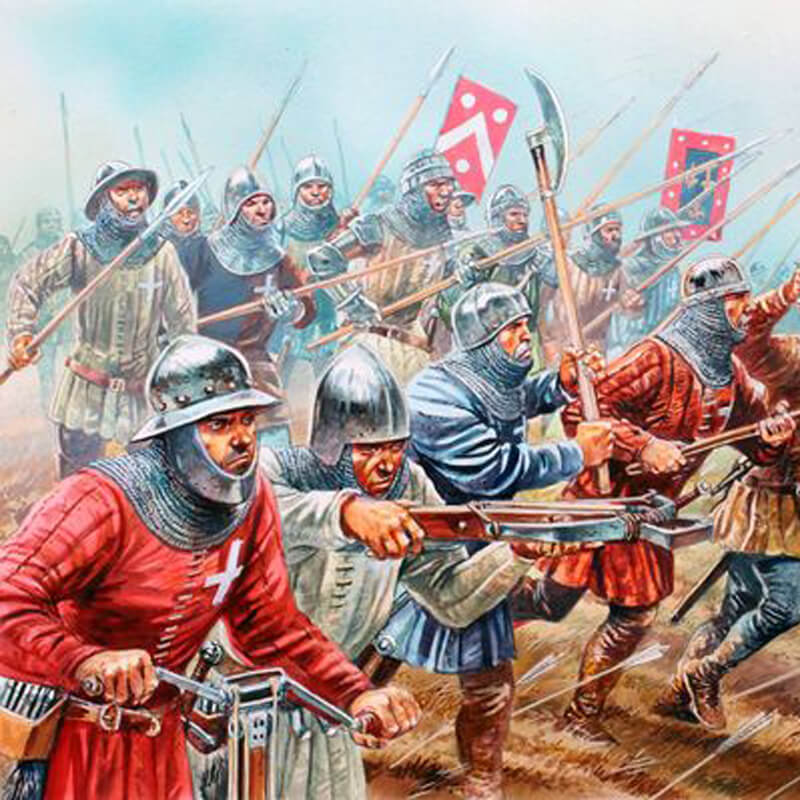
One of the main causes was a dispute over the French succession. When King Charles IV of France died in 1328 without a surviving son, the French crown passed to his cousin Philip of Valois, who became Philip VI. However, Edward III of England claimed that he had a stronger right to the French throne through his mother, Isabella of France, who was Charles IV’s sister.
Edward initially accepted Philip as king, but relations deteriorated. Another major source of conflict was territory. English kings controlled large areas of land in France, particularly Gascony, and disputes over these possessions created continuing tension between the two monarchies.
In 1337, Philip VI confiscated Edward’s lands in Gascony. Edward responded by asserting his claim to the French crown, marking the beginning of the Hundred Years’ War.
Early English Victories
The first phase of the war brought several spectacular English victories. England’s military success was partly due to its effective use of the longbow, which allowed English archers to fire rapidly at enemy troops from a distance.
In 1346, Edward III invaded France and defeated the French at the Battle of Crécy. The English victory demonstrated the effectiveness of their infantry and archers against the heavily armoured French forces.
The English subsequently captured Calais, which became an important English base on the French coast and remained under English control for centuries.
Another major English victory occurred in 1356, when Edward, the Black Prince, defeated and captured King John II of France at the Battle of Poitiers. The resulting Treaty of Brétigny in 1360 temporarily gave England extensive territories in France and appeared to represent a major English success.
French Recovery
The situation changed during the reign of Charles V of France. Under commanders such as Bertrand du Guesclin, the French avoided unnecessary large battles and instead used raids and sieges to recover territory. By the late-14th century, England had lost much of the territory it had gained.
The war then entered a period of relative peace, but the underlying rivalry between the two kingdoms remained.
Henry V and Agincourt
The conflict was revived in the early-15th century by Henry V of England. Henry claimed the French crown and invaded France in 1415.
His most famous victory came at the Battle of Agincourt on 25th October 1415. Despite being heavily outnumbered, the English army defeated a much larger French force. Muddy ground, English defensive positions and the effectiveness of the longbow contributed to the French defeat.
Henry V later secured a major diplomatic victory through the Treaty of Troyes in 1420. The agreement recognised him as heir to the French throne and arranged his marriage to Catherine of Valois, the daughter of Charles VI.
However, Henry died in 1422, shortly before Charles VI. Henry’s infant son, Henry VI, inherited the English and claimed French crowns, but he lacked the ability to maintain his father’s military successes.
Joan of Arc and the French Revival
A major turning point came with the emergence of Joan of Arc, a young French woman who claimed to have received divine guidance to support Charles, the French heir.
In 1429, Joan helped inspire French forces to lift the Siege of Orléans. Her success greatly strengthened French morale and contributed to the coronation of Charles VII at Reims.
Joan was captured by the Burgundians, allies of the English, in 1430. She was handed over to an English-backed ecclesiastical court and executed in 1431. Although her military career was brief, she became a powerful symbol of French resistance.
The End of the War
During the 1430s and 1440s, Charles VII reorganised the French army and strengthened royal government. French forces gradually recovered territory from the English.
In 1453, the French defeated the English at the Battle of Castillon, generally regarded as the final major battle of the Hundred Years’ War. England lost almost all its possessions in France, except Calais, which remained English until 1558.
Consequences
The Hundred Years’ War had enormous consequences for both countries. In France, the conflict helped strengthen the monarchy and encouraged the development of a more centralised state. French national identity also became stronger as resistance to English rule developed.
England’s position was very different. The loss of its French territories reduced English ambitions on the continent and contributed to political instability at home. Many nobles had lost wealth and influence through the wars, while military rivalries contributed to the conditions that eventually produced the Wars of the Roses.
The war also changed warfare. Gunpowder weapons became increasingly important, while the dominance of heavily armoured medieval knights declined. Professional soldiers and more organised armies gradually became more significant.
The Hundred Years’ War was therefore a defining conflict of medieval European history. What began as a dispute over royal succession and territory eventually transformed the political development of both England and France. Its legacy can be seen in the growth of stronger monarchies, changing military technology and the emergence of more distinct English and French national identities.
Did you enjoy this post?
I hope you found this post useful. I put a great deal of time and effort in to building, maintaining and populating the website. If you like, you could say a small thank you by buying me a coffee. You don't have to, but it would be nice :)
Buy me a coffee
Stay up to Date
Follow me on my journey and get notified whenever a new post is published by following Kings & Castles on Facebook.
Follow MeExplore The Map
Discover the hundreds of castles, churches, monasteries, cathedrals and other historic locations that I've personally visited across England and Wales. Search by location, explore nearby sites and plan your next historical adventure.
Share: